Can You Feed Sheep Bread and Dried Bread? How Much Per Day and the Price at Which It Beats Barley
Dried bread gives sheep a fifth more energy than barley, but no more than 20–25% of the ration. How much bread to feed rams, ewes and lambs, the price at which it beats barley in October 2026, savings on 100 rams, and which bread to never feed.
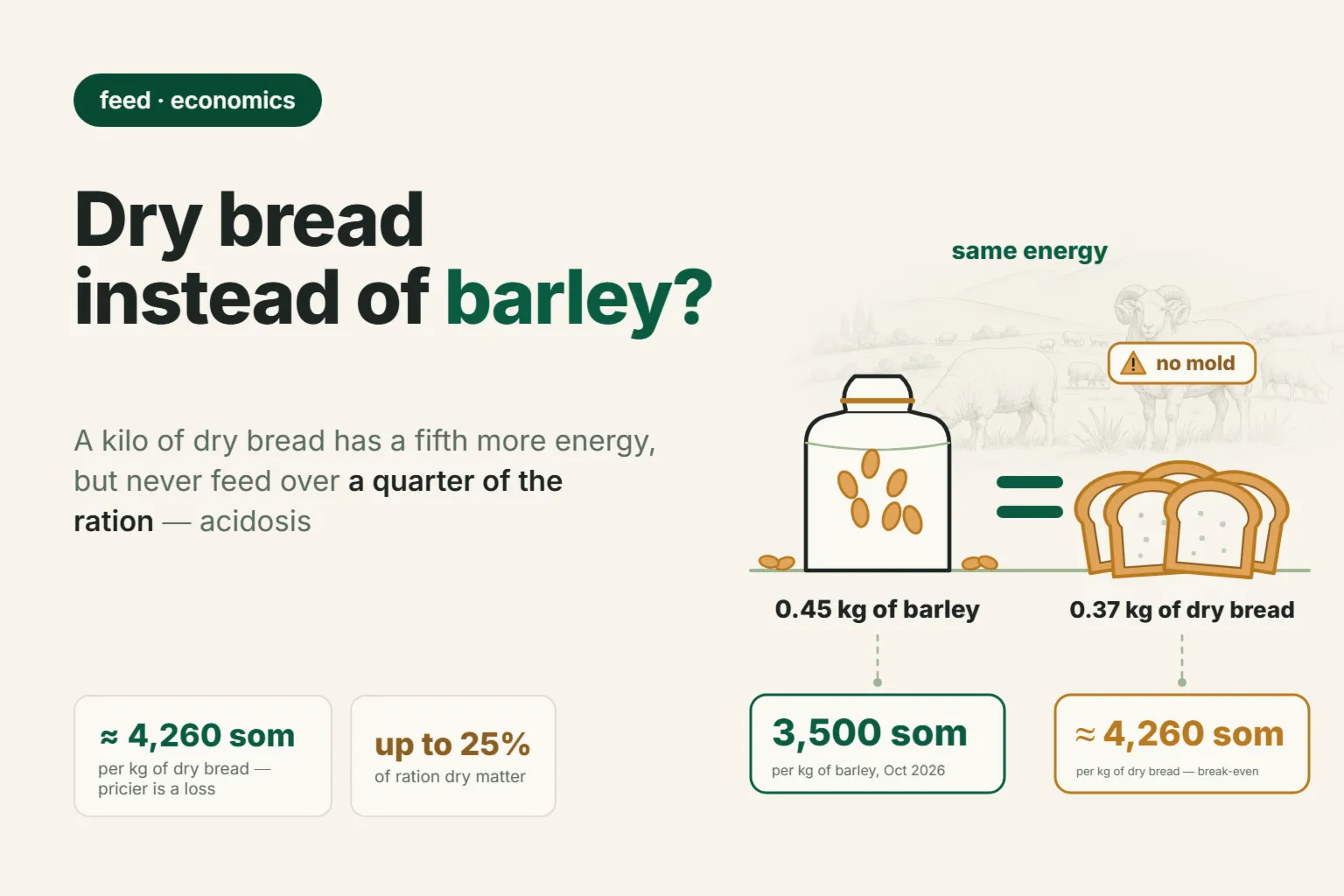
You can feed sheep bread and dried bread, but only as part of the concentrate and only dry and mold-free. Dried bread is energy: a kilogram of it carries about a fifth more energy than a kilogram of barley, with almost the same protein. The safe limit is up to 20–25% of the ration's dry matter: for a fattening adult ram that is about 350–400 g of dried bread a day in place of half the barley. It pays off as long as a kilogram of dried bread costs less than about 4,260 som (≈ $0.35) when barley is 3,500 som.
Below: how much bread to give sheep by group, at what price dried bread beats barley in October 2026, how much that saves on 100 rams over a fattening cycle, and which bread you must never feed. The Central Bank of Uzbekistan rate on 17 October 2026 is 12,055.90 som per dollar.
Can sheep eat bread?
Yes, if the bread is dry, clean and fed in small amounts. Bread waste has long been a known feed for ruminants: according to Feedipedia (the feed database of INRAE, CIRAD, AFZ and FAO), it goes into rations at up to 30% with no loss of performance, as long as there is enough roughage. Dried bread is bread dried until it crunches, which is why it keeps for months and does not mold if you keep it dry.
But for a sheep, bread is not "table food". It is a concentrate, like barley or corn. It is almost all starch, and that starch ferments in the rumen faster than barley starch. Give too much at once and you get the same thing as grain overload: acid in the rumen, diarrhea, refusal to eat, and deaths among heavy rams. The MSD Veterinary Manual lists bread and dough directly among the causes of grain overload in ruminants.
How do the energy and protein in dried bread compare with barley?
According to Feedipedia, bread waste averages 90.7% dry matter, 14.5 MJ of metabolizable energy and 12.4% crude protein per kilogram of dry matter. Barley has 87.1% dry matter, 12.4 MJ and 11.8% protein. Metabolizable energy is the part of a feed's energy that the sheep actually spends on living, growing and making milk.
| Per 1 kg of feed as fed | Dried bread | Barley |
|---|---|---|
| Dry matter | 907 g | 871 g |
| Metabolizable energy | 13.2 MJ | 10.8 MJ |
| Crude protein | 112 g | 103 g |
| Starch and sugars | about 71% of dry matter | about 62% of dry matter |
| Fiber | almost none (0.8%) | about 5% |
This gives the key ratio: 0.37 kg of dried bread gives as much energy as 0.45 kg of barley. With that swap you get 5 g less protein a day, which is minor for a fattening ram. There is almost no fiber in bread, so dried bread can replace only grain, never hay or straw.
Keep the spread in mind: dry matter in bread from different bakeries ranges from 69 to 98%, and salt varies a hundredfold. Wet bread from a sack carries more water and less energy per kilogram than the table shows.
At what price is dried bread cheaper than barley?
You have to compare the price of energy, not the price of a kilogram. In October 2026 barley on olx.uz listings costs 3,100–4,200 som per kg, most often 3,400–3,800; the calculation uses 3,500 som (≈ $0.29). That is 324 som per megajoule of energy. So dried bread beats barley as long as a kilogram costs less than ≈ 4,260 som (≈ $0.35).
| Dried bread, October 2026 | Price, som/kg | Price of 1 MJ | Versus barley |
|---|---|---|---|
| 50 kg sack for 65,000 som, Tashkent | 1,300 ($0.11) | 99 som | 3.3 times cheaper |
| Loose, Tashkent, Samarkand, Namangan | 2,500–4,000 ($0.21–0.33) | 190–304 som | 6–41% cheaper |
| 10 kg sack for 50,000 som, Almalyk | 5,000 ($0.41) | 380 som | 17% more expensive |
| Barley for comparison | 3,500 ($0.29) | 324 som | — |
Prices come from olx.uz listings from 26 September to 16 October 2026. The sack at 1,300 som/kg is the cheapest listing found; the usual price for loose dried bread is 3,000–4,000 som. Note the two rows with similar sack prices, 65,000 som in Tashkent and 50,000 in Almalyk: that works out to 1,300 som per kilogram in one case and 5,000 in the other. Never buy a sack without knowing its weight: ask, or weigh it on a hand scale in front of the seller.
How much dried bread should a sheep get per day?
The limit is set as a share of the ration's dry matter, not as grams per head. Guidelines from the trials collected by Feedipedia, recalculated for typical Uzbek rations:
| Group | Bread share limit | Example per day | Condition |
|---|---|---|---|
| Fattening rams and lambs | up to 25% of dry matter | 350–400 g instead of 0.45 kg barley | at least 40% alfalfa hay in the ration |
| Nursing and pregnant ewes | up to 20% of dry matter | about 200 g instead of 0.25 kg barley | introduce at least a month before lambing |
| Suckling lambs | do not feed | — | the rumen does not yet work like an adult's |
| Breeding rams in the mating season | no more than ewes get | 150–200 g | extra starch means extra fat |
An important caveat on roughage. In a trial on lambs whose only roughage was wheat straw (20% of the ration), even 10% bread in place of barley lowered intake and gain; the authors put it down to subacute acidosis. With 40% alfalfa hay, a 25% replacement went through with no losses. So dried bread goes into the ration only when the sheep get good hay, not straw alone. The 20% limit for nursing ewes was tested in a trial; for pregnant ewes, suckling lambs and breeding rams there are no direct trials, so the timing and grams in those rows are our own cautious recommendation.
How do you introduce sheep to bread without causing acidosis?
Bring dried bread in gradually, over 2–3 weeks: the MSD manual recommends that transition period for cattle moving to a new concentrate, and sheep should not be rushed. Start with 50–100 g per head per day and add more every 3–4 days, cutting the barley at the same time.
Three more rules:
- Hay first, then dried bread. A hungry sheep that gets bread first gulps it greedily and in quantity, and that is the road to overload.
- Feed everyone equally. Dried bread in a common pile goes to the pushiest rams, and they overeat. Provide trough space for the whole group at once.
- Unlimited water. Bread is salty, and the amount of salt in it varies widely.
If a ram stops eating after bread, lies down, has a rumen that is not working, or develops diarrhea or a wobbly gait, take the bread and barley out of the trough and call a vet. We covered how rumen acidosis develops and what to do in the first hours in the article why rams die on grain fattening.
How much does it save on fattening 100 rams?
Take a fattening ram on a ration of 1.0 kg of alfalfa hay and 0.9 kg of barley a day. We swap half the barley, 0.45 kg, for 0.37 kg of dried bread: the energy is the same, and bread makes up about 21% of the ration's dry matter. Barley use drops by 1,575 som per head per day. The saving on 100 rams over 90 days of fattening depends on what you paid for the dried bread:
- dried bread at 1,300 som/kg: saving ≈ 9.85 million som (≈ $817);
- dried bread at 3,000 som/kg: saving ≈ 4.19 million som (≈ $347);
- dried bread at 5,000 som/kg: overspend of ≈ 2.48 million som (≈ $205) compared with plain barley.
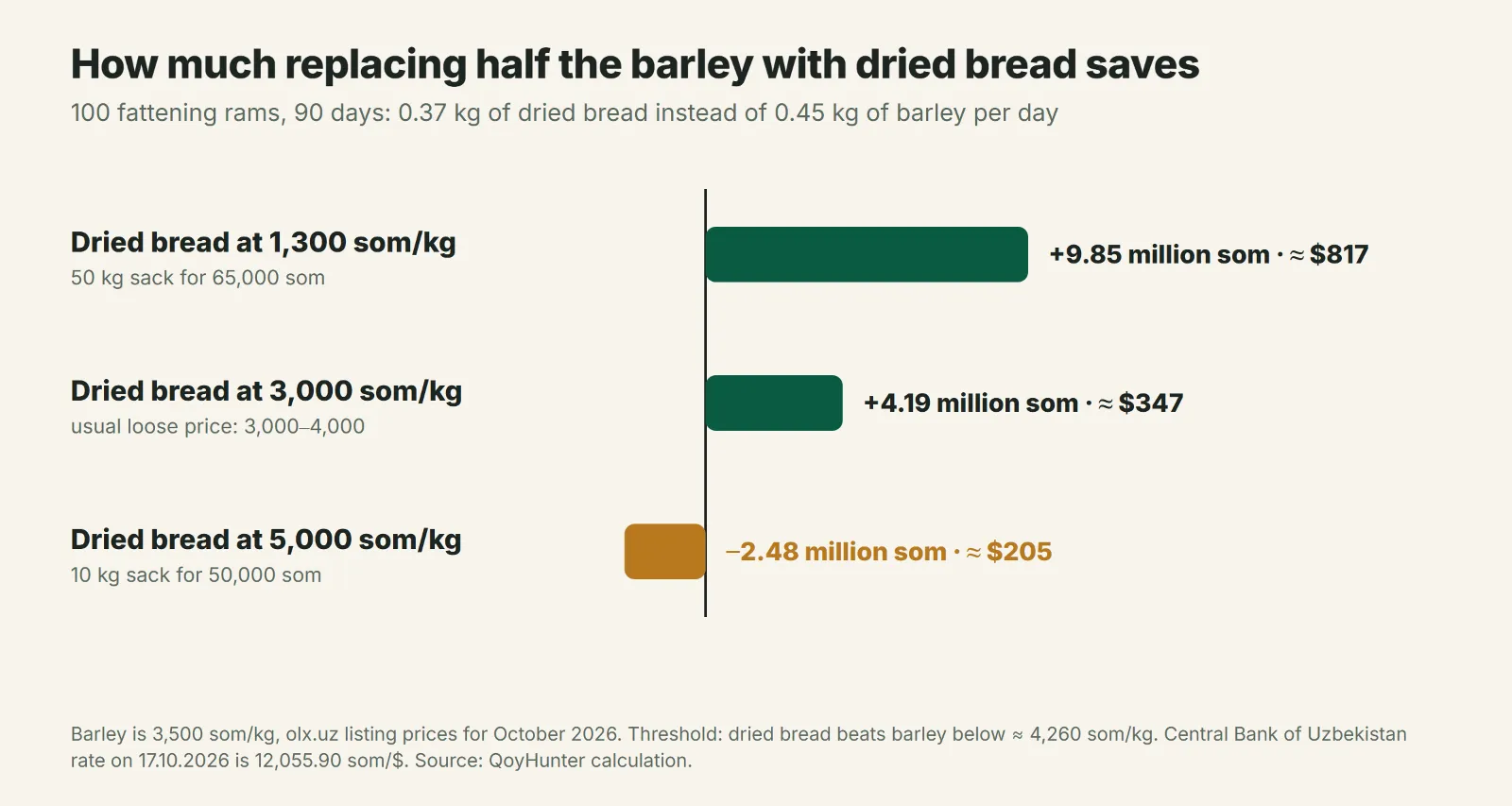
The calculation is illustrative: it ignores delivery and storage losses, and weight gain is assumed equal, since the ration does not change in energy or protein. Barley is still needed as the base of the concentrate; you can compare grain prices from several sellers in listings where you can buy barley and compound feed for sheep. We covered how to compare feeds by the price of energy and protein, not the price of a sack, in the article what to replace expensive feed with for rams.
Which bread must never be fed to sheep?
- Moldy. Green, black or white spots or a musty smell mean the whole sack goes out. Mold on grain and bread releases toxins: one of them, zearalenone, is partly converted in a sheep's body into α-zearalenol, which acts as a hormone several times more strongly and hits ewe fertility (a review in the journal Toxins, 2020).
- Fresh and soft, in large amounts. It clumps together, ferments faster and molds within a couple of days. Soft bread is dried first.
- Bread from a kitchen or canteen, or that has touched meat. In the UK and the EU, feeding kitchen waste to livestock is banned, and bakery bread is allowed only if it has not contacted meat or fish. According to the UK's APHA, the 2001 foot-and-mouth epidemic most likely began with kitchen waste fed to pigs, and more than 10 million cattle and sheep had to be destroyed. We found no direct ban on such feed in Uzbekistan's law "On Veterinary Medicine", but the risk is the same.
- With packaging. Strip off bags, film and foil: they do not digest in the rumen.
- Pastries, cakes and sweet baked goods. They carry sugar and fat, so feed them in tiny amounts or not at all.
One more case from the Feedipedia database: in Canada in 2001, 52 of 795 head of cattle fell ill at a feedlot and 14 died. The cattle had been fed various wastes, and bread waste was named the likely source, as the botulism pathogen was found in it. Spoiled, damp bread left lying in a pile is no saving.
How do you keep records if dried bread is a permanent part of the ration?
Dried bread pays only while you know its real price per kilogram and how much has been used. Batches arrive from different sellers, at different prices and weights, and a month later you can no longer recall what the fattening cost. A notebook is enough if you buy one or two sacks a season.
If bread is a regular part of the ration, set it up as a separate feed in feed records and stock tracking. It is a section of QoyHunter (a CRM for sheep records and the bazar.qoyhunter.com marketplace): a purchase goes straight into farm expenses, feeding deducts from stock, and when stock runs low you get a reminder to buy.
FAQ
Can sheep be fed only bread instead of grain?
No. Bread has almost no fiber, and its starch ferments in the rumen faster than barley's. The limit is up to 20–25% of the ration's dry matter, and only with good alfalfa hay. For a fattening adult ram that is about 350–400 g of dried bread a day in place of half the barley, introduced over 2–3 weeks.
At what price is dried bread better value than barley?
With barley at 3,500 som per kilogram, dried bread pays off as long as it costs less than about 4,260 som per kilogram (≈ $0.35) as of October 2026. A kilogram of dried bread has about 13.2 MJ of metabolizable energy, a kilogram of barley about 10.8 MJ. A 50 kg sack for 65,000 som (1,300 som/kg) is three times better value than barley; a 10 kg sack for 50,000 som (5,000 som/kg) is more expensive than it.
Can sheep be given moldy bread if there is only a little?
No. Mold on bread releases toxins that you cannot see and that drying does not remove. They lower intake and gain, and some, like zearalenone, hit ewe fertility. A sack with mold spots or a musty smell is thrown out whole.
Can lambs be given dried bread?
Suckling lambs, no: their rumen does not yet work like an adult's, and there are no direct trials on them. Weaned lambs on fattening, yes, up to 25% of ration dry matter, if the ration has at least 40% alfalfa hay, starting at 50 g a day.
Why is a ram bloated or scouring after bread?
Most likely it is rumen acidosis from starch overload: too much bread at once, or on an empty stomach. Take away the bread and grain, give hay and water, and call a vet right away, because with severe acidosis it is a matter of hours. Next time, start at 50–100 g per head and build up over 2–3 weeks.
Manage your flock in QoyHunterCRM for sheep farmers: livestock, health, weighing, finance and analytics — in the app and a Telegram bot.All features →