Hydroponic fodder for sheep: does sprouted barley pay off in 2026? A dry matter calculation
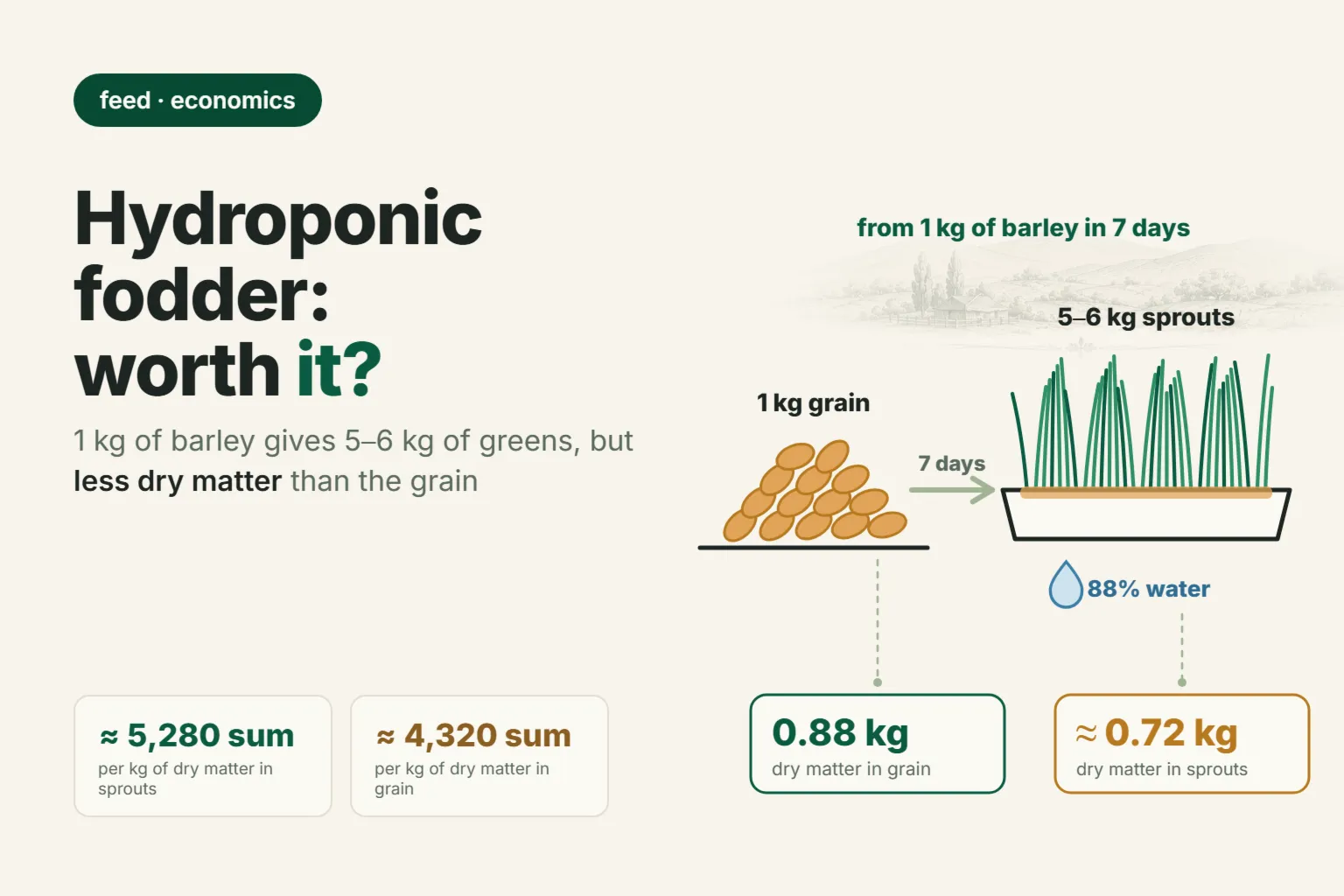
1 kg of barley gives 5–6 kg of sprouts in 7 days, but they hold only about 0.72 kg of dry matter instead of 0.88 kg in the grain. In autumn 2026, 1 kg of dry matter costs ≈ 5,280 sum in sprouts vs 4,320 in grain and 1,480 in hay. A flock-level calculation, mold risks and when a unit makes sense.
Hydroponic fodder for sheep, meaning barley sprouted for 6–8 days, does not pay off on most farms in Uzbekistan. 1 kg of grain gives 5–6 kg of green mass, but that mass holds only about 0.72 kg of dry matter, against 0.88 kg in the grain itself. With barley at 3,800 sum per kg (autumn 2026), 1 kg of dry matter in sprouts costs about 5,280 sum, in grain about 4,320 sum, and in alfalfa hay about 1,480 sum. Below is the math, and the cases where a unit still makes sense.
What is hydroponic fodder for sheep?
Hydroponic fodder (hydroponic greens, "green feed from grain") is grain, most often barley, soaked and sprouted on trays without soil for 6–8 days at constant moisture and temperature. The result is a mat of roots and shoots 15–20 cm tall, fed whole, roots and leftover grain included.
Units are sold as a way to get "greens all year round: 6–10 kg of feed from 1 kg of grain." The kilogram figure is true but misleading: mostly it is water that gets added. Barley grain holds about 88% dry matter, while sprouts on day 7 hold 10–15%.
How much feed does 1 kg of barley really give?
Dry matter is what is left of a feed once the water is removed: all the energy, protein and minerals are in it. A sheep fills up and grows on dry matter, not on fresh weight.
While grain sprouts, it breathes and burns its own starch to grow a root and a leaf. So there is always less dry matter on the tray than there was in the grain. In the review by Sneath and McIntosh (Australia, RIRDC, 2003), dry matter losses during sprouting ranged from 7 to 47%. In Iranian work by Fazaeli and co-authors, sprouts had 18–24% less dry matter than the original grain, and its share of the mass fell from 91% to 13% over 8 days.
| Indicator | 1 kg dry barley | Sprouts from 1 kg barley (7 days) |
|---|---|---|
| Fresh weight | 1 kg | 5–6 kg |
| Dry matter, % | 88% | 12% |
| Dry matter, kg | 0.88 kg | ≈ 0.72 kg |
| Crude protein, % of dry matter | 11–12% | 14–16% |
| Crude protein, g | ≈ 100 g | ≈ 105 g |
The protein percentage is higher in sprouts, and unit sellers usually show exactly this figure. But the protein did not appear from nowhere: by amount it is almost the same, there is just less starch around it. The energy in sprouts from 1 kg of grain is lower than in the grain itself: about a fifth of the dry matter is lost, and fiber goes up.
How much does 1 kg of dry matter cost in sprouts, grain and hay?
The calculation uses autumn 2026 prices: barley 3,800 sum/kg, alfalfa hay 1,300 sum/kg, an exchange rate of about 11,800 sum per dollar.
| Feed | Price per kg | Dry matter, kg | Price per kg of dry matter |
|---|---|---|---|
| Alfalfa hay | 1,300 sum | 0.88 kg | ≈ 1,480 sum ($0.13) |
| Barley as grain | 3,800 sum | 0.88 kg | ≈ 4,320 sum ($0.37) |
| Barley sprouts, seed only | 3,800 sum per 1 kg of grain | 0.72 kg | ≈ 5,280 sum ($0.45) |
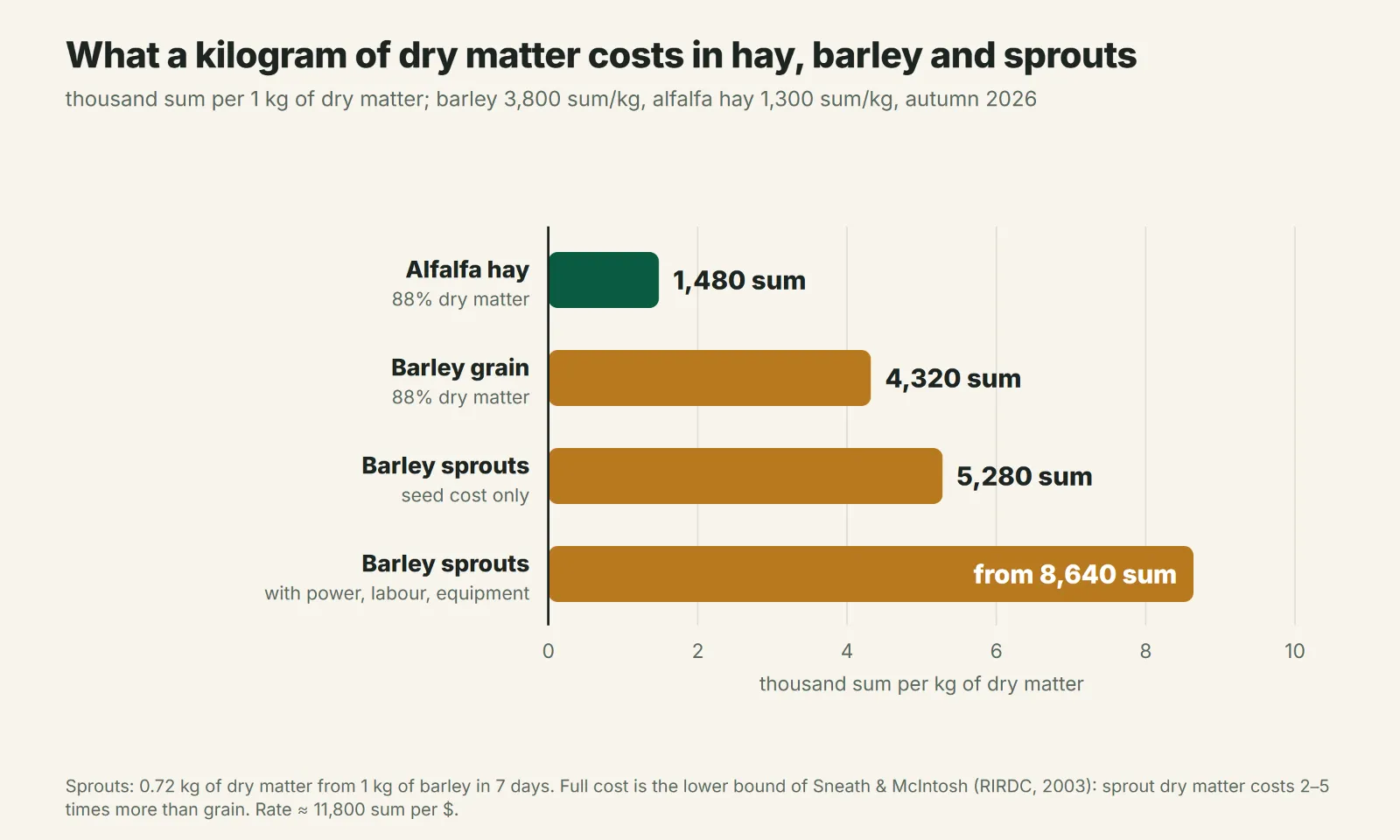
And that is only the price of seed. On top come electricity for light and indoor climate, heating in winter, water, daily labor (soaking, spreading, rinsing, taking off the trays) and the unit itself. With these costs, by Sneath and McIntosh's estimates for livestock in Australia, the dry matter of sprouts comes out 2–5 times more expensive than the dry matter of the original grain.
What will hydroponic fodder cost a flock of 50 ewes over the winter?
Take the usual seller recommendation, 1.5 kg of sprouts per head per day, and compare it with the same amount of dry matter from grain and hay over 120 winter days.
- Sprouts: 50 head × 1.5 kg = 75 kg per day. That takes 12.5 kg of barley (47,500 sum per day). Over 120 days, 1,500 kg of grain and 5.7 million sum (≈ $483) for seed alone.
- Barley as grain with the same dry matter (9 kg per day): 10.2 kg of barley, 38,900 sum per day, 4.66 million sum (≈ $395) for the winter.
- Alfalfa hay with the same dry matter: 10.2 kg, 13,300 sum per day, 1.6 million sum (≈ $135) for the winter.
The gap between sprouts and the same barley fed as grain is about 1 million sum (≈ $88) over the winter for 50 ewes, before light, labor and the cost of racks. Hay is lower in energy than grain and sprouts, so in a ration they are not swapped one to one, but sprouts lose to grain in any calculation. If the goal is cheap bulk, it is better to buy barley and alfalfa hay for sheep in autumn, before hay climbs to the winter 1,800 sum/kg.
Does hydroponic fodder give sheep better weight gain?
Most trials do not confirm it: by Sneath and McIntosh's review, 21 of 33 trials found no benefit or found harm. In an Iranian trial on fattening bull calves (Fazaeli et al., 2011), sprouts in place of part of the barley gave no extra gain, while the feed became about 24% more expensive. These reviews have almost no trials on sheep specifically, but a sheep's rumen works the same way. Animals eat sprouts willingly, and that is true, but willingness to eat is not weight gain.
If sheep on grain and hay grow poorly, the cause is usually ration balance: not enough protein or minerals, or feed lost underfoot. It is cheaper to start there, for example by working out the price of a kilogram of protein in meal, bran and barley.
When does a hydroponic fodder unit make sense?
There are three cases where the math changes.
- No pasture and no hay: a drought, hay cannot be bought for reasonable money, and pregnant ewes need greens at the end of winter. Then sprouts are an expensive but available source of green feed.
- Your own grain that cannot be sold: barley from your own field with good germination and no buyer for it. Then the money for seed does not leave your pocket.
- A small dose as a supplement: 0.3–0.5 kg of sprouts per day for ewes before lambing, for carotene (an editorial guideline, not a standard; a sheep's rumen synthesizes many vitamins itself, so the benefit is modest). But the same job is done more cheaply by good alfalfa hay, carrots and premix. A price comparison is in the article on pumpkin, beets and carrots for sheep.
What are the dangers of sprouted barley for sheep?
The main risk is mold. Warm, wet trays are an ideal environment for fungi, and a moldy mat may contain mycotoxins. Signs are a gray or black coating, a musty smell, and slime near the roots. Such a tray does not go into the feeder.
What to keep under control:
- Seed germination of at least 85–90% is desirable. Grains that fail to sprout rot first.
- Only untreated grain. Seed barley treated with a fungicide must not be fed.
- Wash and disinfect the trays after every cycle.
- Introduce sprouts gradually, like any new feed, over 7–10 days, so as not to upset the rumen.
How do you tell whether the fodder pays off on your farm?
Only your own records give the answer: how much feed left the store, what price it was bought at, and how much the flock gained over the same time. If you keep records of feed use by storeroom in QoyHunter, a CRM for sheep records and the bazar.qoyhunter.com marketplace, the cost of every feed you buy lands in the farm's expenses by itself, and winter rations can be compared by numbers rather than by eye. A notebook is enough too, if you write honestly: date, feed, kilograms, price.
The rule for hydroponics is simple: count not kilograms of greens but kilograms of dry matter and the sum spent on them. Then sprouts are compared fairly with grain and hay.
FAQ
How much green feed do you get from 1 kg of barley?
Over 6–8 days of sprouting, 1 kg of barley gives 5–6 kg of green mass, and some units promise 8–10 kg. But this mass holds less dry matter than the grain did: about 0.72 kg instead of 0.88 kg. The more kilograms promised, the more water in them.
Is hydroponic fodder cheaper than barley as grain?
No. With barley at 3,800 sum per kg (autumn 2026), 1 kg of dry matter in sprouts costs about 5,280 sum by seed price alone, while in grain it is about 4,320 sum. With electricity, labor and the unit, by Sneath and McIntosh's estimates (Australia, 2003), the dry matter of sprouts comes out 2–5 times more expensive than the dry matter of grain.
How much sprouted barley should you give a sheep per day?
Unit sellers usually advise 1–2 kg of sprouts per head per day. As a small supplement for carotene, 0.3–0.5 kg for ewes before lambing is usually enough; this is a guideline, not a standard. Sprouts should be introduced gradually, over 7–10 days, and only when mold-free.
Can you sprout seed barley as feed for sheep?
Only if it is untreated. Seed barley treated with a fungicide must not be fed to sheep. Hydroponics needs clean grain with germination of at least 85–90%, otherwise grains that fail to sprout rot and the mat molds.
When does a hydroponic unit make sense for a farmer in Uzbekistan?
When there is no pasture and hay cannot be bought, when you have your own unsold grain with good germination, or when pregnant ewes need a small dose of greens at the end of winter. In other cases, barley as grain and alfalfa hay give the same dry matter more cheaply.
Manage your flock in QoyHunterCRM for sheep farmers: livestock, health, weighing, finance and analytics — in the app and a Telegram bot.All features →