Bottle Jaw in Sheep: Why the Swelling Appears Under the Jaw and How to Stop the Anaemia
A soft swelling under a sheep's lower jaw is almost always a sign of low blood protein and parasite-driven anaemia. We break down the causes (Haemonchus, liver fluke, poor nutrition), how to tell them apart, and how to treat it under Uzbekistan's conditions.
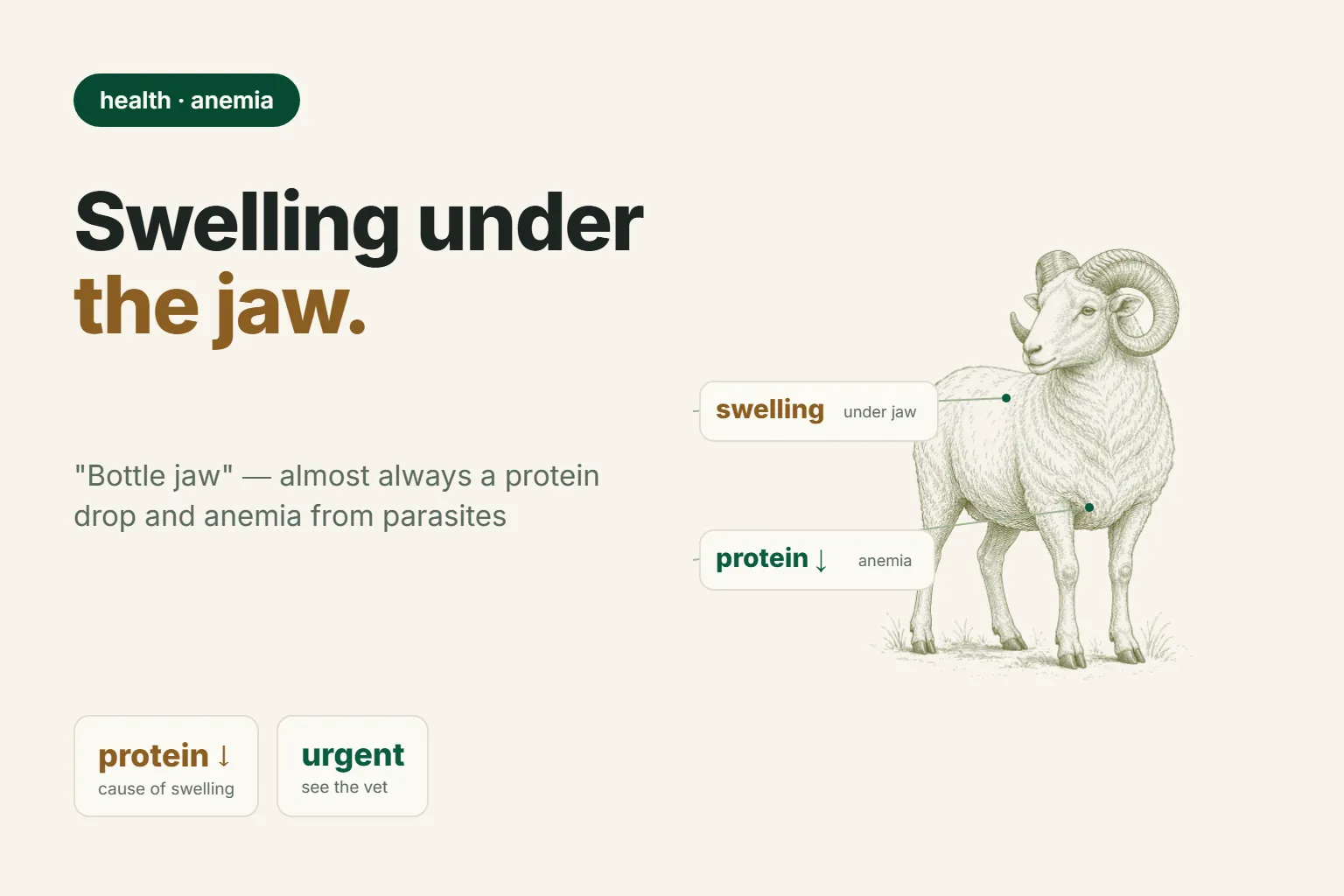
A soft, pouch-like swelling under a sheep's lower jaw isn't a "chill," a wasp sting, or an abscess. Most often it's bottle jaw, and it means the animal's blood protein has dropped and anaemia is developing. Behind this "cushion" there are almost always parasites literally draining blood and protein from the inside. If the cause isn't found, the flock quietly loses weight, lambs fall behind in growth, and the weakest die. Let's break it down in plain farmer terms: where the swelling comes from, how to tell the causes apart, and what actually treats it under Uzbekistan's conditions.
What Is Bottle Jaw
Blood keeps fluid inside the vessels thanks to protein — mainly albumin. When blood protein drops (hypoproteinaemia), fluid leaks out of the vessels into the tissues and collects at the lowest point of the body. A grazing sheep holds its head down toward the ground, so the fluid pools under the lower jaw — hence "bottle jaw."
What it looks like: a soft, painless, cool swelling under the jaw. It's larger in the morning and may go down by evening. Press it with a finger and a dent remains that slowly smooths back out.
The key thing to understand: bottle jaw is not a disease, it's a symptom. It signals low blood protein and, usually, anaemia. Other signs are usually visible alongside it: pale, whitish gums, eyelids and tongue instead of bright pink; lethargy; stunted growth; dull, easily shedding wool.
Three Main Causes
Haemonchus — the "Blood-Sucking Worm" in the Abomasum
The most common cause in warm weather. Haemonchus (Haemonchus contortus) is a thin worm that sits in the abomasum and sucks blood from its wall. In heavy infestations, when there are thousands of worms, a sheep can lose up to 250 ml of blood a day — which is exactly what drives the anaemia, the protein loss, and the swelling under the jaw. Larvae develop right on the pasture in warm, humid weather, so summer on irrigated and low-lying pastures is ideal ground for them. Young animals suffer the most.
Liver Fluke — Fascioliasis
The flat fluke worm (Fasciola) lives in the liver and bile ducts. Its life cycle runs through an intermediate host — a small freshwater snail that lives in wet places: irrigation channels, ditches, marshy patches, pond edges, puddles by watering troughs. Chronic fascioliasis also causes anaemia, hypoproteinaemia, bottle jaw and wasting. It's a disease of farms with irrigation and waterlogged pastures, and it typically flares up toward autumn and winter.
Poor Nutrition and Protein Deficiency
Simple protein starvation — poor winter hay, additive-free straw, a meagre ration at the end of wintering — drops blood protein on its own and produces swelling. Poor nutrition usually goes hand in hand with parasites: a weakened animal handles the infestation worse. Less often, bottle jaw is caused by coccidiosis in lambs and blood parasites.
If the problem is the ration, the protein gap is closed with feed rather than medicine: buy cottonseed meal and cake costs less than treating anaemia across the whole group.
How to Tell the Causes Apart
| Cause | When more common | Other signs | How to confirm |
|---|---|---|---|
| Haemonchus | Warm, humid season; young stock | Pale eyelids and gums, weakness; diarrhoea not required | Faecal egg count, FAMACHA scoring |
| Liver fluke | Wet and irrigated pastures, autumn–winter | Wasting, swelling, sometimes deaths with no obvious cause | Faecal test for fluke eggs, post-mortem of dead animal |
| Poor nutrition | Late winter, meagre ration | Whole flock thin at once, dull wool | Ration and body-condition assessment |
Assessing Severity: Check the Eyelid
Since the main culprits feed on blood, severity is best judged by anaemia — by the colour of the mucous membranes. Pull down the lower eyelid and look at its inner surface. Bright red or deep pink is normal. Pale pink, almost white, means the animal is anaemic and needs treatment first. The same rule applies to the gums and tongue. This method is called FAMACHA (a scale from 1 — red, healthy to 5 — white, severe anaemia).
Practical rule: treat the palest animals first. In a flock, typically around 20% of the animals carry up to 80% of the parasites — there's no need to dose everyone if help is only needed for specific animals. Be alert to the combination of bottle jaw plus pale eyelids plus lethargy plus weight loss. If an animal dies, ask a vet to do a post-mortem: worms in the abomasum or flukes in the liver are visible to the naked eye and immediately reveal the cause for the whole flock.
What to Treat With
The most important thing first: treat the cause, not the swelling. The swelling itself will go down once you clear the parasites and raise the protein in the ration. Only a vet should prescribe the exact regimen and dose — the active ingredients and reference points below are for guidance. Dose strictly according to the specific product's instructions and the animal's actual weight: underdosing fails to clear the infection and breeds resistant worms.
| Active ingredient | Against what | Dose guide (check the product label!) | Note |
|---|---|---|---|
| Albendazole | Haemonchus, adult fluke, tapeworms | about 7.5 mg/kg orally | Not for the first ~30 days of pregnancy — risk to the fetus |
| Ivermectin | Haemonchus and other roundworms (doesn't cover fluke) | 0.2 mg/kg | Resistance is common — don't rely on it alone |
| Levamisole | Roundworms, including Haemonchus | per label (roughly 7.5–12 mg/kg) | Narrow safety margin — precise dosing is essential |
| Closantel | Haemonchus and fluke (from ~4–5 weeks old) | about 10 mg/kg orally | Handy when the cause is unclear: hits both the blood-sucking worm and the fluke |
| Triclabendazole | Fluke, including young stages | about 10 mg/kg | The only one that reliably clears young fluke |
For recovery after anaemia, the main thing is to remove the parasite burden and provide full-value protein: lucerne/alfalfa (hay or green feed), cottonseed cake or meal, grain, and plenty of clean water. Iron supplements and vitamins help the blood recover, but they're supportive care under a vet's direction — without deworming they won't save the animal. Give severely affected animals rest, shade, and a separate pen.
Treatment dates matter more than the drugs themselves here: a deworming log per animal shows who has already been dosed and who was missed last time.
Bottom line: with obvious bottle jaw, don't treat "by eye" and don't rely on folk remedies — that's how animals are lost. A single faecal test (and a post-mortem in case of death) costs little and saves the whole flock.
Prevention
Deworming Schedule
Don't "dose" everyone on a fixed yearly calendar — that speeds up the growth of drug resistance. A sensible minimum for Uzbekistan: treatment in spring before turnout to pasture and in autumn, with young stock and pregnant ewes handled under veterinary supervision, and during the warm, humid season watch the flock's eyelid colour and treat the pale ones specifically.
Be sure to rotate drug classes from year to year (benzimidazoles — levamisole — macrocyclic lactones like ivermectin): keep using the same one and the worms adapt to it. Treat new animals and keep them in separate quarantine before adding them to the flock.
Pasture and Water
Haemonchus loves warmth and moisture. Don't keep sheep on low, damp ground for long, especially after rain or irrigation and during morning dew — that's where infective larvae are most numerous. Since the fluke's life cycle runs through a snail, drain or fence off marshy patches, ditches, and puddles by watering troughs, and water animals from a clean well or running water rather than an irrigation channel. Where possible, rotate grazing areas to let the pasture rest.
And keep body condition up with good feeding: a well-fed, well-conditioned sheep resists parasites better and doesn't slide into anaemia as easily as a thin one.
Keep a simple treatment log — who was dewormed, when, and with what, and what colour their eyelids were — so you treat specifically and on time, not blindly. As soon as you see bottle jaw and pale eyelids on a sheep, don't wait — call the vet: a test will confirm the cause, and the product will be chosen to fit your flock.
Manage your flock in QoyHunterCRM for sheep farmers: livestock, health, weighing, finance and analytics — in the app and a Telegram bot.All features →