Orf (Contagious Ecthyma) in Sheep: Sores on Lambs' Lips — How to Tell It from Pox and Foot-and-Mouth Disease, How to Treat It and Whether It Is Dangerous to Humans
Orf (contagious ecthyma) in lambs: blisters, pustules and scabs on the lips that clear up in 1–4 weeks. How to tell orf from pox and foot-and-mouth disease, how to feed sick lambs and protect ewes from mastitis, when vaccination is needed and what an outbreak costs a flock of 100 ewes.
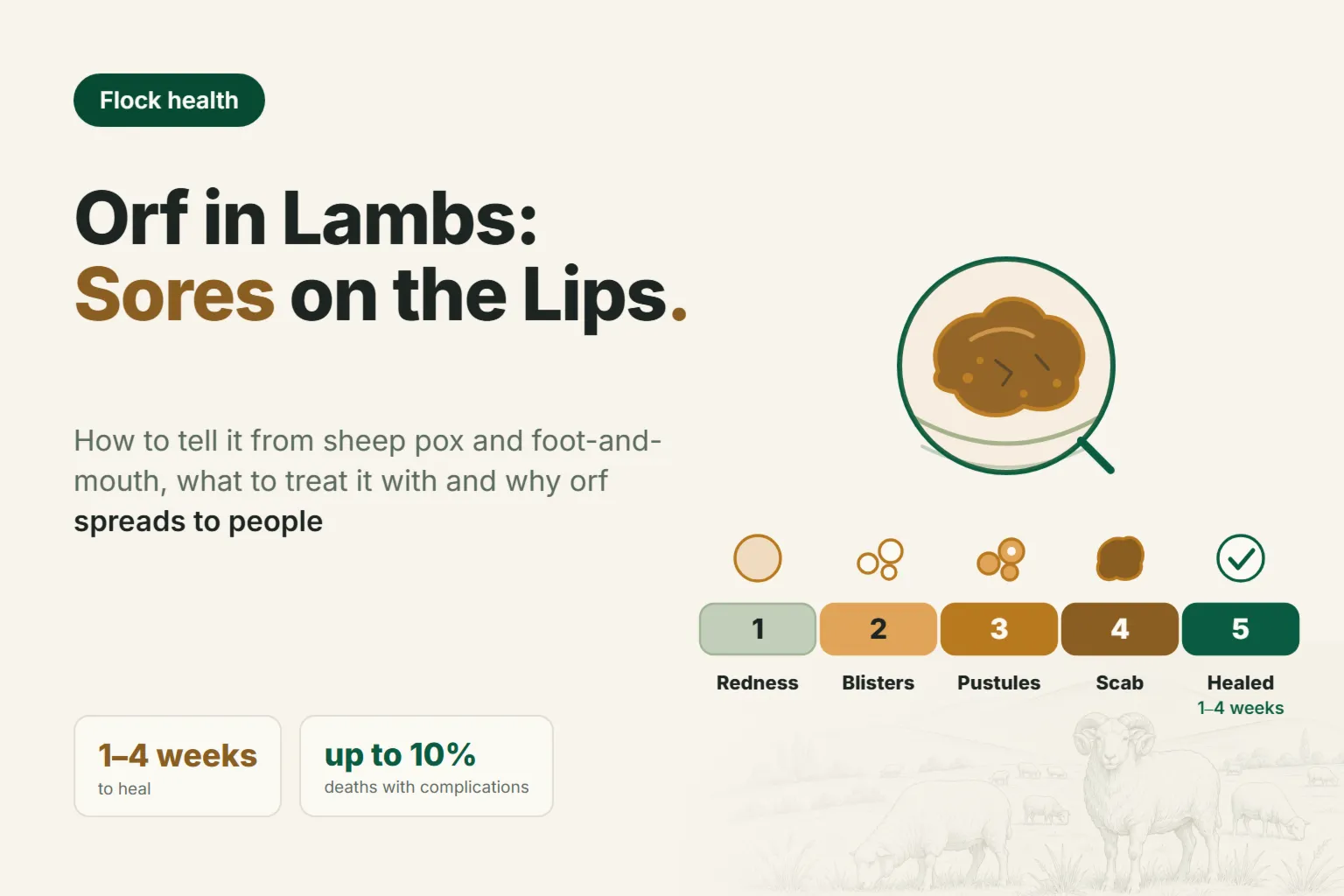
Orf in sheep is a viral sore on the lips of lambs: first redness, then blisters and pustules, then a thick scab. There is no specific treatment for orf in sheep, and in most lambs it clears up on its own in 1–4 weeks. The farmer loses money not on the disease itself but because suckling and eating hurt: the lamb falls behind in weight, may weaken and die, and by infecting the ewe's teats it causes mastitis. So the goal is not to "cure" but to support the lambs, keep the disease from reaching the ewes, and not confuse orf with sheep pox and foot-and-mouth disease.
Below: the signs of orf in lambs day by day, how it differs from pox and foot-and-mouth disease, what to do with sick lambs, how to protect yourself (orf passes to humans), and what an outbreak costs a flock of 100 ewes. Prices are for October 2026, at the Central Bank of Uzbekistan rate of 16 October 2026 — 12,011.65 som per dollar.
What is orf in sheep and where does it come from?
Contagious ecthyma (orf, contagious pustular dermatitis) is an infectious viral disease of sheep and goats in which blisters, pustules and scabs appear on the lips, around the mouth, on the teats of the udder and sometimes on the legs. It is caused by a parapoxvirus — a relative of the pox virus, but the disease is much milder.
The main source of the virus is the scabs. Once they fall off a sick lamb's lips, they stay in the bedding, feeders and on the ground, and the virus survives in the dry scabs for years: according to the MSD Veterinary Manual, it has been found in scabs after 12 years. That is why orf usually "lives" on the farm: if it appeared once, expect it again in the next batches of lambs.
The virus enters through a break in the skin. Hence the main trigger in Uzbekistan is thorny and coarse feed: camelthorn (yantoq), hard stubble, coarse hay with thistles. Thorns scratch the lips, and the virus from scabs on the ground gets into the scratch. The second common route is lambs bought at the market that already have sores or are just developing them.
What does orf in lambs look like, day by day?
The incubation period after infection is from 2–3 to 10 days. After that the disease goes through stages; the days in the table are approximate, and every lamb has its own timing:
| Stage | When | What it looks like |
|---|---|---|
| Redness | Day 1–3 | Red patches and bumps at the corners of the mouth and on the lips |
| Blisters | Day 3–5 | Small blisters with clear fluid |
| Pustules | Day 5–8 | Blisters turn cloudy and burst, the lips weep |
| Scab | Day 8–14 | Thick gray-brown scab, the lips crack and bleed |
| Healing | 1–4 weeks, usually by the end of the month | Scabs fall off, usually no scar is left |
The ones who mostly get sick are lambs from a few weeks to a few months old, but also adult sheep with no immunity. Orf spreads through a group quickly: in an affected flock almost every lamb can go through it. Few die: in uncomplicated cases about 1% or less. But if bacteria join the sores or the lamb cannot suckle and weakens, deaths reach up to 10% (according to Iowa State University).
Signs the farmer should watch for:
- a lamb comes up to the ewe or the feeder but walks away without eating;
- drool runs from the mouth, the lips are swollen and covered with scab;
- ewes have sores on the teats, which means the lambs have already infected the udder;
- a lamb is visibly losing weight even though there is plenty of feed.
How does orf differ from sheep pox and foot-and-mouth disease?
This is the key question: pox and foot-and-mouth disease are very dangerous diseases, and orf is often confused with exactly these two. But there is something else worth knowing: since 22 July 2026, orf in Uzbekistan is also on the list of diseases for which restrictive measures (quarantine) are introduced, under Cabinet of Ministers Resolution No. 190 of 20 April 2026 (Annex 2, item 26, "contagious pustular stomatitis (dermatitis-ecthyma)"). While the restrictions are in force, animals cannot be brought onto or taken off the farm, or traded. So report any outbreak of mouth sores in lambs to the district vet.
| Sign | Orf | Sheep pox | Foot-and-mouth disease |
|---|---|---|---|
| Where the sores are | Lips, mouth, teats, sometimes legs | All over the body, especially where there is little wool | Mouth, tongue, between the hooves |
| Temperature | Usually normal | High, the sheep is depressed | High in the first days |
| Lameness | Rare | No | Yes, the main sign |
| Deaths | Usually about 1%, up to 10% with complications | Up to 50% and more in lambs | In lambs, from heart damage |
| Quarantine in Uzbekistan | Yes, since 22.07.2026 | Yes | Yes |
If the sheep are depressed, have a fever, have sores all over the body, or the flock has gone lame, this is not orf, and you call the vet the same day. We covered in detail how to tell pox apart day by day in our article on sheep pox. If in doubt, call the vet anyway: a correct diagnosis is made by examination and, if needed, by testing the scabs.
How do you treat orf in lambs?
There is no drug that kills the orf virus: the lamb's immune system copes on its own in 1–4 weeks. The farmer's job is to make sure that during those weeks the lamb does not lose weight, does not pick up a bacterial infection and does not infect the ewes.
- Separate the sick lambs together with their ewes from the healthy part of the flock and give them their own feeders and drinkers.
- Do not pick off the scabs. Under the scab there is a live wound, and a torn-off scab falls into the bedding and infects the next lambs. The scabs will fall off by themselves.
- Treat the sores with an antiseptic, and for weeping, festering sores the vet prescribes an antibiotic spray — it treats not the virus but the bacteria that settle in the cracks.
- Feed soft. Remove thorns and coarse hay from the ration, give soft alfalfa, soaked compound feed and plenty of clean water. A lamb that cannot suckle is fed milk or milk replacer from a bottle.
- Check the ewes' udders every day. Sores on the teats are a signal: the ewe is in pain, drives the lamb away, milk stagnates and mastitis begins. Such ewes are treated together with the vet.
- In warm weather, watch for flies. Flies lay eggs on weeping sores, and maggots appear in the wounds; repellents and insecticides against flies and maggots are used on the vet's advice.
The treatment scheme and drugs are chosen by the vet — this article informs but does not replace an examination.
Is orf dangerous for humans?
Yes. Orf is a zoonosis: a person is infected when they touch a sick lamb's lips with bare hands, feed it from a bottle or pick off the scabs. A painful bump appears on a finger or hand, goes through the same stages as in the lamb and, according to the US CDC (Centers for Disease Control and Prevention), usually heals on its own in about 6 weeks. Orf is most dangerous for people with weak immunity: they can get large sores that look like a tumor. If the sore grows, hurts a lot or you get a fever, see a doctor.
The rules are simple: work with sick lambs in rubber gloves, wash your hands with soap afterward, and cover any wounds on your hands with a plaster. Children stay away from sick lambs. If a bump appears on your hand after working with sheep, tell the doctor that you worked with lambs with sores on the lips.
What does an orf outbreak cost a flock of 100 ewes?
Let's calculate for a flock of 100 ewes and 110 lambs in a season. Suppose orf went through 70% of the lambs, which is 77 head. This is a cautious estimate: in an outbreak almost the whole group can go through it.
- Weight lag. A sick lamb eats at half strength for about 3 weeks. If instead of 200 g of daily gain it gains about 100 g, in 21 days it falls behind by about 2 kg. At 55,000 som per kilogram of lamb live weight (as we calculated in the article on lamb mortality), that is 77 × 2 × 55,000 = 8.47 million som (≈ $705).
- Deaths. Suppose that with poor care 2 of the 77 lambs die, about 2.6%. A lamb weighing 26 kg at weaning is worth about 1.43 million som, so two cost 2.86 million som (≈ $238).
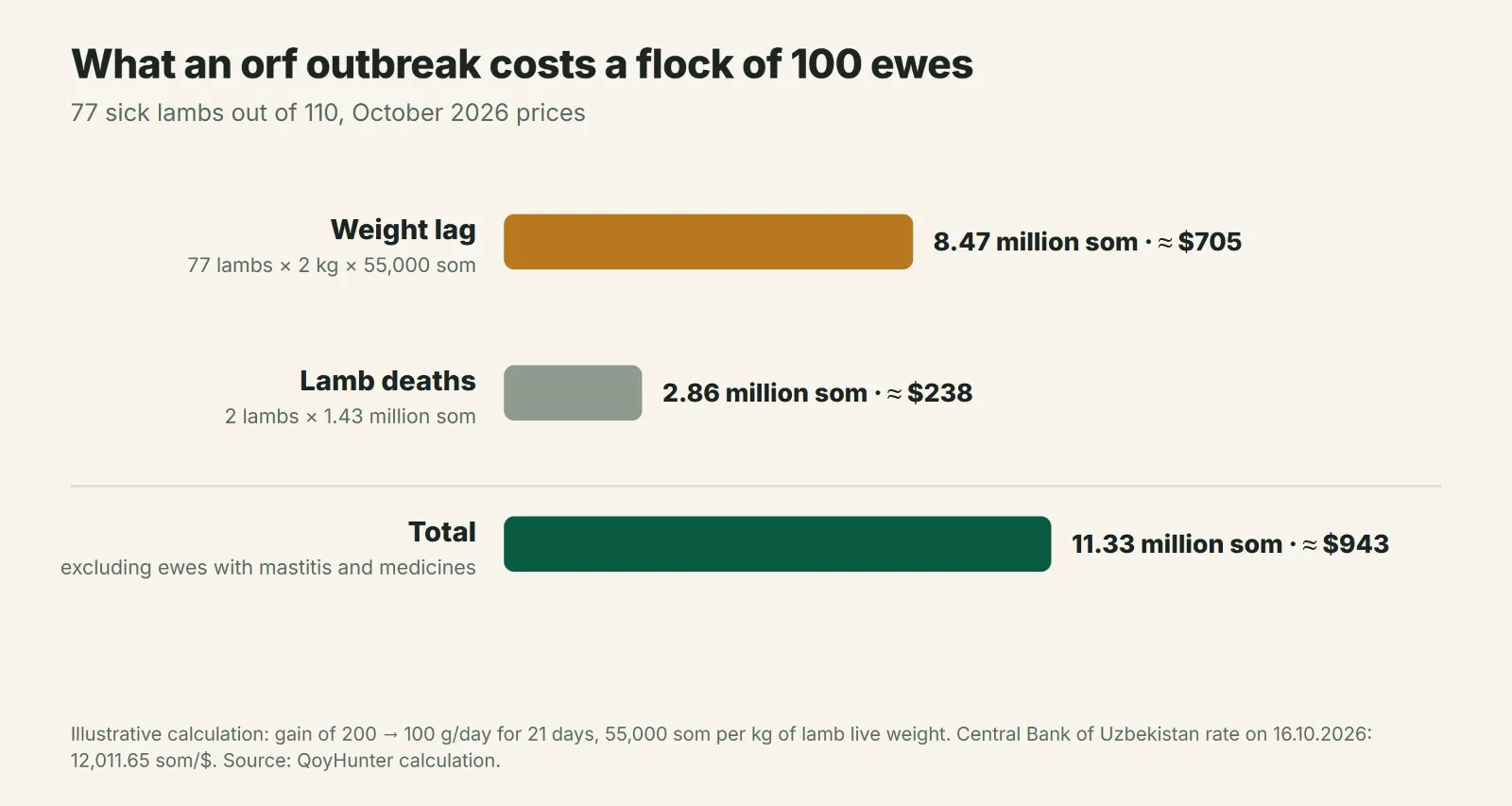
In total, about 11.3 million som (≈ $943) per outbreak, and that excludes ewes with mastitis, medicines and the time spent feeding by bottle. With good care — soft feed, bottle-feeding, udder checks — deaths can be avoided and the weight lag reduced. The calculation is illustrative: plug in your own gain and price figures.
It is convenient to record which lambs have been sick, which ewes were treated for mastitis, and how much each lamb weighed before and after the illness in the log of vet treatments and illnesses. QoyHunter, a CRM for sheep records and the bazar.qoyhunter.com marketplace, keeps the illness history of each animal, so by the next lambing you can see which batch had orf and whom to check first.
Is there a vaccine for orf and who should get it?
A live vaccine against contagious ecthyma exists. It is applied to the skin, on a scratch (scarification), on a patch without wool, and the vaccinated sheep develops a mild local form of the disease at that spot, after which immunity appears. It protects well but not completely: according to the MSD Veterinary Manual, a vaccinated sheep can still fall ill, though more mildly.
Three things are important to understand:
- The vaccine is live. Vaccinated sheep shed the virus from the scabs at the vaccination site, so vaccination is done only on farms where orf is already present. In a clean flock, the vaccine itself will bring in the virus.
- Colostrum does not protect lambs. Even if the ewe was vaccinated, her lambs are born without protection against orf. Vaccinating ewes is needed so that their udders do not get sore and they do not infect the lambs, but on an affected farm the lambs are vaccinated separately.
- Ewes are vaccinated no later than 7–8 weeks before lambing. Those vaccinated later will shed the virus from scabs just when the lambs are born. Vaccinated sheep are kept apart from unvaccinated ones until the scabs at the vaccination site fall off. Lambs on an affected farm can be vaccinated from the first day of life, according to the instructions for the Scabivax Forte vaccine. The exact scheme is set by the vet according to the instructions of the product that is on sale.
Vaccination is done by the district veterinarian: the product itself and the scheme depend on what is registered and available. Everything else rests on measures that do not involve vaccination:
- remove thorns and coarse hay from the lambs' feeders, and do not graze lambs on camelthorn and hard stubble;
- after an outbreak, clear out and burn the bedding with scabs, and wash the feeders;
- keep purchased lambs and sheep separate for 30 days and check their lips and teats — we covered how to set up such a quarantine in the article "Quarantine for New Sheep".
When buying lambs for fattening, first look at the lips and the corners of the mouth: scabs, cracks or drool are a reason to turn the batch down. You can look for healthy sheep and lambs of known origin among the lambs and sheep for sale in Uzbekistan: before the deal, ask the seller for a close-up photo of the lips and ask whether the farm has had orf.
FAQ
Why do lambs have sores on their lips?
Most often this is contagious ecthyma (orf), a viral disease in which blisters, pustules and thick scabs appear on the lips and around the mouth of lambs. The virus enters through scratches, so outbreaks often start when lambs eat thorns, camelthorn, hard stubble or coarse hay. If the sheep have a fever and sores all over the body, or the flock is limping, it may be pox or foot-and-mouth disease, and then you call the vet at once.
How long does orf last in sheep?
Usually 1–4 weeks, most often by the end of the month. First the lips turn red, on day 3–5 blisters appear, by the end of the first week pustules, then a scab that falls off by itself. Do not pick off the scabs: there is a live wound under them, and a torn-off scab infects the bedding.
Can you catch orf from a sheep?
Yes, orf passes to humans through wounds on the hands, when a person with bare hands touches a sick lamb's lips or feeds it from a bottle. A painful bump appears on a finger, which usually heals on its own in about 6 weeks. Work with sick lambs in gloves and wash your hands with soap afterward.
Should sheep be vaccinated against orf?
Only if orf has already been on the farm. The vaccine is live: vaccinated sheep shed the virus, and in a clean flock vaccination will bring it in. The colostrum of a vaccinated ewe does not protect lambs from orf, so on an affected farm the vaccination scheme for ewes and lambs is drawn up by the district vet.
Can you sell lambs that have had orf?
In Uzbekistan, since 22 July 2026, orf is on the list of diseases for which the veterinary service may introduce restrictive measures (Cabinet of Ministers Resolution No. 190 of 20 April 2026). While they are in force, animals cannot be taken off the farm or sold. Once the restrictions are lifted and the lambs have healed, recovered lambs are sold as usual. But a lamb with scabs on its lips infects another flock, so an honest seller waits until the scabs fall off, and a buyer always checks the lips and the corners of the mouth before the deal.
Manage your flock in QoyHunterCRM for sheep farmers: livestock, health, weighing, finance and analytics — in the app and a Telegram bot.All features →