A Shashlik Place at Our Own Farm: Working Out Whether It Adds Up to $3,000 a Month
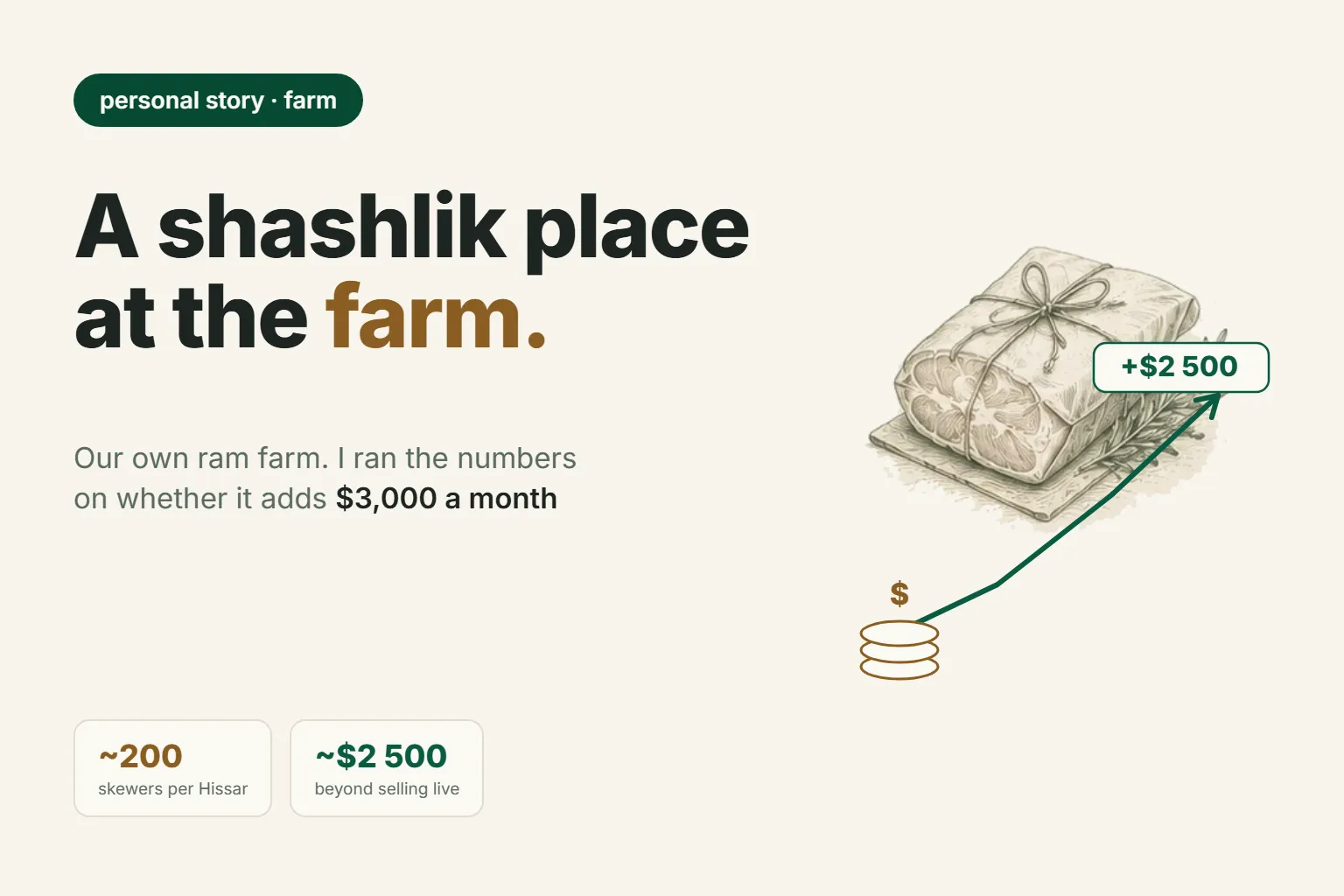
We run our own ram farm. I sat down and worked out how much a shashlik place at the farm would actually add — from one Hissar ram to monthly profit. The honest math: around $2,500, and why your own ram isn't free.
We run our own ram farm. And almost every season the same thought comes back: why not set up a shashlik place right at the farm? The meat is already ours, there's nowhere to go get it, and tourists drive by on the highway. On paper, it sounds like money for nothing.
I sat down and ran the numbers honestly. Below is the whole model: from one Hissar ram to monthly profit. I'll give away the ending first: if you count your own ram as free, you get a fairy tale of close to ten thousand dollars a month. But the ram isn't free, and once I factored that in, the honest number came out more modest — around $2,500 a month (it only reaches $3,000 on the busiest days). Here's how it adds up.
Prices are for Tashkent, summer 2026, at a rate of ~12,060 sum/$. I flag where I'm calculating versus where I actually know for a fact: there's no publicly available Uzbek standard for carcass butchering or for how much meat goes on a skewer, so some of the numbers here are reasoned assumptions.
What One Hissar Ram Yields
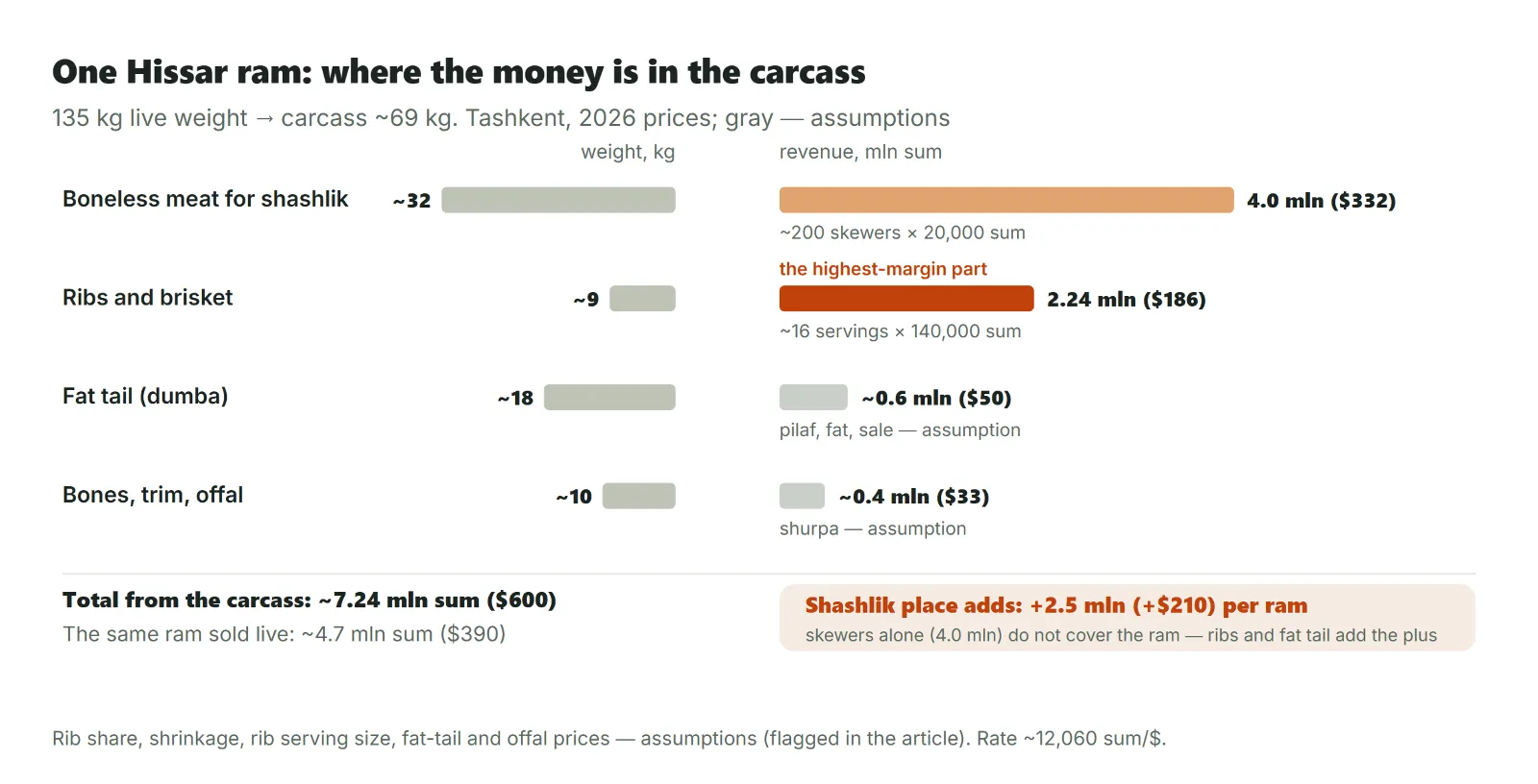
Take an average Hissar ram. Per our article on the breed, that's ~135 kg of live weight (the best reach 180–190), with a dressing percentage of 50–53%. The carcass comes to about 69 kg. It needs to be broken down into what actually gets put to use:
- boneless meat for shashlik — ~32 kg;
- ribs and brisket — ~9 kg (10–17% of the carcass; there's no exact standard for mutton, so I take the midpoint);
- fat tail (dumba) — ~18 kg (the Hissar is famous for exactly this);
- bones, trim, and offal — ~10 kg, which goes into shurpa soup.
Now the skewer. A griller counts it not by raw weight but by the cooked result: about 100 g of grilled meat per skewer, priced at ~20,000 sum ($1.66). Meat shrinks by 35–38% when grilled, so one skewer takes about 160 g of raw boneless meat. That gives roughly 200 skewers out of 32 kg of boneless meat.
Plus the ribs — but I count those separately, since the economics there are different.
Why Ribs Pay Better Than Skewers
At the market, ribs are cheaper than boneless meat — that's how the meat trade works. For beef, this shows up directly in Uzbek market data; for mutton, cuts aren't priced separately in public sources, so I take it by analogy and flag it as an assumption. At a café, though, ribs are their own menu item with a markup: according to Tashkent restaurant menus, a serving runs 140,000–240,000 sum ($11.6–20). For the model, I use a modest 140,000 sum per serving — the low end of the market.
9 kg of ribs works out to about 16 servings (that's ~560 g per serving — Uzbek menus never list portion weights, so I go by the general culinary benchmark for a "rack of lamb," 500–650 g; this too is an assumption). A simple comparison follows: a kilogram of boneless meat sold as skewers brings in ~125,000 sum in revenue, while a kilogram of ribs sold as servings brings in ~250,000 sum — twice as much, on cheaper raw material besides. Ribs are a third the weight of the boneless meat, yet they account for more than half of all the skewer revenue. That's where the highest margin sits.
A Ram from Your Own Farm Isn't Free
This is the main trap in the calculation. It feels like the meat is ours, so it's free. It isn't. Every ram I send to the grill, I could instead sell live. According to listings on bazar.qoyhunter.com (July 2026), a mature, fattened ram goes for 4.5–9.5 million sum ($373–788). For a fattened Hissar, I conservatively take the low end — ~4.7 million sum ($390). That is the real price of the raw material.
This threshold is worth rechecking before every season: fattened ram prices in listings climb towards Qurbon Hayit, and the grill’s "free" raw material climbs with them.
And here's the sobering part. Skewers alone from one ram bring in ~4.0 million sum in revenue ($330) — that doesn't even cover its live price (4.7 million, $390). What pushes the model into the black is the ribs (~2.2 million, $190) and the fat tail plus shurpa (~1.0 million, $80). All told, a ram brings in ~7.2 million sum ($600) at the shashlik place, versus ~4.7 million ($390) selling it live. The difference is what the shashlik place adds on top.
A Month of Running the Place
How many rams a week can one place handle? The bottleneck is the griller: he grills 100–170 skewers per shift (data from kebab businesses; there are no Uzbek figures for chaikhanas, so I'm extrapolating). At 200 skewers per ram, that's roughly one ram a day at the limit. I take a working pace of 5 rams a week (~20 a month): around 150 skewers a day, which the griller can handle while a helper works the ribs.
Here's the whole model for a month. I estimated expenses conservatively, and the shakier line items are marked with an asterisk.
| Line item | Per month (sum) | In $ |
|---|---|---|
| Revenue | ||
| Shashlik: 4,000 skewers × 20,000 | 80.0 million | $6,600 |
| Ribs: 320 servings × 140,000 | 44.8 million | $3,700 |
| Fat tail, shurpa, offal | 20.0 million | $1,700 |
| Total revenue | 144.8 million | $12,000 |
| Expenses | ||
| Rams — alternative live-sale price: 20 × 4.7 million | 94.0 million | $7,800 |
| Rent (on our own land → 0) | 5.4 million | $450 |
| Griller (200,000/day) | 5.2 million | $430 |
| Cook/helper | 4.5 million | $370 |
| Charcoal, firewood* | 2.0 million | $170 |
| Utilities* | 1.5 million | $120 |
| Tax, other* | 2.0 million | $170 |
| Total expenses | 114.6 million | $9,500 |
| Profit (added value over selling live) | ~30 million | ~$2,500 |
* estimate: I couldn't find exact Uzbek figures for these line items.
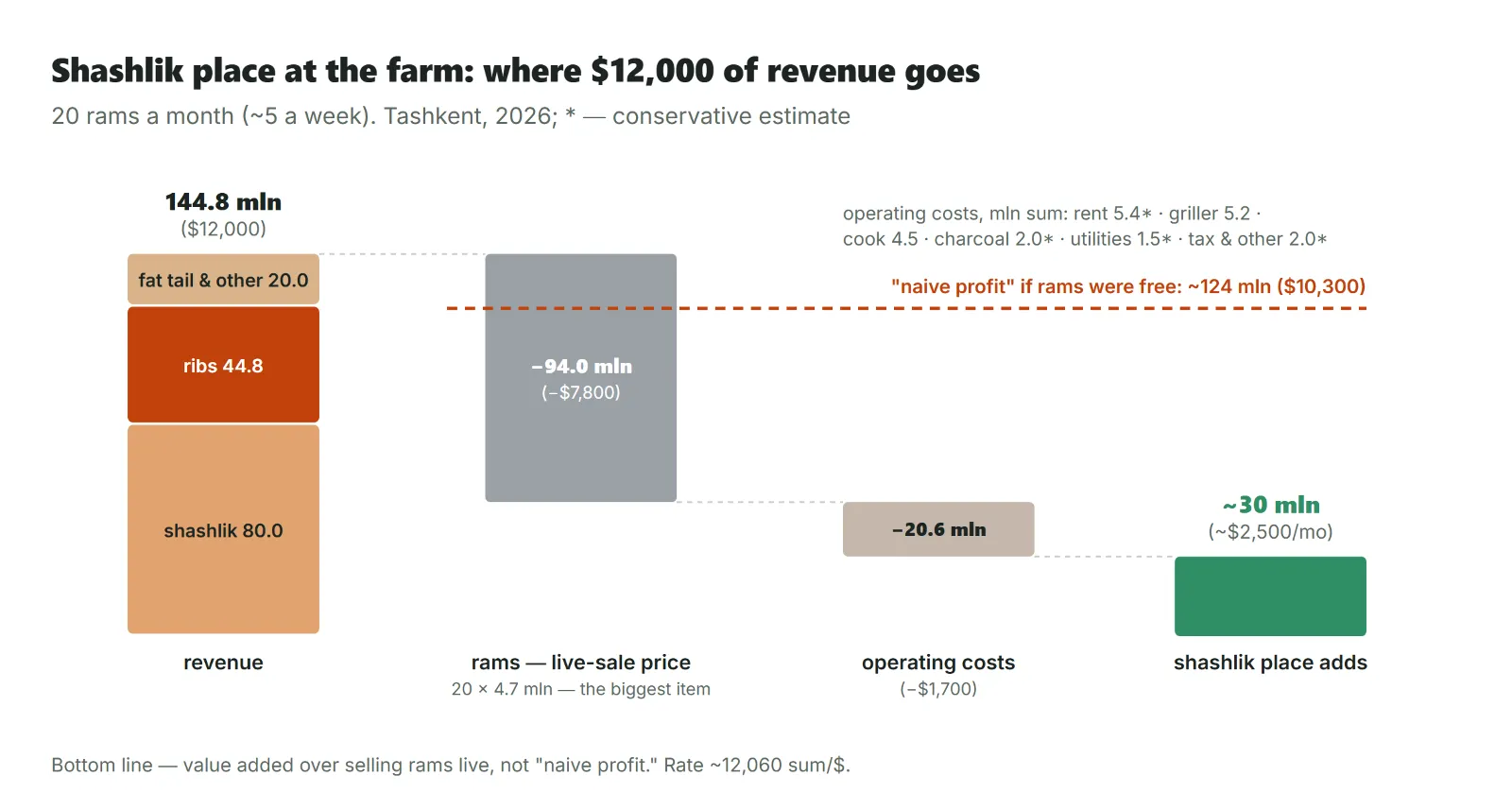
Strip the rams out of the expenses (as if they were really free), and "profit" balloons to ~124 million sum ($10,300) a month. That exact self-deception is what makes a shashlik place at the farm look like a gold mine. The real added value is around 30 million sum, about $2,500 a month. At full capacity (6 rams a week, on the busiest days) it reaches ~$3,000; in the off-season it drops.
What This Means for Your Farm
A shashlik place at the farm does add to the margin, but not by multiples. And it isn't the boneless meat that brings that added value. Three levers actually move the number:
- Sell the finished product, not live weight. A Hissar is expensive alive; to cover its cost with 20,000-sum skewers, you'd need to sell an awful lot of them. The markup sits in the finished dish — the meat itself doesn't carry much margin.
- Ribs. The highest margin is here. If you're running a shashlik place, ribs can't go into the general pot.
- Your own land. Rent is a major expense; on your own land there is none, and that goes straight into profit.
It makes sense to check the model monthly rather than at year end: revenue and cost tracking for the outlet by day shows whether the margin on ribs holds up when meat gets more expensive.
And to be honest about the weak points. The ribs' share of the carcass (10–17%), the shrinkage (35–38%), the portion put on a skewer, the place's throughput, the price of the fat tail and offal (~1.0 million sum per ram — I couldn't find public prices for these in Uzbekistan, so it's an estimate) — these are all range-assumptions, with no firm Uzbek standard behind them. Shift the ribs' price or the throughput, and the result moves anywhere from $1,500 to $3,000. But the order of magnitude holds: a farm plus a shashlik place earns more than the farm alone. Just not ten times more, as it might seem going in.
For exactly how much a ram costs today, and what the price depends on, see our article "How Much Does a Ram Cost in Uzbekistan in 2026". And whether fattening to heavy condition pays off (a heavy ram is worth more, but feed for the last kilograms of gain isn't cheap either) is something we covered in the article on fattening rams.
Manage your flock in QoyHunterCRM for sheep farmers: livestock, health, weighing, finance and analytics — in the app and a Telegram bot.All features →