
How to Feed Rams for Weight Gain: A Fattening Ration and Getting Ready for Winter in July
A working ram-fattening ration from local feeds — alfalfa, barley, cottonseed cake: per-head norms, realistic gains, cake limits, and how much hay to stock for winter.
A ram's price is, above all, its weight. One well-fattened fat-tailed ram is worth more than two skinny ones, and the feed that goes into the gain costs a fraction of the price difference. July is exactly the right time to plan a fattening cycle: young stock is cheap after Qurban Hayit, summer feed is cheap, and autumn demand and winter lie ahead. Let's break down a working ration from local feeds, realistic weight gains, and how not to harm the animal with cheap oilseed cake.
How Much a Ram Actually Gains
Let's start with honest expectations so the economics don't fool you:
- Pasture grazing for adult sheep and young stock — roughly 120–200 g per day.
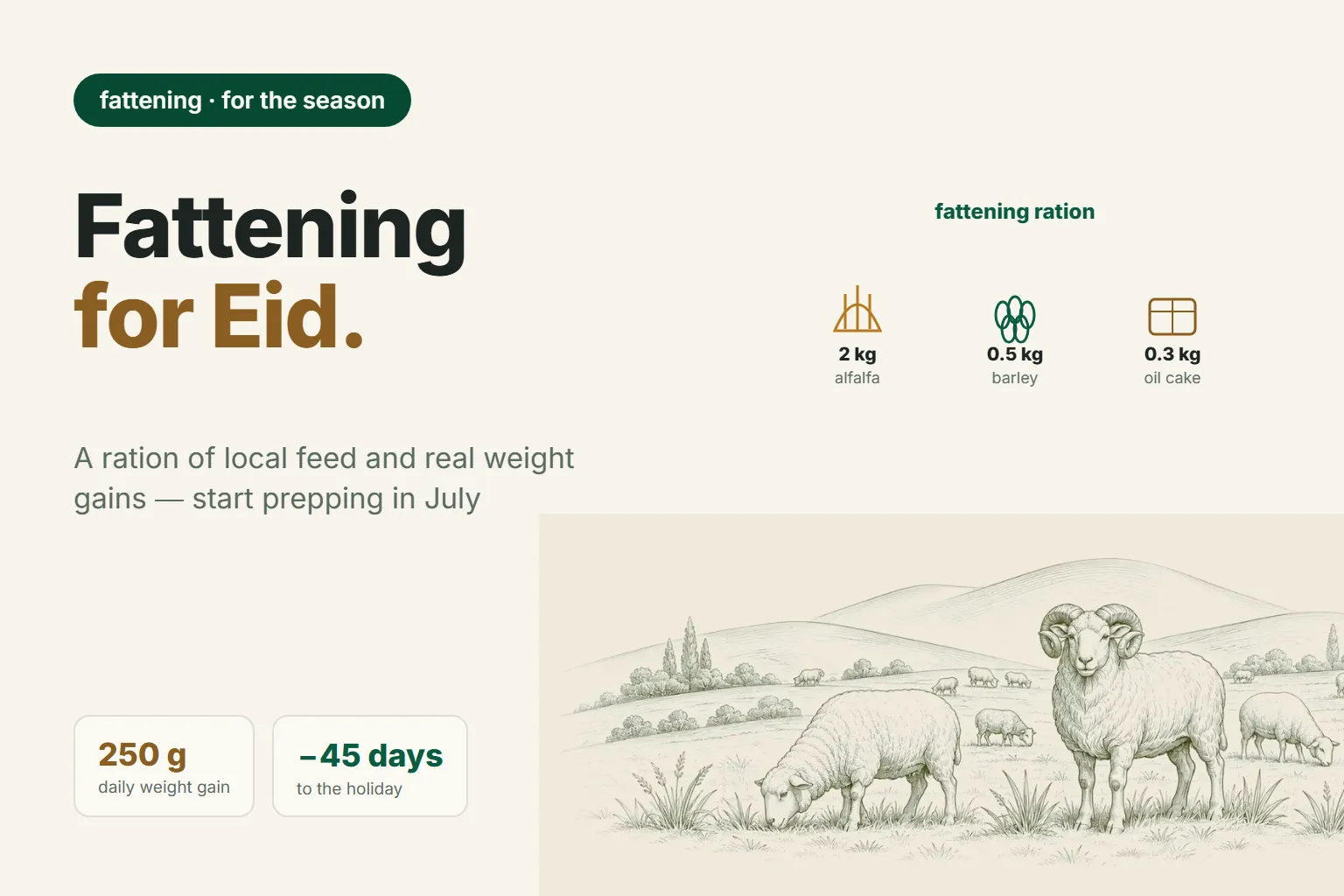
- Intensive pen fattening of fat-tailed breeds — roughly 150–250 g per day.
Figures like "300–350 grams and up" appear in farmers' stories but are not backed by zootechnical norms — budget your business on the lower end. An important pattern: the heavier the animal, the slower the gain. A young 30–40 kg ram grows far more readily than a fattened 60–80 kg one, so chasing weight for too long doesn't pay — there is an optimal moment to sell.
What the Ration Is Made Of
A good fattening ration has three parts:
- Roughage (the base) — alfalfa hay, mixed grass. Provides fiber and rumen health. It must not be removed entirely even at the finishing stage.
- Concentrates (energy for gain) — barley, cracked corn, wheat bran. These drive fast growth.
- A protein supplement — cottonseed cake or meal. A cheap local protein source, but with a catch (see below).
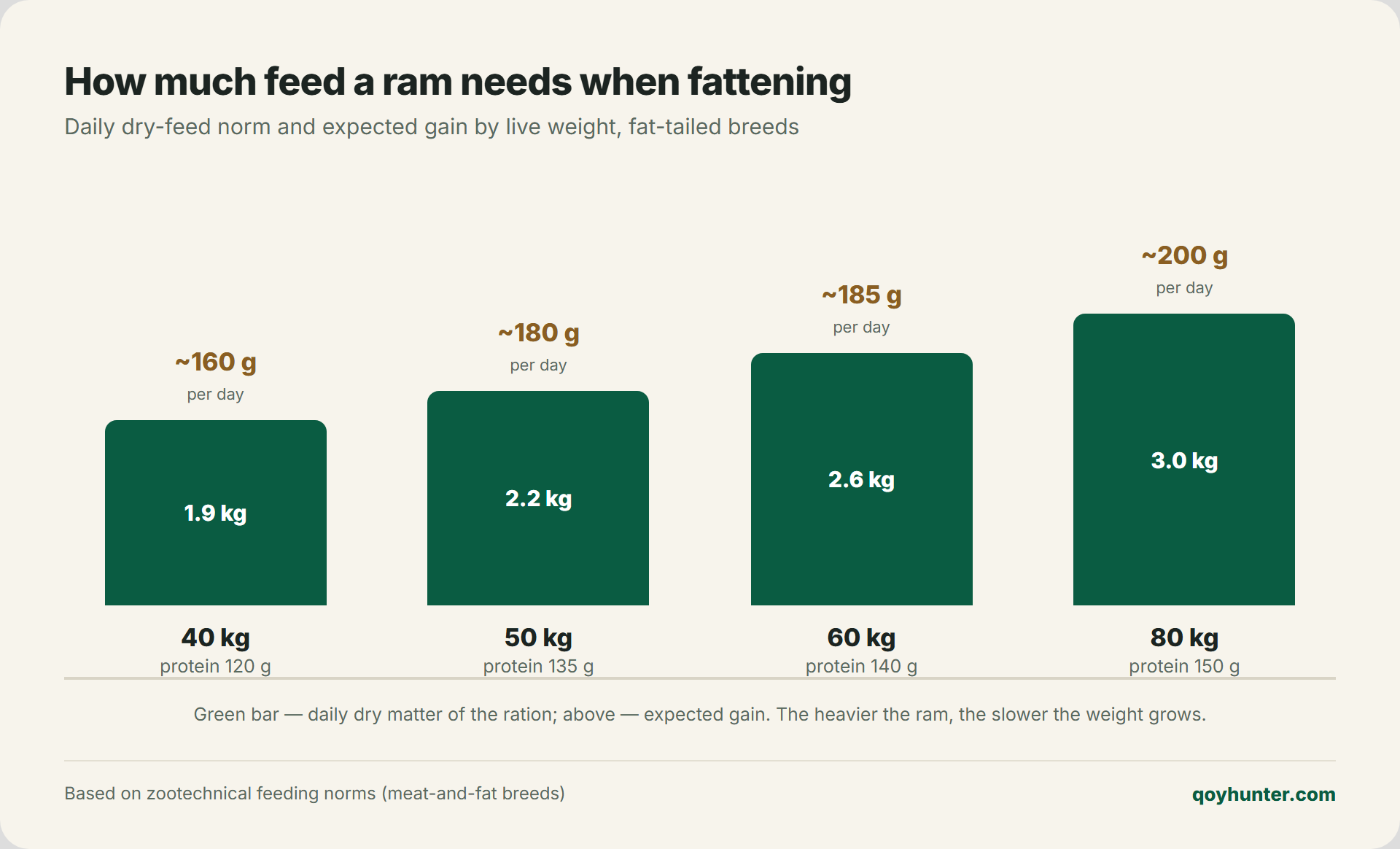
Approximate daily norms for fattening fat-tailed breeds (from zootechnical references):
| Live weight | Dry matter, kg | Digestible protein, g | Salt, g |
|---|---|---|---|
| 40 kg | ~1.9 | ~120 | 12 |
| 50 kg | ~2.2 | ~135 | 14 |
| 60 kg | ~2.6 | ~140 | 15 |
| 80 kg | ~3.0 | ~150 | 17 |
A Sample Ration from Local Feeds
Here is what a daily ration for a young ram in active fattening might look like (based on practitioners' experience — treat it as a starting point and adjust to your animals and their condition):
- alfalfa (clover) hay — 1.5 kg;
- cracked barley — 0.7 kg;
- cracked corn — 0.4 kg;
- wheat bran — 0.5 kg;
- salt lick and clean water — free choice.
A ration like this is costed in sacks for the whole group and the whole period: to buy barley, corn and bran in one purchase in July or August is cheaper than topping up bit by bit towards winter.
Toward the end of fattening, the share of concentrates is raised and roughage lowered — but never removed completely. Switch the animal onto such a ration gradually (see the section on mistakes).
Cottonseed Cake: Cheap, but Handle with Care
Cottonseed cake and meal are the cheapest protein in Uzbekistan, but they contain gossypol — a natural compound that is toxic in excess. The safety rules:
- Lambs under 4 months must not be given cottonseed cake or meal — their rumen does not yet protect them from gossypol.
- Young stock over 4 months — no more than about 10% of the ration by nutritional value; adults — in moderation, with a practitioner's benchmark of up to 200 g per head per day.
- Cake (pressed) is usually safer than meal (solvent-extracted) — it contains less free gossypol.
- Gossypol content depends on the specific batch of raw material and cannot be judged by eye.
Gossypol builds up in the body over time, so the amount of cottonseed cake for your flock and your batch of raw material should be confirmed by a vet or livestock specialist. This is a case where saving on the consultation can cost you animals.
Water and Salt — the Forgotten Basics
A sheep drinks 2–3 times more water than the dry feed it eats. Normally that is 3–4 liters a day, and in the Uzbek summer heat — up to 6 liters and more. A shortage of water halts weight gain instantly — troughs must always be full. Salt (a lick or in the ration) — 12–20 g a day depending on weight.
The Main Fattening Mistake — Switching to Grain Abruptly
The most common and costly mistake is dumping a lot of barley on a ram at once. A sudden excess of starch overloads the rumen and causes acidosis — the animal goes off feed, weakens, and can die. The rule is simple:
- introduce concentrates gradually, over 2–3 weeks;
- add grain in small steps — about 5–10% every 3–5 days;
- always keep roughage in the ration.
If a ram suddenly refuses feed, is listless, or has bloat or diarrhea — that is a reason to call a vet at once, not to wait.
Why July Is the Time to Prepare for Winter
Fattening is half the job; the other half is getting through winter without losses. In summer, hay is cheap and plentiful; in winter it is expensive and may run short. Stock up in advance:
- estimate how many head will go into winter and prepare hay with a margin — winter is long in the steppe regions;
- store hay dry and under cover: damp hay molds and loses nutritional value;
- weak and surplus animals are better sold in autumn, before the cold, than fed all winter at a loss.
A simple strategy for a small farm this season: buy young stock cheap in summer → fatten it on cheap summer feed → sell in autumn or before the next Qurban Hayit, keeping only the head you can definitely feed through winter. We break down current sheep prices in a separate article.
In Short
- Real fattening gain is 150–250 g/day; budget on the lower end.
- Ration: alfalfa hay + barley/corn + a little cottonseed cake; don't remove roughage.
- Cottonseed cake — mind the gossypol: none for lambs under 4 months; confirm the amount with a vet.
- Switch to grain gradually, over 2–3 weeks — otherwise acidosis.
- Water and salt — always free choice.
- Stock hay for winter in summer, with a margin.
Run your fattening with numbers: in daily weight gain tracking you can record weighings for free and see each ram's gain from your phone — you'll know at once whether the feed is paying off and when to sell. Buy young stock or sell fattened animals on the feeder lambs for sale listings.
The norms in this article are approximate, based on zootechnical references and farm experience. Confirm your feeding plan — and especially the amount of cottonseed cake — with a vet or livestock specialist.
Manage your flock in QoyHunterCRM for sheep farmers: livestock, health, weighing, finance and analytics — in the app and a Telegram bot.All features →