Wool for Pennies: Why Fleece No Longer Pays the Shepherd — and What to Do About It
In 2026, shearing a sheep often costs more than its wool is worth. Why coarse fleece lost its value, why farmers still need to shear, and where to sell wool in Uzbekistan — a breakdown with numbers.
Two generations ago, wool was a shepherd's second paycheck: sell the spring clip, buy summer feed. Today it's the opposite — shearing a sheep often costs more than its fleece is worth. Sacks of wool pile up in farmyards, and buyers take them reluctantly, for next to nothing. Here's why this happened, what's going on with the wool market worldwide and in Uzbekistan, and where to take your wool right now, right after shearing.
How Much Wool a Flock Produces
Our main breeds are fat-tailed meat-and-fat breeds, and their wool is coarse. Yields are modest:
| Breed | Annual yield (2 shearings) | Wool type |
|---|---|---|
| Hisor | 0.8–1.6 kg | Coarse, with kemp (dead) fiber |
| Jaydari | 2–3.5 kg | Coarse, carpet-grade |
| Karakul | 2.2–3.8 kg | Coarse and semi-coarse, used for carpets |
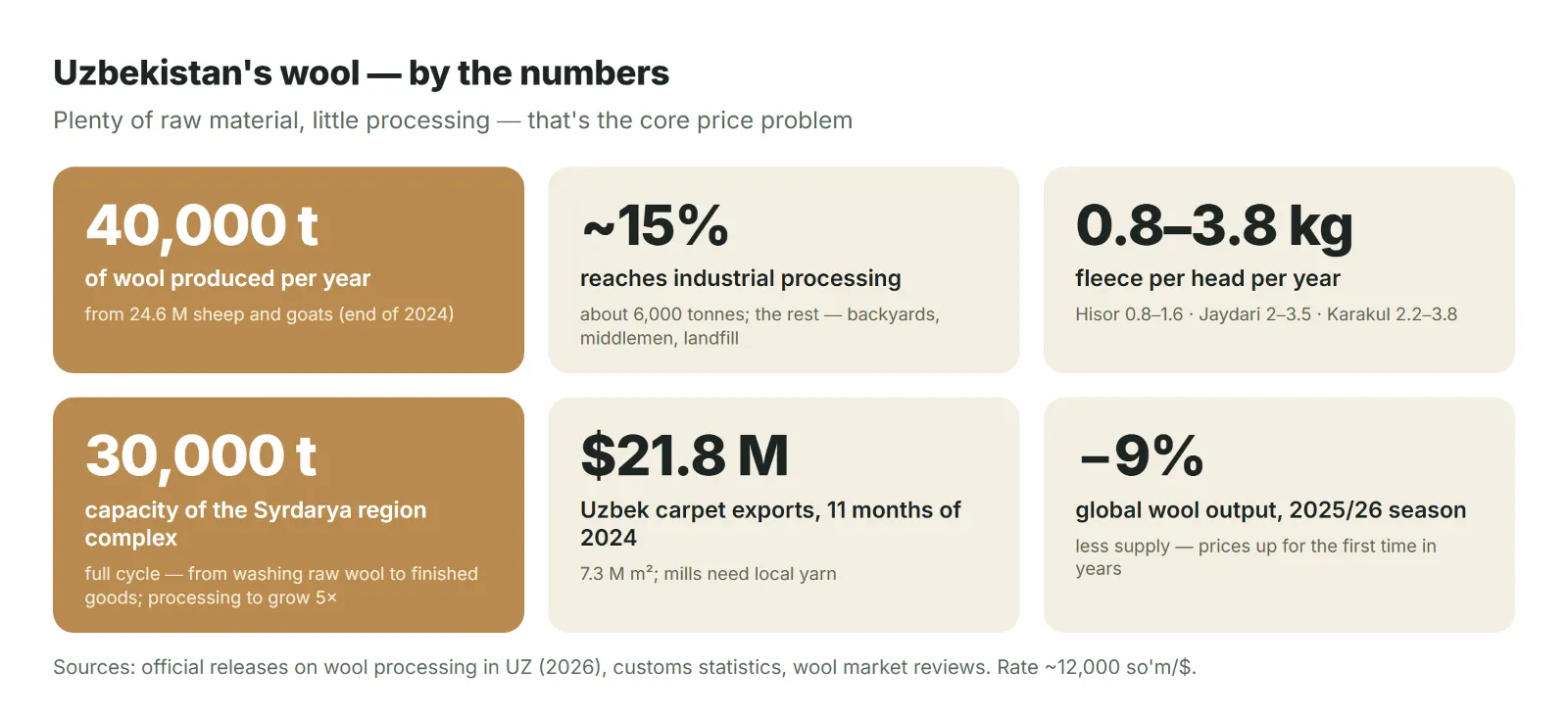
Even a flock of 100 head yields only 150–300 kg a year. At the national scale the numbers are already significant: with a headcount of 24.6 million sheep and goats (as of end-2024), Uzbekistan harvests about 40,000 tons of wool a year.
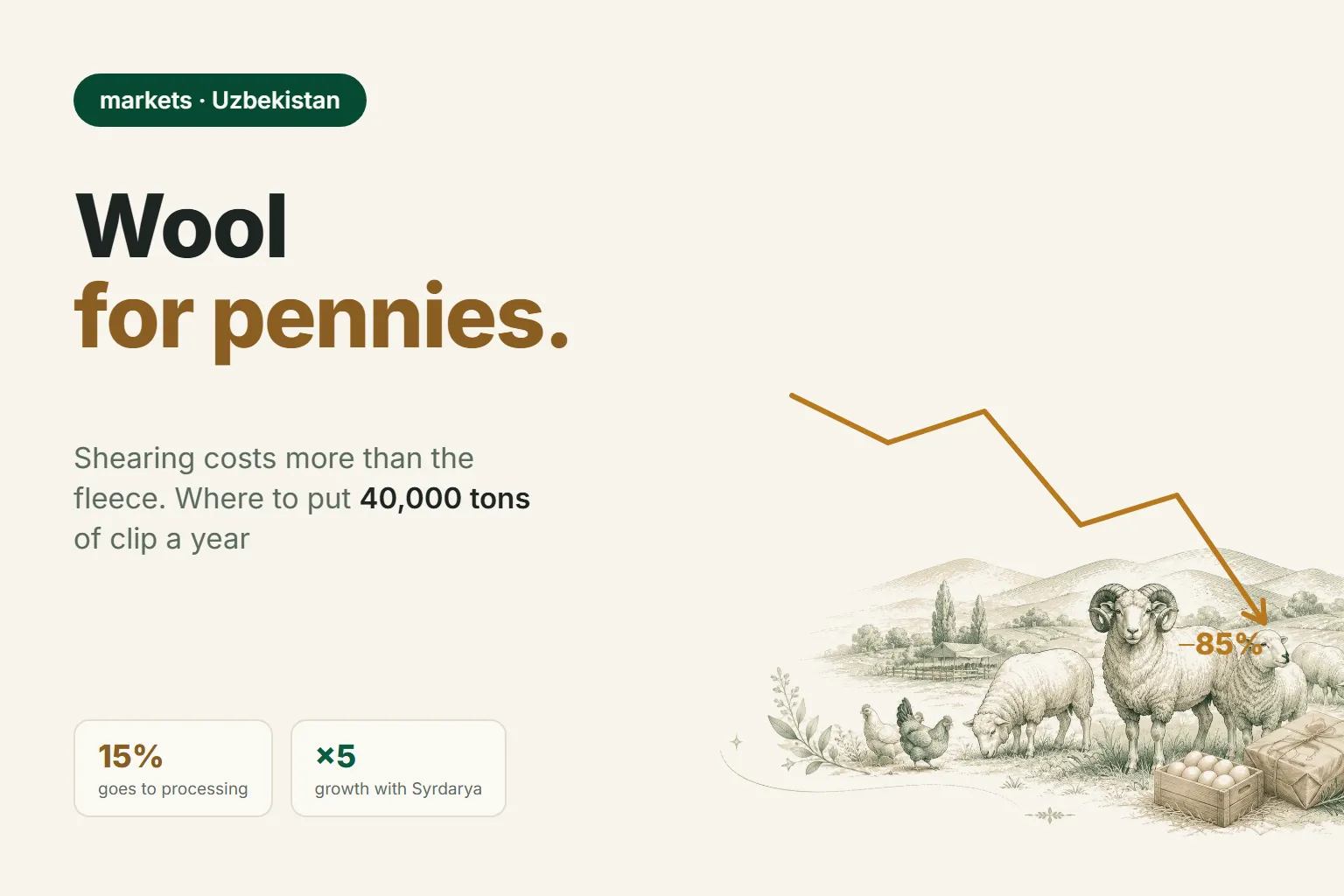
Now the key figure: of those 40,000 tons, industry processes only about 6,000 tons — roughly 15%. The remaining 85% goes to buyers for next to nothing at best, or rots in sheds at worst.
Why Wool Stopped Being Worth Money
In short: synthetics. Carpets, blankets, mattresses and insulation that used to be made from coarse wool are now made from polyester — it's cheaper, lighter, and doesn't smell like sheep. Only fine merino wool for suits and sportswear still commands a good price, but that's not our breeds: Hisor and Jaydari produce coarse, carpet-grade fiber.
This is a global story, not just ours:
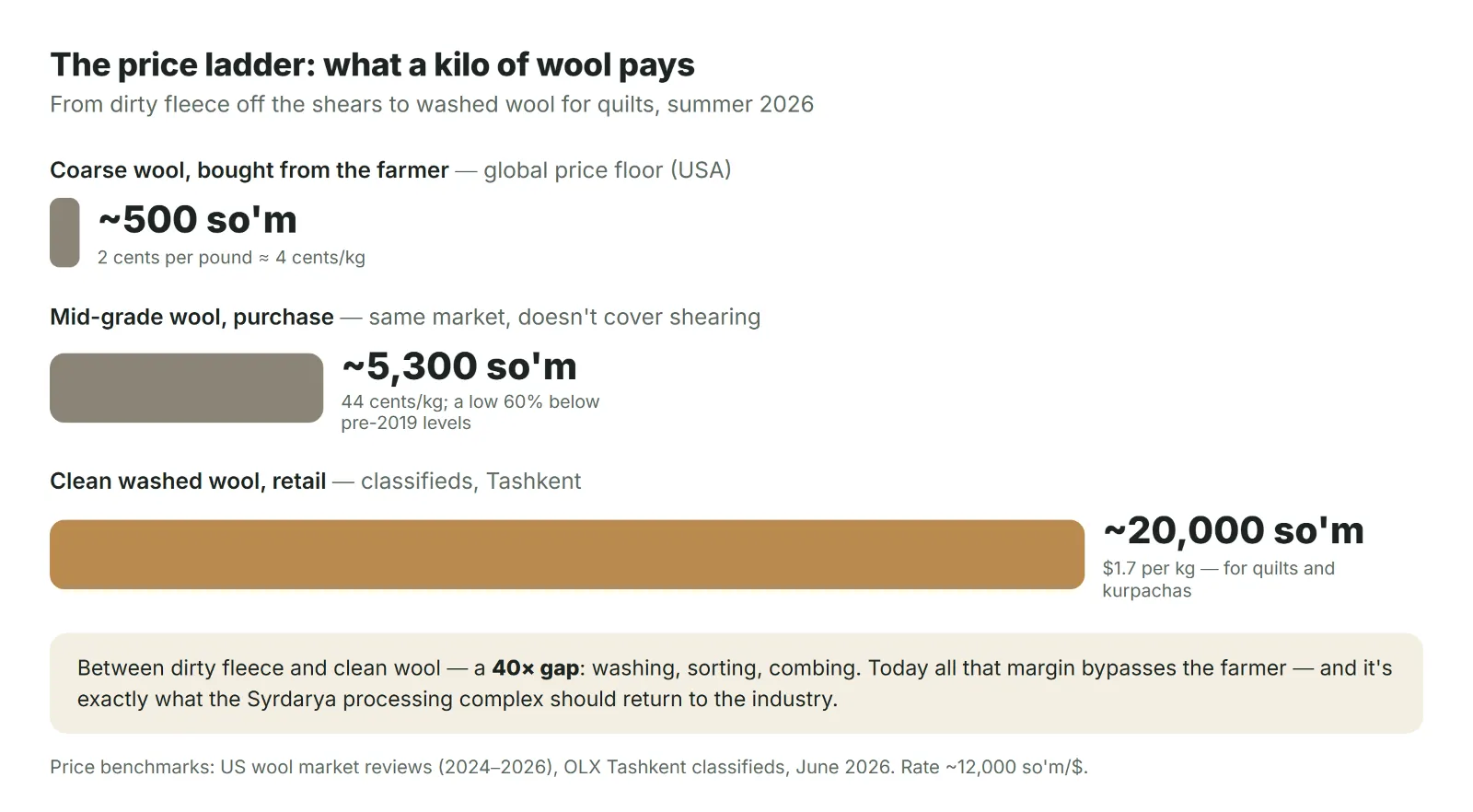
- In some US states, coarse wool is bought at 2 cents a pound — roughly 4 cents (about 500 soums) per kilogram. Farmers in the Midwest openly tell journalists they bury or burn their clip: hauling it costs more than throwing it away.
- Medium-quality wool there fetches about 20 cents a pound (roughly 44 cents, or 5,300 soums, per kilogram) — at least 60% less than before 2019, and even that doesn't cover the shearer's fee.
This affects Uzbek shepherds directly: while the country was processing only 15% of its wool, purchase prices for raw coarse fleece stayed at "we'll take it if you basically give it away" levels. For comparison: on classified-ad sites, clean, washed wool for blankets retails at about 20,000 soums ($1.7) per kilogram — but between dirty fleece straight off the shears and wool like that lies washing, sorting and carding, none of which a farmer has the time or means for.
Shearing Is Still Mandatory
If wool is worth nothing, why bother shearing? Because shearing is first and foremost about flock health, not income:
- Heat. Summer temperatures on the steppe top +40°C. An unshorn sheep overheats, eats less, and gains weight more slowly. With lamb selling at 90,000–120,000 soums ($7.5–10) per kilogram, every kilogram of lost weight gain costs more than all the wool on that sheep.
- Parasites. Matted fleece breeds ticks and fly larvae and hides skin disease underneath. After shearing, any problem is immediately visible.
- Lambing and mating. A shorn ewe is easier to examine, and a lamb finds the udder more easily.
Shearing a hundred head by hand takes a long time, while a crew gets through the flock in a day: sheep shearing services are usually priced per head, and in the heat that costs less than the weight gain you would lose.
Fat-tailed sheep are sheared twice a year: in spring, before the heat sets in, and in early autumn, so the fleece has time to grow back before the cold. Skimping on shearing means trading a trivial saving for losses in meat — and meat is now the shepherd's main source of income.
Spring and autumn shearing dates by breed, preparing the flock, dipping after shearing, and whether the fleece even covers the shearer's fee are covered in sheep shearing times for spring and autumn.
What's Changing in 2026
There are two developments that mean it's too early to write off wool.
First — Uzbekistan is building processing capacity. In Syrdarya region, a full-cycle complex is being designed with capacity for up to 30,000 tons of wool a year — from washing raw fleece to finished product. Alongside it, wool collection and primary-processing points are being set up across the regions. If the plans go through, processing capacity will grow from 6,000 to 30,000 tons — fivefold — and for the first time in years, buyers will genuinely compete for raw material. Carpet production is already growing: in the first 11 months of 2024, Uzbekistan exported 7.3 million m² of carpets worth $21.8 million, and factories need local yarn.
Second — the global market has bounced off the bottom. The world's sheep population is shrinking: the forecast for the 2025/26 season is a drop in wool production of almost 9%. Less supply means higher prices: at British auctions, June 2026 trading closed up more than 10%. Coarse wool won't turn into gold, but for the first time in years the trend has turned upward.
Where to Take Your Wool Right Now: 5 Options That Work
- Carpet and felt workshops. Karakul and Jaydari are classic raw material for carpet yarn and felt. Find out if there's a workshop in your district — many buy wool in batches of several hundred kilograms.
- Blanket and mattress makers. Craftsmen who sew traditional quilts (kurpacha) and blankets pay more for washed wool than collectors do. If you have time to wash and dry your clip, the price goes up several times over.
- Team up with neighbors. A buyer isn't interested in your 50 kg, but is interested in a ton from your mahalla. Pool a joint batch with your neighbors — it's easier to negotiate price, and transport costs split among everyone.
- Insulate your own farm. Wool is an excellent insulator for barn and coop walls: it breathes, holds heat, and dampens noise.
- Fertilizer and mulch. Wool slowly releases nitrogen and holds moisture in the soil — a real find for our dry gardens. In the US, low-grade wool is already being pressed into fertilizer pellets; in a home garden, you can work it straight into the beds without any equipment at all.
What to Record
Wool today is a byproduct, but record-keeping is exactly what turns it from waste into a commodity: a buyer or workshop talks business once you can state the batch volume, the breed, and the shearing dates. Log the yield after every shearing and keep your headcount under control — in the QoyHunter app this takes a minute on your phone: events for every animal, weight, notes. When the Syrdarya complex comes online and competing buyers start showing up for wool, the winner will be whoever has a batch that's collected, weighed, and documented.
The easiest time to start is this season: shearing yield records takes a minute and a year later gives you a ready description of the batch — weight, breed and dates.
The bottom line is simple: don't expect money from fleece today, but don't burn it either. Shear on time for your flock's health, collect and record your yield, team up with neighbors — and keep an eye on processing news. It looks like, for the first time in years, wool is getting a buyer again.
Manage your flock in QoyHunterCRM for sheep farmers: livestock, health, weighing, finance and analytics — in the app and a Telegram bot.All features →