Sheep Farm Business Plan: Startup Costs, Expenses, and Payback Period
A step-by-step calculation for a sheep farm in Uzbekistan: how much you need to start, what makes up annual costs (feed is the main line item) and revenue, and how many years it takes for a flock to pay for itself. Includes a simplified financial model for 50 ewes and a breakdown of risks.
"I want to start raising sheep — is it profitable?" There's only one honest answer: run the numbers. A sheep farm isn't a lottery ticket or a goldmine — it's an ordinary business with straightforward arithmetic: investment, annual costs, revenue, and payback period. Below is a step-by-step business plan, brought together into a simplified financial model for 50 ewes. All figures are benchmarks based on summer 2026 prices (rate ~12,000 UZS/$); exact numbers depend on your region, scale, whether you own land, and your own labor. Run your own numbers.
Step 1. Startup Investment
Startup investment is what you pay once to get the farm running. Four main categories:
- Breeding ewes. The main and almost unavoidable expense. A ewe of local meat-fat-tailed breeds costs roughly ~2.8M UZS ($230). A flock of 50 ewes runs about 140M UZS ($11,700).
- Breeding ram. One ram can cover 25–40 ewes, but it's best to start with two — as a backup and for future replacement. A good ram starts from 6M UZS ($500); budget 12–16M UZS ($1,000–1,300) for two.
- Sheepfold and water supply. The most unpredictable line item. If you already have a building and a pen, you'll get by with adaptation and running in water (10–25M UZS). If you need to build a sheepfold from scratch, it can become the biggest expense of all (an extra 30–100+M UZS), and only a local builder can give you an exact estimate.
- Equipment. Feeders, waterers, scales (without them you won't see weight gain), a first-aid kit, and other supplies — 5–10M UZS ($400–800).
Add a cushion for feed until the first sales — provisions for the first winter run 15–25M UZS. All told, a realistic start on your own land is around 180–215M UZS ($15,000–18,000); with sheepfold construction, noticeably more.
Step 2. Fixed and Variable Costs
This is what the farm eats up every single year. This is where beginners go wrong most often: they only count buying the animals and forget the flock needs feeding 365 days a year.
- Feed is the main expense. In sheep farming, feed typically accounts for 50–70% of total annual costs. In summer, pasture and seasonal grazing help out, but the winter barn period (5–6 months) — hay, alfalfa, barley, straw, cottonseed cake — hits the wallet hard. For a flock of 50 ewes plus their lambs, budget roughly 35–45M UZS a year ($3,000–3,750). Stock up with a surplus in summer, and you won't overpay three times over in winter.
- Veterinary care. Vaccination, deworming, parasite treatment, and medical care — 4–6M UZS a year. This isn't a place to cut corners: one disease outbreak costs more than a full year of prevention.
- Water and electricity — 2–4M UZS a year, higher in arid regions.
- Other — tagging and identification (a legal requirement starting August 2026), transport, veterinary certificates for sales, taxes, and consumables — 4–7M UZS.
- Labor. A family farm runs on its own hands — "free" only on paper. A hired shepherd costs 3–5M UZS a month, meaning +40–55M UZS a year, almost doubling costs. This is the key fork in the plan. How to structure this line so it pays for itself is covered separately: how much to pay a shepherd and how to calculate a lamb-survival bonus.
Do not lift this line from somebody else’s plan: check hay, barley and meal prices in your own region — the spread between regions easily swings ±10 mln UZS a year on fifty ewes.
Without hired labor, the annual costs for a 50-ewe farm run about 45–62M UZS ($3,800–5,200).
Per head, these line items work out to 1.02 million UZS a year on your own, and 1.20 million UZS with a hired shepherd. The full line-by-line breakdown is in our piece on how much it costs to keep a sheep for a year.
Step 3. Revenue
Sheep farming is a reproduction-based business: the flock produces lambs every year, and you sell them.
- Lambs are the main income. Local breeds have a fertility rate of 105–115 lambs per 100 ewes (up to 120 for some), with survival to weaning of around 90%. That means 50 ewes yield roughly 45 lambs a year for sale. Young stock is sold for meat and live weight (a fattened ram from 4–4.7M UZS) or for breeding (2–3M UZS). Realistic revenue from the flock is 120–140M UZS a year ($10,000–11,700).
- Meat and live weight — the main channel. Prices peak right before Qurban Hayit (Eid al-Adha), so it's worth timing sales around it.
- Breeding stock. The best ewe lambs and rams sell for more than meat animals — a price premium if you run a selection program.
- Wool and milk barely count. The coarse wool of local breeds has lost its value: shearing often costs more than the fleece itself is worth. Commercial sheep milk barely exists in Uzbekistan. Don't build your income around them.
Step 4. Simplified Financial Model (50 Ewes)
Let's bring it all together into a single annual calculation. This is an illustration of "how to calculate," not a guarantee — plug in your own numbers.
| Indicator | Estimate, M UZS/year | ~$ |
|---|---|---|
| Revenue | ||
| Young stock for sale (~45 head) | 120–140 | $10,000–11,700 |
| Wool / milk | ~0 | ~0 |
| Total revenue | 120–140 | $10,000–11,700 |
| Expenses | ||
| Feed (50–70% of costs) | 35–45 | $3,000–3,750 |
| Veterinary care | 4–6 | $350–500 |
| Water, electricity | 2–4 | $170–330 |
| Record-keeping, transport, taxes, consumables | 4–7 | $350–580 |
| Total expenses (own labor) | 45–62 | $3,800–5,200 |
| Annual profit (own labor, own land) | ~65–85 | ~$5,500–7,000 |
| Hired shepherd (if hiring) | +40–55 | +$3,300–4,600 |
A reminder: startup investment (~180–215M UZS) isn't included in this table — that's separate, one-time money that gets paid back out of annual profit.
Step 5. Payback Period and Profitability — Without Illusions
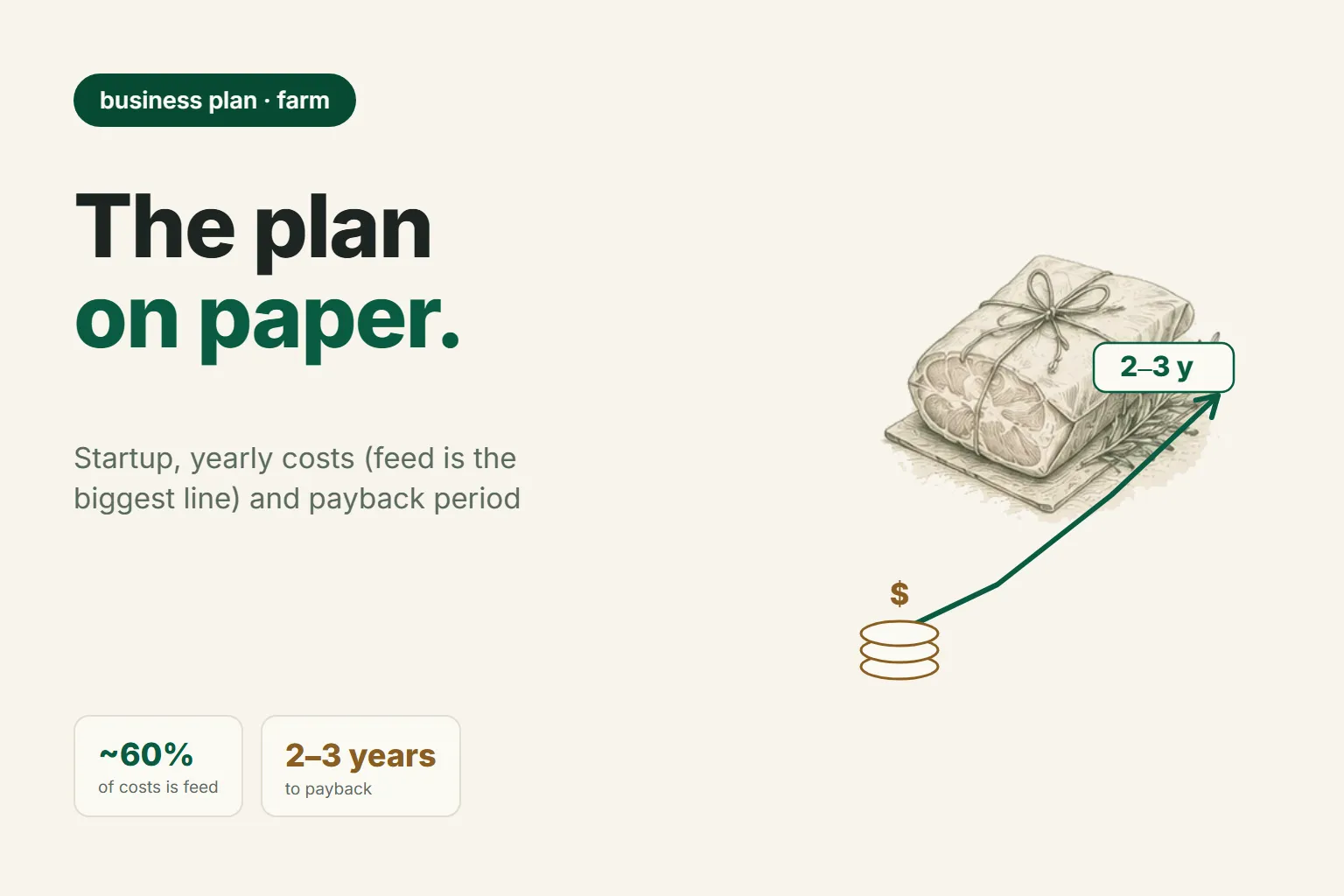
Payback period = startup investment ÷ annual profit. With a ~180–215M UZS start and ~65–85M UZS in annual profit, that works out to roughly 3–5 years. If you hired a shepherd or built the sheepfold from scratch, the period stretches to 6 years or more.
An important honesty check: this "profit" is largely payment for your own labor and your own land — free on paper, not in real life. If you rent land and hire a worker, the real margin gets thinner. Market benchmark: the overall profitability of Uzbek farm enterprises is 5–7%, and after VAT on agricultural products is zeroed out starting 2026, the Ministry of Agriculture expects growth to around 15%. Foreign estimates for meat sheep farming (15–30% profitability, 2–5 year payback) exist, but don't translate directly to Uzbekistan. Bottom line: don't believe promises of "300% in one season" — the real horizon is measured in years.
Risks That Can Break the Plan
- Mortality. A 90% survival rate already means 10% losses. A damp sheepfold, weak prevention, buying animals without veterinary papers — losses grow, and the whole model collapses along with them.
- Feed prices. Feed makes up 50–70% of costs, so a dry summer and expensive hay hit hardest of all. A feed reserve equals a safety margin for your business.
- Price seasonality. A ram before Qurban Hayit and the same ram in a "dead" month are worth different money. Sell at the peak, not "when you're desperate."
- Scale effect. With 10 head, there's no business — revenue won't cover the labor. The model starts working from several dozen ewes upward.
Calculate with Numbers, Not by Eye
A business plan on paper is only half the job. Profit shows up where you can see, animal by animal: how much weight a lamb gained, whether the feed grain paid for itself, which ewe produces lambs and which just eats feed, and where a death occurred. In a notebook tracking 50 head, these numbers get lost.
With farm income and expense software, you can manage your flock for free right from your phone: headcount, weight gain, lambing, mortality — and in the analytics and finance sections, income and expenses for every animal. That turns the business plan in this article into your real report, not just an estimate. Buy a starter flock or sell young stock on the sheep and ram marketplace.
These figures are estimated calculations based on publicly available summer 2026 prices (rate ~12,000 UZS/$), not guaranteed numbers. Before starting, prepare a budget tailored to your region, breed, and conditions.
Manage your flock in QoyHunterCRM for sheep farmers: livestock, health, weighing, finance and analytics — in the app and a Telegram bot.All features →