
Barley for sheep: how much per day, grinding, and when it pays
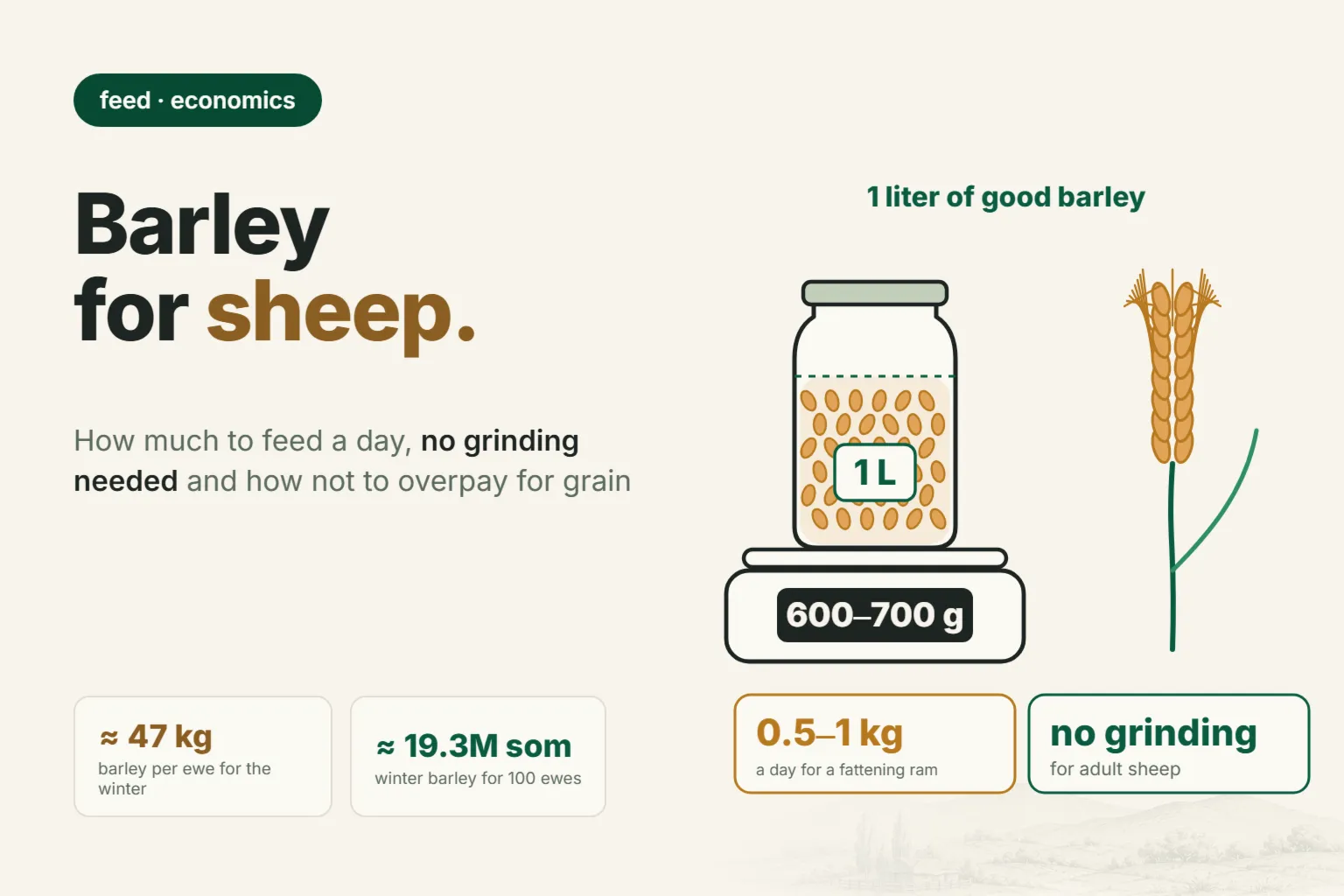
A fattening ram gets 0.5–1 kg of barley a day, a pregnant ewe 0.3–0.45 kg; no grinding needed. Amounts by group, winter stock and November 2026 prices.
Barley is the main grain feed for sheep in Uzbekistan: a fattening ram gets 0.5–1 kg of barley a day, a pregnant ewe 0.3–0.45 kg in the last 6 weeks, and a nursing ewe 0.4 kg with one lamb and 0.8 kg with twins. Adult sheep do not need barley ground: a sheep chews whole grain well. For the winter, a flock of 100 ewes needs about 5.2 tonnes of barley, roughly 19.3 million som (≈ $1,610) at November 2026 prices.
Below: how much barley each group of sheep gets, how much grain to buy for the winter, when barley is a better buy than maize, wheat and bran, and where farmers overpay for it. In November 2026 barley on olx.uz costs 3,200–4,200 som per kg, most often 3,500–4,000; we use 3,700 som (≈ $0.31) in the calculations. The Central Bank of Uzbekistan rate on 25 November 2026 is 11,990.54 som per dollar.
Why do sheep need barley if they have hay?
Barley is a concentrate: a kilogram of barley grain has about 10.8 MJ of metabolizable energy and 103 g of crude protein, according to the international feed database Feedipedia (INRAE, CIRAD, AFZ and FAO). Metabolizable energy is the part of a feed's energy that the sheep actually uses for living, growing and making milk. A kilogram of good alfalfa hay has about 8 MJ.
Energy from hay is cheaper. With hay at 1,800 som per kg (the winter 2026 price), a megajoule from hay costs 225 som, and from barley at 3,700 som it costs 343 som, one and a half times as much. But the rumen has limited volume: on hay alone a sheep cannot eat as much energy as a ram needs for fast gain or an ewe with twins needs for milk. So barley is a supplement to hay where hay is no longer enough, not a replacement for it.
Barley's weak spots: it is low in calcium and high in phosphorus, and its starch ferments quickly in the rumen. Too much barley at once means acidosis, and rams on grain without alfalfa get urinary stones.
How much barley should a sheep get per day?
The amounts below are for sheep on alfalfa hay when barley is the only concentrate. If part of the grain is replaced with maize, wheat or bran, less barley is fed for the same energy.
| Group of sheep | Barley per head per day | Alfalfa hay |
|---|---|---|
| Dry ewes and the first 3.5 months of pregnancy | 0–0.2 kg (thin ones only) | 1.8–2.2 kg |
| Pregnant ewes, last 6 weeks | 0.3–0.45 kg | 1.8–2 kg |
| Nursing ewe with one lamb | 0.4 kg | 2 kg |
| Nursing ewe with twins | 0.8 kg + 0.2 kg cottonseed cake | 1.8 kg |
| Weaned lambs, 3–5 months | 0.3–0.5 kg + 50–80 g meal | unlimited |
| Fattening rams and lambs | from 0.5 kg at the start to 0.9–1 kg at the finish | at least 1 kg |
| Breeding rams 6 weeks before mating | 0.4–0.5 kg | 2 kg |
| Lambs from 2–3 weeks, creep feed | 50–200 g | — |
Do not give more than 0.5 kg of barley in one feeding: the daily amount is split between morning and evening, and at the end of fattening into three feedings. We covered the ration of an ewe after lambing in detail in the article what to feed a ewe after lambing.
How do you get sheep used to barley so they do not get acidosis?
Introduce barley over 2–3 weeks: start with 100 g per head per day and add 50–100 g every 2–3 days until you reach the amount for the group. Do not take away the hay: it keeps the rumen working.
Any change — a new batch of barley, a switch from maize to barley, a missed feeding — means bringing the grain in gradually again. After a break of 2–3 days, restart at half the amount.
If a ram goes off its feed after grain, lies down, its rumen stops working or it gets diarrhea, take away the grain and call a vet. What happens in the rumen when you overfeed grain and what to do in the first hours is covered in the article why rams die on grain fattening.
Do you need to grind barley for sheep?
For adult sheep and weaned lambs, no. A sheep chews whole grain well and grinds it once more when ruminating. In experiments by Ørskov at the Rowett Institute in Scotland in the 1970s, weaned lambs grew on whole barley just as well as on rolled barley, and the rumen environment was noticeably less acidic.
Fine grinding is harmful: barley flour ferments in the rumen faster than whole grain and raises the acidosis risk, and sheep eat dust less willingly. In November 2026 a grinder on olx.uz costs 1.3–3.5 million som (≈ $110–290), which is the price of 350 kg to almost a tonne of barley. For a flock of adult sheep and weaned lambs it does not pay for itself.
Only old ewes with worn teeth get barley coarsely cracked into 2–4 pieces. There is no need to soak or steam barley for sheep either: it does not make the grain more nutritious, and wet grain sours and molds within a day.
How much barley does a flock need for the winter?
Take 100 ewes lambing in February: in December and January the ewes are on hay and thin ones get a little grain, in the last 6 weeks of pregnancy they get 0.4 kg, then 8 weeks of nursing. Say 10 of the 100 ewes have twins: Hissar ewes produce 105–115 lambs per 100 ewes.
| Period | Days | Barley per ewe per day | Barley per ewe for the period |
|---|---|---|---|
| December–January, hay | 60 | 0.1 kg on average | 6 kg |
| Last 6 weeks of pregnancy | 42 | 0.4 kg | 16.8 kg |
| Nursing, 8 weeks (90 with one lamb, 10 with twins) | 56 | 0.44 kg on average | 24.6 kg |
| Total per ewe | 158 | — | ≈ 47 kg |
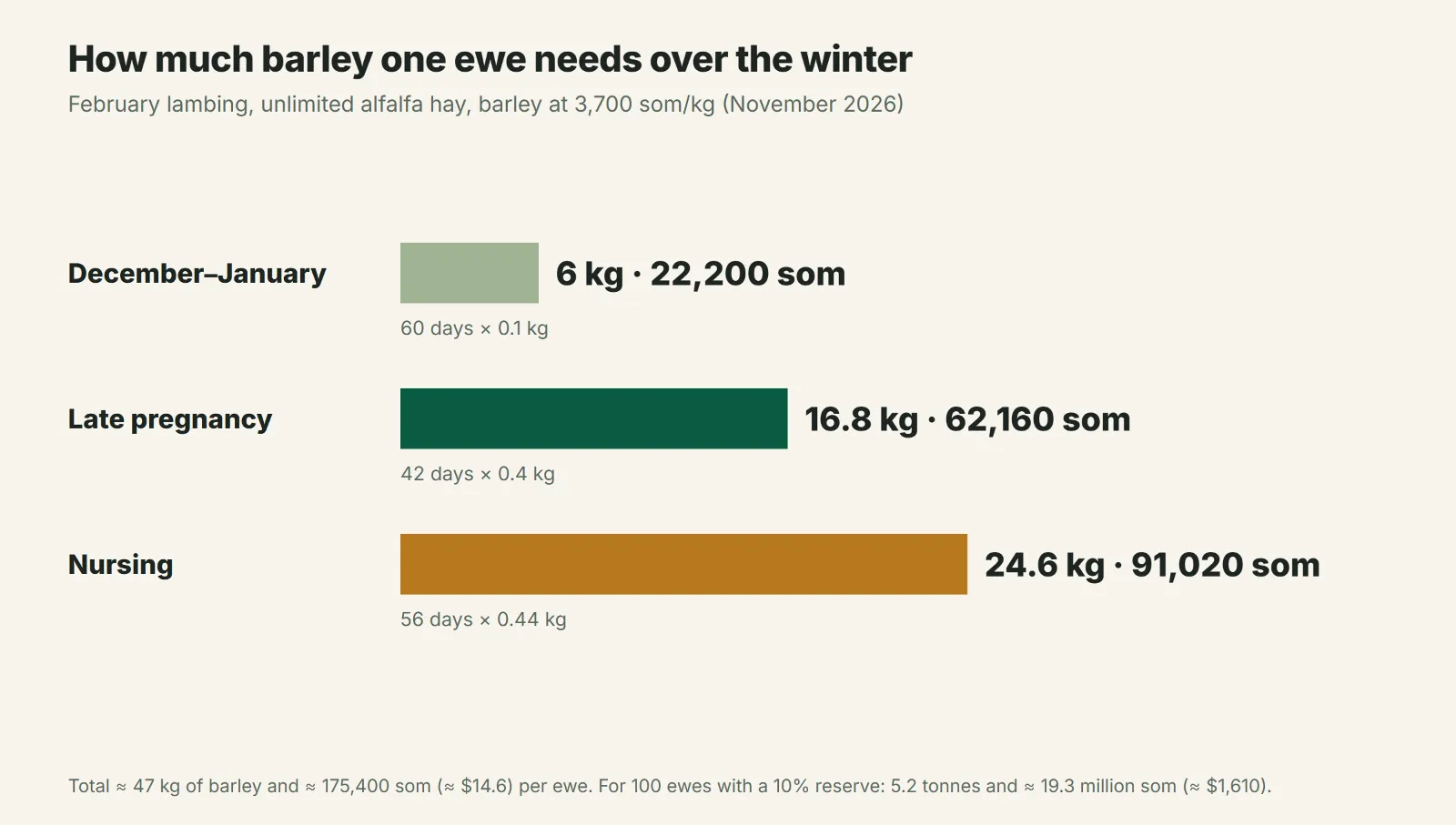
For 100 ewes that is 4.74 tonnes of barley, or ≈ 17.6 million som (≈ $1,460) at 3,700 som per kg. With a 10% reserve for losses and a cold March, it is 5.2 tonnes and ≈ 19.3 million som (≈ $1,610). Half of the grain goes to nursing: if barley runs short, it runs short exactly when the lambs need milk.
It pays to buy this much at once in autumn, while new-harvest grain is on sale: compare prices in the listings for barley and compound feed, and remember to factor in delivery.
When is barley a better buy than maize, wheat and bran?
Compare feeds by the price of energy, not the price of a kilogram. With barley at 3,700 som per kg, the break-even prices are as follows (from our articles on each feed):
| Feed instead of barley | How much replaces 0.45 kg of barley | Beats barley while a kg costs less than |
|---|---|---|
| Maize | 0.41 kg | ≈ 4,000 som (≈ $0.33) |
| Wheat | 0.43 kg | ≈ 3,900 som (≈ $0.33) |
| Bran, ewes | by pure energy | ≈ 3,000 som (≈ $0.25) |
| Bran, fattening | by pure energy | ≈ 2,800 som (≈ $0.23) |
Maize and wheat can cost a bit more than barley and still come out ahead: they have more energy. Bran, on the other hand, pays only when it is clearly cheaper than barley.
Where do farmers overpay for barley?
- Light grain. Shriveled barley with a large share of husk carries less energy but costs the same. It is easy to check: a liter jar of good barley weighs 600–700 g. Compare sellers by the weight of a liter, not only by price.
- Trash and dust. Straw, soil and weed seeds in the sack are money paid for what the sheep will not eat. Clean barley ("toza") that costs 100–200 som more per kg often works out better.
- Mold. A musty smell, caked lumps, a green or black coating: do not give such barley to sheep. Molds produce toxins (mycotoxins) that cause abortions and barren ewes, and poison the rest of the flock. Store grain on pallets, not on an earth floor.
- Seed barley as feed. Sellers often ask more for seed barley (urugʻlik) than for feed barley, up to 5,000 som per kg. Feed barley is all you need.
- Overfeeding at the finish. The heavier the ram, the more each kilogram of gain costs. We worked out when and why fattening stops paying in the article on the cost of gain.
How do you prevent urinary stones in rams on barley?
Barley is low in calcium and high in phosphorus. If fattening rams and wethers eat a lot of grain and little alfalfa, the calcium-to-phosphorus ratio drops below the norm and stones form in the urinary tract. Wether lambs are hit most often.
Prevention: alfalfa hay every day, unlimited water and, if the ration is built on straw rather than alfalfa, about 1.5% ground limestone (chalk) by grain weight, that is 15 g per kilogram of grain. There should be at least twice as much calcium in the ration as phosphorus. Keep a salt lick available at all times. If a ram strains and urinates in drops, call a vet at once.
How do you keep track of barley so it lasts until spring?
Grain in the store melts away unnoticed: the shepherd scoops it "by eye", and a stock meant for 158 days runs out in the middle of nursing. Record purchases and daily use, and you can see how many days of barley are left. In QoyHunter (a CRM for sheep records, plus the bazar.qoyhunter.com marketplace) this is done in the feed and farm stock tracking section: feed received, distribution to groups and the balance in days.
FAQ
How much barley should a ram get per day?
A fattening ram gets from 0.5 kg of barley a day at the start to 0.9–1 kg at the finish, together with at least 1 kg of alfalfa hay. Start at 100 g per head and add 50–100 g every 2–3 days. A breeding ram 6 weeks before mating needs 0.4–0.5 kg a day.
Do you need to grind barley for sheep?
No. Sheep, including weaned lambs, chew whole barley well, and fine grinding raises the acidosis risk. Grain is ground coarsely only for old ewes with worn teeth. A grinder at 1.3–3.5 million som (November 2026) does not pay for itself in an ordinary flock.
How much barley does a sheep need for the winter?
An ewe lambing in February needs about 47 kg of barley over the winter: 6 kg in December–January, 17 kg in the last 6 weeks of pregnancy and about 25 kg over 8 weeks of nursing. For 100 ewes with a 10% reserve that is 5.2 tonnes, about 19.3 million som (≈ $1,610) at November 2026 prices.
How much does barley cost in Uzbekistan?
In November 2026 feed barley in olx.uz listings costs 3,200–4,200 som per kilogram, most often 3,500–4,000 som (≈ $0.29–0.33). Kazakh barley in 50 kg sacks in Tashkent sells for 3,450–3,500 som.
Can you feed sheep barley alone, without hay?
No. Without hay or straw the rumen does not work, and barley starch causes acidosis. The base of a sheep's ration is roughage and barley is a supplement: 0.3–0.8 kg a day for an ewe, up to 1 kg for a fattening ram, and always together with hay.
Manage your flock in QoyHunterCRM for sheep farmers: livestock, health, weighing, finance and analytics — in the app and a Telegram bot.All features →