Sorghum for sheep: how much to feed, prussic acid risk and price vs barley
Sorghum grain replaces barley almost one to one: 0.45–0.9 kg a day for a fattening ram. Break-even price vs barley and when green sorghum kills sheep.
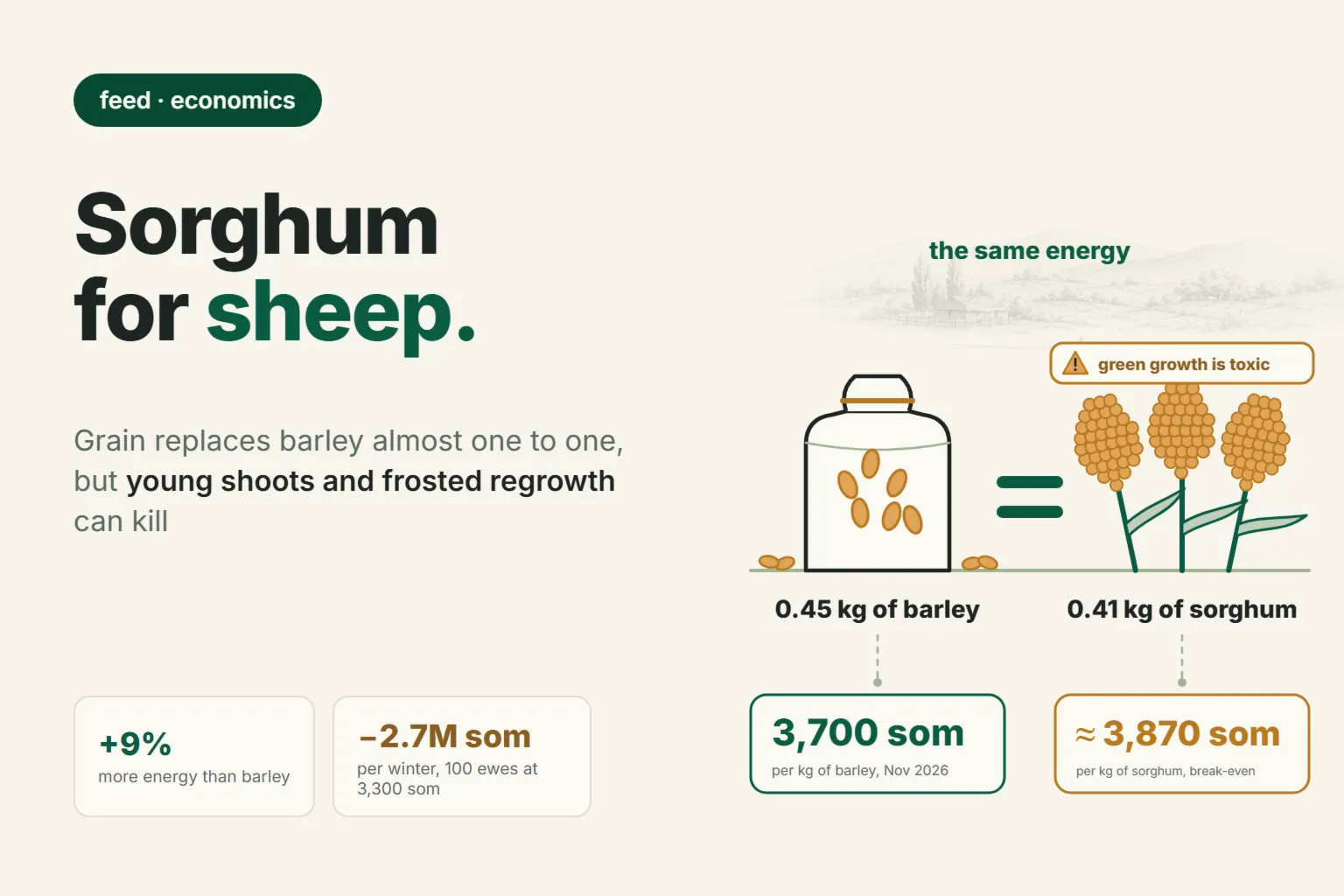
Sheep can eat sorghum (jugara, as it is called in Uzbekistan): ripe sorghum grain replaces barley almost one to one. A kilogram of sorghum grain has 9% more energy than barley and 9% less protein. A fattening ram gets 0.45–0.9 kg of sorghum a day, and a pregnant ewe in the last 6 weeks of gestation gets 0.3–0.4 kg. Adult sheep do not need the grain cracked. The danger is not the grain but the green plant: young shoots, regrowth and frosted plants contain prussic acid (hydrogen cyanide). Signs of poisoning show up within 15–20 minutes, and a sheep can die within hours.
Below we cover how much sorghum grain to feed each group of sheep, at what price it beats barley, how to feed green sorghum and stalks without poisoning, and what to do if a sheep has already been poisoned. Prices are for November 2026, with barley at 3,700 som per kg (≈ $0.31) based on olx.uz listings. The Central Bank of Uzbekistan exchange rate on 25 November 2026 was 11,990.54 som per dollar.
What is jugara, and how does sorghum grain differ from barley?
Jugara is the local name for sorghum, a drought-tolerant cereal with a seed head (panicle) of round grains. In Uzbek, sorghum is "joʻxori", and white-grain sorghum is "oq joʻxori". It is not maize: maize is "makkajoʻxori". Sorghum copes with heat and drought and tolerates salty soil better than maize, so in Uzbekistan it is grown where water is short and maize yields poorly.
In composition, sorghum grain is closer to maize than to barley: plenty of starch, little protein. The figures below come from Feedipedia, the international feed database (INRAE, CIRAD, AFZ and FAO), converted to an as-fed basis.
| Per 1 kg of grain as fed | Sorghum (jugara) | Barley |
|---|---|---|
| Dry matter | 874 g | 871 g |
| Metabolizable energy | 11.8 MJ | 10.8 MJ |
| Crude protein | 94 g | 103 g |
| Starch | 651 g | 520 g |
Metabolizable energy is the part of a feed's energy that the sheep actually uses to stay alive, gain weight and make milk. That gives a simple conversion: 0.41 kg of sorghum gives the same energy as 0.45 kg of barley.
Sorghum starch ferments in the rumen more slowly than barley or wheat starch: the grain is hard, and the starch is locked inside a protein layer. That is a plus for sheep: less risk of acidosis for the same energy. But like any grain, sorghum is low in calcium, so it is never fed without alfalfa hay.
How much sorghum should a sheep get per day?
The amounts below are for sheep on alfalfa hay, with sorghum as the only concentrate. They are the barley rates from our article on barley for sheep, converted to sorghum's energy value.
| Group of sheep | Sorghum per head per day | Barley instead |
|---|---|---|
| Dry ewes and ewes in the first 3.5 months of pregnancy | 0–0.2 kg (thin ones only) | 0–0.2 kg |
| Pregnant ewes in late gestation (last 6 weeks) | 0.3–0.4 kg | 0.3–0.45 kg |
| Ewe nursing a single lamb | 0.37 kg | 0.4 kg |
| Ewe nursing twins | 0.73 kg + 0.2 kg cottonseed cake | 0.8 kg + 0.2 kg cottonseed cake |
| Weaned lambs, 3–5 months | 0.3–0.45 kg + 50–80 g sunflower meal | 0.3–0.5 kg + sunflower meal |
| Fattening rams and lambs | from 0.45 kg at the start to 0.9 kg at the finish | 0.5–1 kg |
| Breeding rams, 6 weeks before mating | 0.37–0.46 kg | 0.4–0.5 kg |
Sorghum has less protein, so ewes nursing twins and weaned lambs keep their protein supplement (sunflower meal or cottonseed cake). Move sheep onto sorghum the way you would onto any grain: start with 100 g per head and add 50–100 g every 2–3 days. If sorghum is replacing barley the sheep already eat, make the switch over a week, swapping a little more barley for sorghum each day.
Do you need to grind sorghum for sheep?
Not for adult sheep or weaned lambs. According to Feedipedia, sheep are fed sorghum both whole and coarsely cracked, and in trials lambs on cracked sorghum grew no better than lambs on whole grain. Sheep chew small grains thoroughly and break them down again when chewing the cud.
Cattle are different: much of the whole sorghum they eat passes through undigested. That is where the advice "sorghum must always be ground" comes from, and people carry it over to sheep. The check is simple: if you see a lot of whole grains in the droppings, crack the sorghum coarsely. Fine grinding is unnecessary: finely ground grain ferments faster in the rumen and is dusty.
At what price is sorghum cheaper than barley?
Sorghum is the better buy as long as a kilogram of ordinary grain costs less than ≈ 3,870 som (≈ $0.32), with barley at 3,700 som. If the grain is high in tannins, be more conservative: it pays up to ≈ 3,600 som (≈ $0.30). A rule of thumb for any season: ordinary sorghum breaks even with barley at a price about 4–5% above barley, high-tannin sorghum at 2% below.
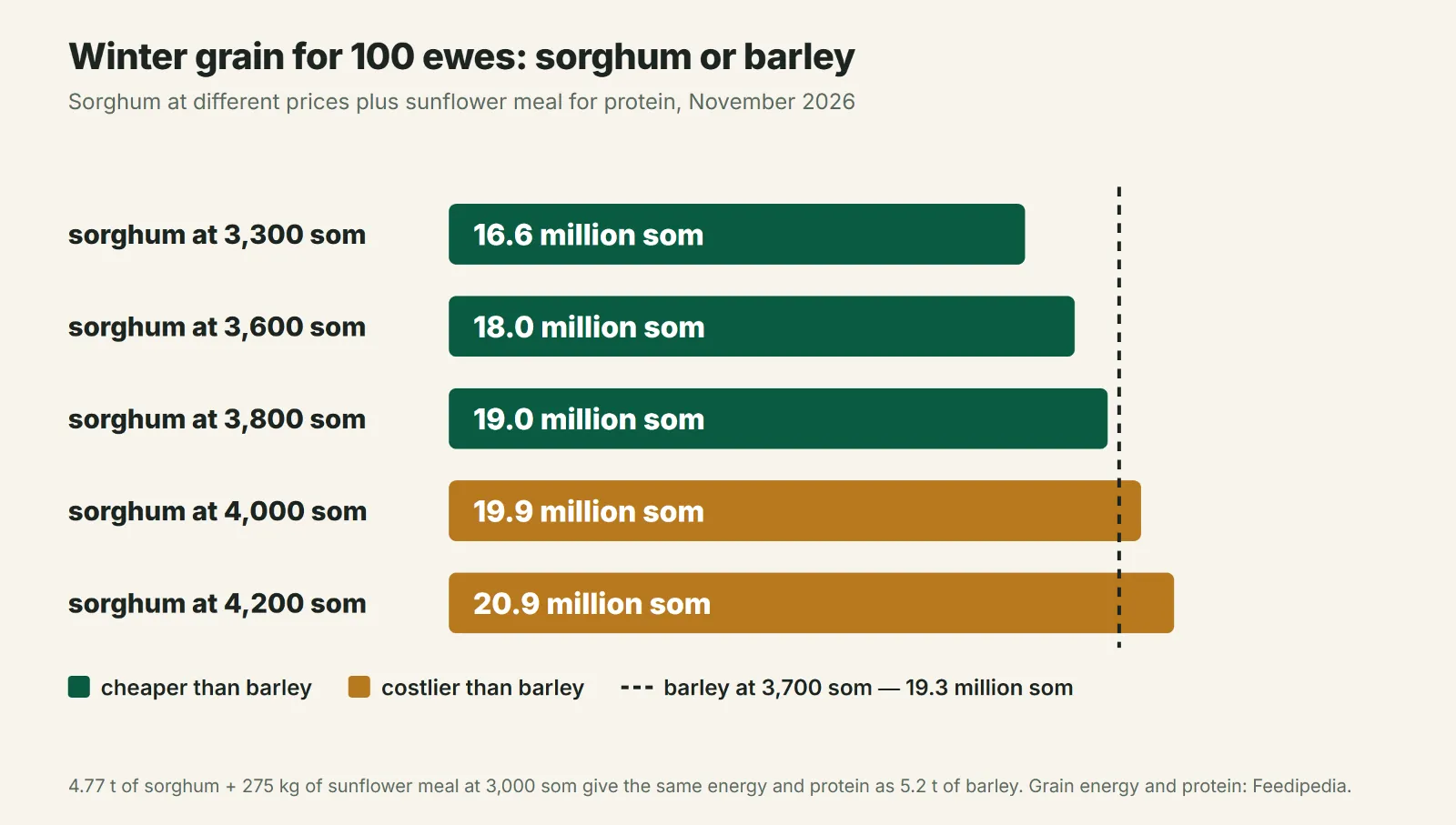
How we worked it out. Over the winter, a flock of 100 ewes lambing in February needs 5.2 tonnes of barley costing 19.3 million som (≈ $1,610), as calculated in the barley article. The same energy comes from 4.77 tonnes of sorghum. That sorghum has 85 kg less protein, which is made up with sunflower meal: 275 kg at 3,000 som per kg (31% protein), another 0.83 million som.
| Sorghum price, som/kg | Grain and meal for the winter, 100 ewes | Versus barley |
|---|---|---|
| 3,300 ($0.28) | 16.6 million som | −2.7 million som (≈ $226 saved) |
| 3,600 ($0.30) | 18.0 million som | −1.3 million som (≈ $107) |
| 3,800 ($0.32) | 19.0 million som | −0.3 million som (≈ $27) |
| 4,000 ($0.33) | 19.9 million som | +0.6 million som extra |
| 4,200 ($0.35) | 20.9 million som | +1.6 million som extra |
Why high-tannin grain is worth less. Some sorghum varieties, usually brown "bird-resistant" ones, are high in tannins, astringent compounds that bind part of the protein and starch. Grain color will not tell you: red sorghum often has almost no tannins. High-tannin grain shows a dark layer under the outer skin: scrape the skin off with a knife, and if there is a brown film underneath, the grain is high in tannins. It also tastes bitter and makes your mouth pucker. Tannins do less harm to ruminants than to poultry, because rumen microbes partly bind them. How much energy a sheep loses has not been measured precisely, so for high-tannin sorghum we play it safe and count its energy as equal to barley.
There is hardly any established market for sorghum grain in Uzbekistan. In November 2026 we found no olx.uz listings for sorghum grain with a clear price: neighbors and farmers in districts that grow it sell it straight off the field. So the price is yours to negotiate, and the break-even figure from the table is your ceiling when haggling. For comparison, check barley, meal and compound feed prices in sheep feed and grain listings in Uzbekistan.
Why is green sorghum dangerous for sheep?
Green sorghum builds up a cyanogenic glycoside called dhurrin. In the rumen it breaks down into prussic acid, which stops the body's cells from using oxygen. Ruminants are poisoned more easily than horses and pigs precisely because of the rumen: cud chewing and rumen microbes release the poison quickly. Ripe grain contains practically no prussic acid; the danger lies in the leaves and young shoots.
The poison is highest in young plants, in regrowth after cutting, in shoots after a frost, and in plants stunted by drought. In November the main risk is frost: the flock is turned out onto the field after the grain harvest, where fresh regrowth has come up.
| What is in the field | When sheep can go in |
|---|---|
| Young sorghum and Sudan grass | Sudan grass at 45–50 cm or taller; sorghum and sorghum-Sudan grass hybrids from 60 cm |
| Light frost, plant survived | Wait at least 2 weeks: new shoots are more toxic than old ones |
| Hard frost, plant killed | Wait at least 7–10 days, until the leaves have turned brown and dried out |
| Stalks after the grain harvest | Once the plant is completely dry, or a week after a frost |
| Sorghum hay | Only when fully cured: drying removes up to 75% of the poison, but not all of it |
| Sorghum silage | At least 3 weeks after ensiling |
The timings for green growth and frost follow guidance from North Dakota State University (NDSU) and Purdue University; other pasture poisons are covered in our article on poisoning in sheep on pasture. Never turn a hungry flock onto sorghum: hay or grain first, then the field. A well-fed sheep grazes more slowly and can neutralize part of the poison; a hungry one takes in a lethal dose fast.
Green sorghum carries a second poison: nitrates. Sorghum accumulates them when the field got heavy nitrogen fertilizer and was then hit by drought. Unlike prussic acid, nitrates do not break down as the crop dries: hay made from such a crop is just as dangerous as the fresh plant.
What should you do if a sheep is poisoned by sorghum?
Signs of prussic acid poisoning appear within 15–20 minutes, sometimes a few hours after eating: rapid, labored breathing, bright red gums and inner eyelids, trembling, staggering, convulsions. Once signs appear, a sheep rarely lives longer than 2 hours, and often it is simply found dead. Bright red membranes set prussic acid apart from nitrate poisoning, which turns them brown or bluish. But with prussic acid they can also turn blue shortly before death, so check the color early on. Source: the MSD Veterinary Manual.
- Move the whole flock off the field at once, calmly, without running them.
- Call a vet and say it plainly: "suspected prussic acid poisoning, sorghum". The antidote is sodium thiosulfate, sometimes combined with sodium nitrite, given intravenously. Sodium nitrite is dangerous in nitrate poisoning, so only the vet should decide what to give.
- Give clean water and hay, and keep the rest of the sheep penned until you find out what was in the field.
With severe poisoning there is almost no time, so prevention, following the table above, is what really counts. Losing one pregnant ewe in November 2026 costs about 3.4–4.2 million som (≈ $280–350), including her unborn lamb, as we calculated in our article on uterine prolapse.
Can sheep be fed sorghum stalks?
Yes, but they are roughage on a par with straw, not hay. Dry sorghum stalks left after the grain harvest are low in protein: according to Feedipedia, about 4% of dry matter on average (from 2 to 8%), and it is poorly digested. Stalks work for dry ewes and wethers in winter as part of the roughage, but pregnant ewes and young stock need alfalfa and concentrate on top.
Chop the stalks or put them whole in the feeder: sheep eat the leaves and thin tops and leave the thick butts. Expect a good share of the mass, those thick butts, to end up as bedding. Before feeding, check the stack for green regrowth and go back over the frost table.
How do you keep the savings from cheap sorghum?
Sorghum can save up to 2.7 million som per 100 ewes over the winter if it costs about 3,300 som. Losses can easily eat that up: damp grain goes moldy in sacks, mice and birds take their share, and feeding by eye easily leads to overfeeding. Dry sorghum grain to 12–13% moisture before storage and keep it on pallets.
If you use QoyHunter, the sheep-records CRM that comes with the bazar.qoyhunter.com marketplace, you can log each incoming batch and daily use in feed and stock tracking. That shows how many days your sorghum will last and which works out cheaper per head, sorghum or barley.
FAQ
Can sheep be fed sorghum instead of barley?
Yes. Ripe sorghum (jugara) grain can fully replace barley: 0.41 kg of sorghum gives the same energy as 0.45 kg of barley. Sorghum has 9% less protein, so ewes nursing twins and young stock stay on sunflower meal or cottonseed cake. Switch from barley to sorghum over a week.
How much sorghum can a fattening ram eat per day?
A fattening ram gets from 0.45 kg of sorghum grain a day at the start to 0.9 kg at the finish, always with at least 1 kg of alfalfa hay. Split the daily ration into two or three feedings and introduce the grain gradually: start with 100 g and add 50–100 g every 2–3 days.
Do you need to grind sorghum for sheep?
Adult sheep and weaned lambs do not need sorghum cracked: according to Feedipedia, lambs on whole sorghum grain grow as well as on cracked grain. If you see a lot of whole grains in the droppings, crack the sorghum coarsely. Fine grinding does harm: finely ground grain ferments faster in the rumen.
Why did sheep die on a sorghum field after a frost?
After a frost, prussic acid rises sharply in sorghum leaves and new shoots. Signs appear within 15–20 minutes: labored breathing, bright red gums, convulsions, and a sheep can die within hours. After a light frost keep sheep off the sorghum field for 2 weeks, after a hard frost for 7–10 days, until the leaves turn brown and dry out. Never turn a hungry flock onto sorghum.
At what price is sorghum a better buy than barley?
In November 2026, with barley at 3,700 som per kg, ordinary sorghum is the better buy as long as it costs less than about 3,870 som (≈ $0.32), and high-tannin sorghum less than 3,600 som (≈ $0.30). With sorghum at 3,300 som, a flock of 100 ewes saves about 2.7 million som (≈ $226) over the winter, including the sunflower meal that makes up the protein.
Manage your flock in QoyHunterCRM for sheep farmers: livestock, health, weighing, finance and analytics — in the app and a Telegram bot.All features →