How Much Water a Sheep Needs Per Day: Norms by Group, Winter Watering, and the Cost of Underwatering
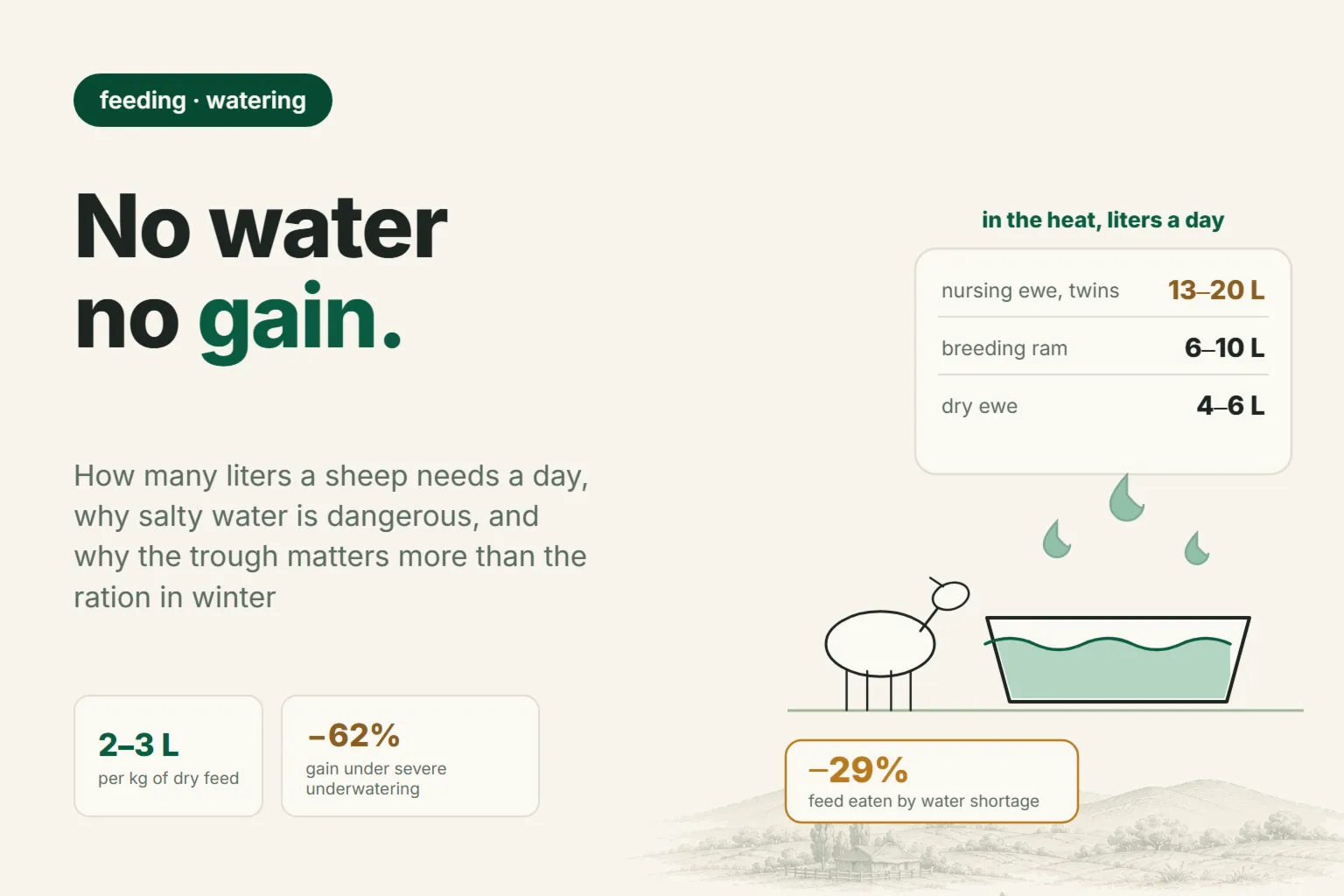
An adult sheep needs 3–6 liters of water a day, up to 8–10 in the heat, and a nursing ewe with twins needs up to 20. Norms by group, water salinity thresholds, winter watering in the sheep shed, and how many UZS a ram's finishing loses when water runs short.
An adult sheep needs 3–6 liters of water a day in cool weather and up to 8–10 liters in the heat; a nursing ewe with twins needs up to 20 liters. The simplest way to think about it is through feed: for every kilogram of dry feed (hay, straw, barley), a sheep drinks 2–3 liters of water, and twice that in the heat. Water is cheaper than any feed in Uzbekistan, but it's the thing that runs short most often: the ram stands at an empty trough, eats less hay, and doesn't put on the gain you already paid for.
Below: norms by animal group, water salinity thresholds for sheep, rules for winter watering in the sheep shed, and a calculation of how much UZS a ram's finishing loses when water falls short of the norm.
How Much Water a Sheep Needs Per Day
The requirement depends on three things: the animal's physiological state, air temperature, and how dry the feed is. A sheep on green spring pasture may barely touch the trough — grass is 70–80% water. The same sheep in a shed on hay and barley drinks several liters a day, and without that water the ration doesn't work.
| Animal group | Cool, +10…+15 °C | Heat, +30…+35 °C |
|---|---|---|
| Dry ewe | 2.5–4 L | 4–6 L |
| Pregnant ewe (last 6 weeks) | 4–5.5 L | 6–8 L |
| Nursing ewe with twins | 8–11 L | 13–20 L |
| Feeder lambs (27–50 kg) | 3.5–5 L | 6–8 L |
| Breeding ram | 4–6 L | 6–10 L |
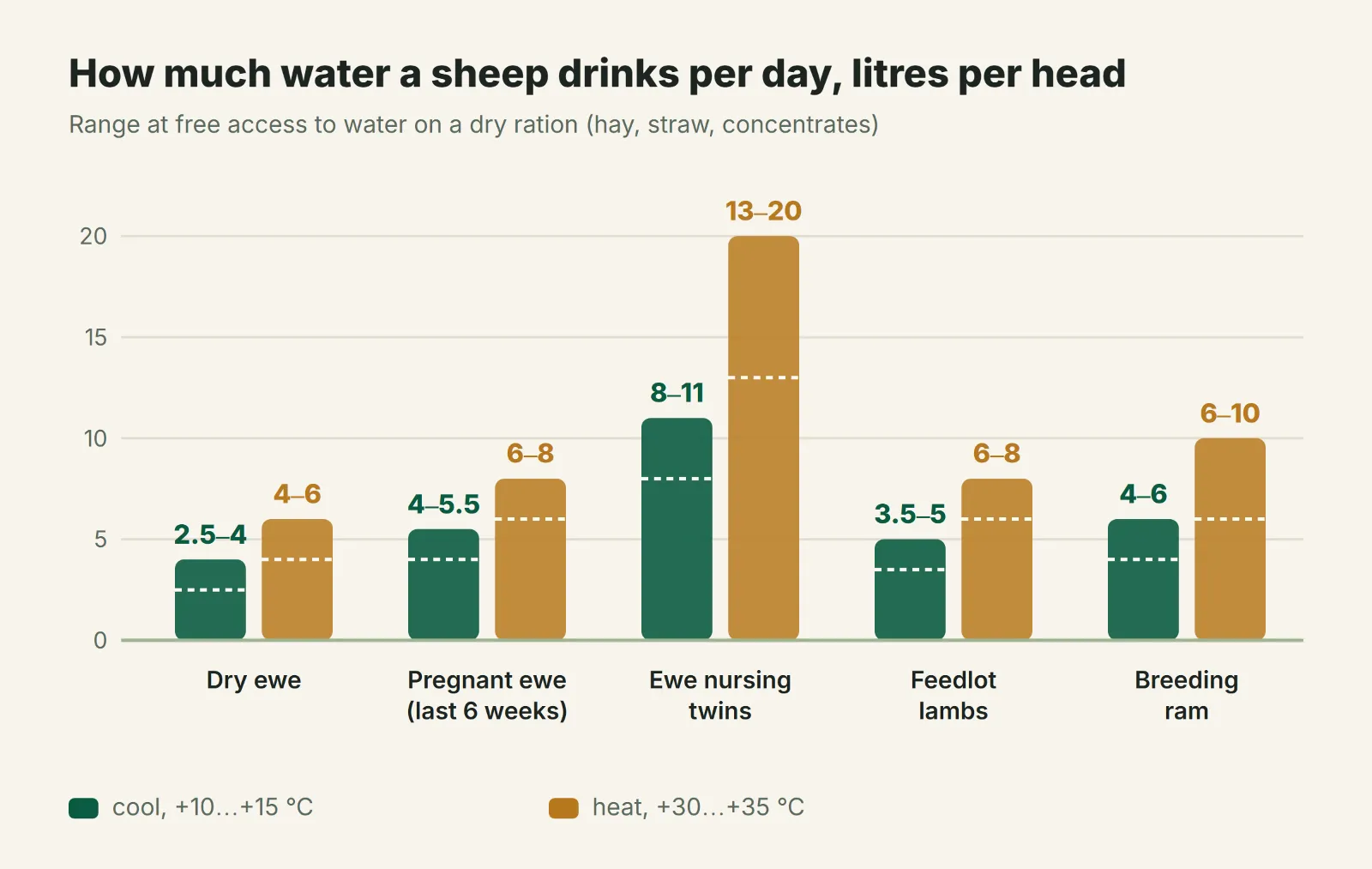
These ranges assume free access to water and a dry ration; they're drawn from North Dakota (NDSU) and Ontario agricultural extension data and from FAO tables. Nursing ewes need the most: sheep milk is about 80% water, and the ewe has to drink everything that ends up in that milk first. According to FAO, a nursing ewe drinks about 8.7 liters a day at +15 °C, 12.9 liters at +25 °C, and over 20 liters at +35 °C. That's roughly double between a cool morning and a July afternoon.
Why a Thirsty Sheep Eats Less Feed
This is the part you can't see just by looking. A sheep's rumen is a fermentation vat where microbes break down feed, and those microbes only work in a wet environment: rumen contents are almost entirely water, and the animal produces several liters of saliva a day. When water is short, the sheep cuts back on dry feed by itself — the body is rationing water, not feed.
From there the chain is simple: less feed means less gain. The hay you paid for in summer sits in the feeder, and the ram's weight doesn't move. From the outside it looks like "bad feed" or "a weak batch of lambs," and the owner starts changing the ration — when what actually needs to change is the trough.
Trials on sheep in arid climates show just how far intake can fall. With water withheld entirely, feed intake in Awassi and Najdi ewes dropped 62% in winter and almost to zero in summer (a 96.5% drop); body weight loss was 11% in winter and 18–21.5% in summer. That's an extreme case, but it explains an ordinary farm too: where water is simply short, the animal undereats the same way — just more slowly.
The second chain is a winter one, and more expensive. A pregnant ewe on dry hay, watered once a day with ice-cold water, underfeeds during the last 6 weeks before lambing — exactly the weeks when the lamb gains most of its birth weight. An underfed ewe delivers a small, weak lamb and produces little colostrum, and that turns straight into losses in the first days of life.
What Water Shortage Costs a Finishing Ram
These numbers aren't a guess — they come from a trial: Najdi ram lambs starting at about 38 kg were kept on the same ration for 42 days, with different levels of water access.
| Water access | Feed intake (dry matter) | Gain, g/day | Feed per kg of gain |
|---|---|---|---|
| Water free-choice | 1.28 kg/day | 210 | 6.1 kg |
| Water one-third below normal | 1.16 kg/day (−9%) | 170 | 6.8 kg |
| Water two-thirds below normal | 0.91 kg/day (−29%) | 80 | 11.4 kg |
Look at the right-hand column: under severe water restriction, it takes almost twice as much feed per kilogram of gain. You're feeding the same hay and the same barley, and getting half the result.
Let's put this in money on our own farm. Take a 40 kg ram on a 90-day finishing period, gaining 250 grams a day under normal feeding — a number we worked through in "How Much Does a Kilogram of Gain Cost". Live weight price is a conservative 55,000 UZS/kg (≈ $4.7; at the Central Bank of Uzbekistan's rate for September 7, 2026 — 11,785 UZS per dollar). We take the drop in gain from the trial above.
| Water access | Gain, g/day | Over 90 days | Loss vs. normal |
|---|---|---|---|
| Water free-choice, round the clock | 250 | 22.5 kg | — |
| Water one-third below normal | ~200 | 18.0 kg | −248,000 UZS (≈ $21) |
| Water two-thirds below normal | ~95 | 8.6 kg | −767,000 UZS (≈ $65) |
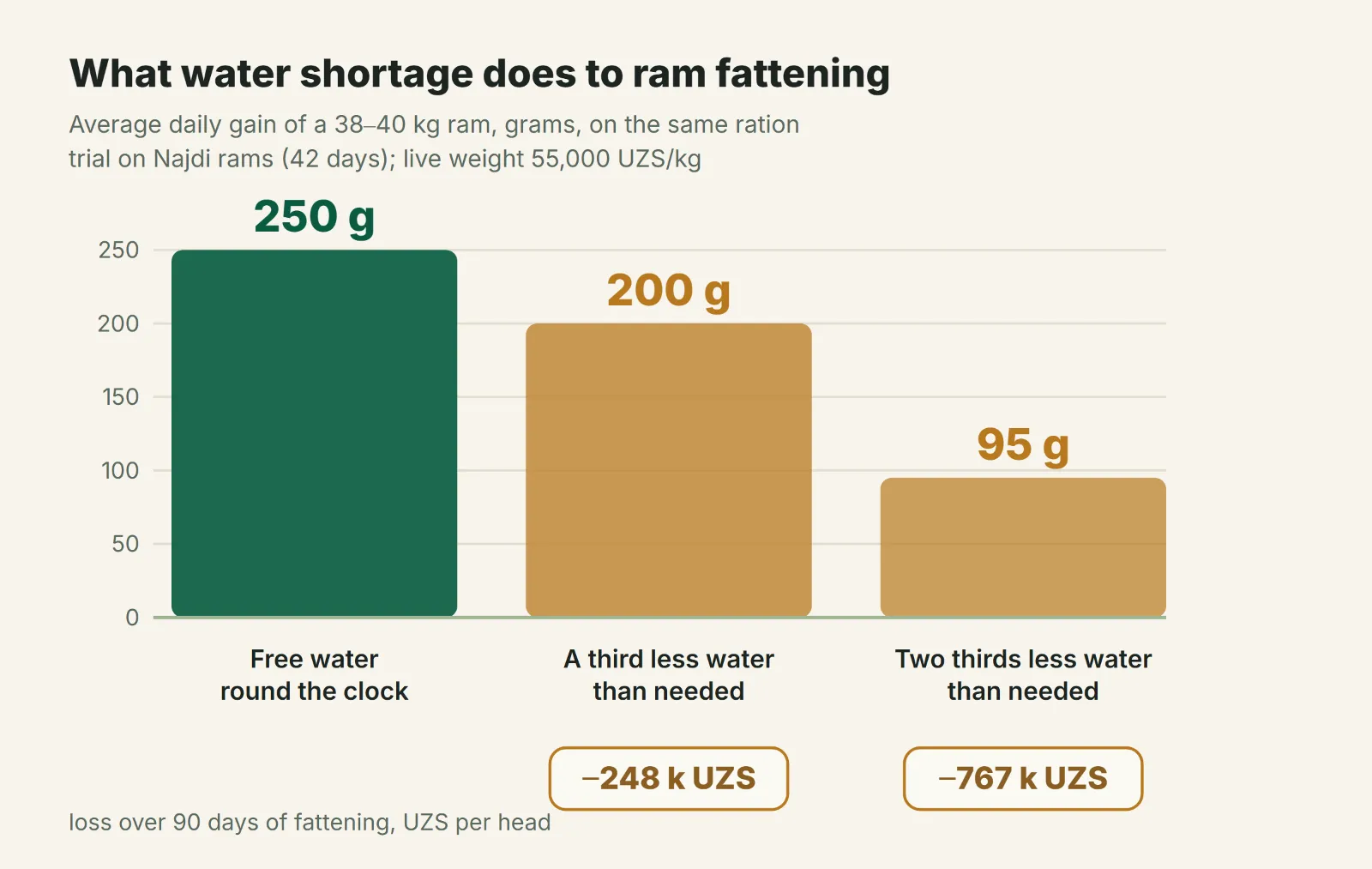
On one animal, the loss looks modest. Across a group of 50 finishing lambs, that's already 12–38 million UZS (≈ $1,050–3,250) for a single finishing season — and the feed was bought and fed in full either way. The only difference is whether there was water in the trough.
Which gives you a rule worth more than any supplement: water first, then the ration. Reworking the mix of grain, meal, and hay only makes sense once animals are drinking freely — otherwise you're paying for feed the sheep physically can't eat. Only after that is it worth checking where to buy compound feed, barley, and meal for sheep cheaper: the listing shows the price per kilogram from different sellers.
What Water You Should Not Give Sheep
Sheep tolerate brackish water better than cattle — but that tolerance has a limit, and you can't judge it by taste: the animals keep drinking, and then gains fall and diarrhea sets in. This isn't a rare story in Uzbekistan: according to data presented at a Tashkent water resources conference (2011), only 40.4% of the country's groundwater reserves are fresh (up to 1 g/L), 47.6% are slightly brackish (up to 3 g/L), and 12% of reserves have salinity above 3 g/L. The main freshwater reserves are in the Tashkent, Samarkand, Surkhandarya, Namangan, and Andijan regions; in the desert zone, well water is noticeably saltier.
Working reference points for total dissolved solids (TDS):
| TDS, mg/L | What it means for the flock |
|---|---|
| up to 1,000 | Good water, no restrictions |
| 1,000–3,000 | Suitable, including for lambs |
| 3,000–5,000 | Acceptable for adults; not recommended for lambs or nursing ewes |
| 5,000–7,000 | Only for dry, non-pregnant adults, and only as a forced measure |
| 7,000–10,000 | Serious risk for pregnant and nursing ewes and lambs; dry adults are at the limit |
| over 10,000 | Sheep refuse to drink, dehydration, risk of death |
A sheep's upper tolerance is higher than a cow's: the Australian standard cited by FAO allows up to 12.8 g/L for a dry, non-pregnant adult sheep, versus 10 g/L for beef cattle and 7.1 g/L for dairy cattle. But that's a survival limit, not a working standard: pregnant ewes, nursing ewes, and lambs shouldn't get water anywhere near that. A similar order of numbers — around 5,000 mg/L TDS for adult sheep and 3,000 mg/L for lambs — also shows up in local livestock reference guides as acceptable when good water isn't available.
Two things deserve separate attention:
- Sulfates. A level up to 500 mg/L is considered safe for sheep; when combined intake from water and feed exceeds 3,000–4,000 mg/L, the risk of polioencephalomalacia — a severe brain disorder — rises.
- Nitrates. Up to 100 mg/L (as nitrate nitrogen) is safe, 100–300 mg/L calls for caution, especially if the feed is also nitrate-rich, and above 300 mg/L means poisoning. Water from a shallow well next to a pen, a manure pit, or a fertilized field is more dangerous than any brackish borehole.
A water test at the district lab is a one-time job, and it costs nowhere near as much as one dead ram. And separately, about dirt: stagnant water turns green in the heat as blue-green algae grow in it — that's poisoning, not just "a dirty trough." Troughs need to be washed, not just topped up.
How to Water Sheep in Winter When the Trough Freezes
In winter, owners tend to relax: it's cold, the sheep drinks little, "it'll get water from the snow." This is exactly where winter gain gets lost.
- Ice-cold water cuts intake. Veterinary guidance for sheep farmers agrees that water should be ice-free and no colder than 8–10 °C; in summer, the opposite applies — no warmer than 20 °C. A sheep that has to warm what it drinks with its own body heat drinks less than it should.
- Water at least twice a day if water isn't available in the trough at all times. Watering once a day is already a restriction, not a proper routine.
- Snow doesn't replace water. To get one liter of water, an animal has to eat about ten liters of loose snow and spend body heat melting it; meltwater also has no minerals in it. For pregnant ewes, nursing ewes, and finishing lambs, this is a direct path to weight loss and colds.
- Check the trough morning and evening. Ice that formed overnight means the animals went without water for half a day — during exactly the hours they're eating dry hay.
- Keep water off the floor. Spilled water in the shed means wet bedding, and dampness in winter causes pneumonia in lambs and foot rot in adults.
How Many Waterers a Flock Needs
Sheep drink as a group, and the biggest mistake is one trough for everyone. Weak and young animals can't push through to the water while the older ones are drinking; from the outside it looks like "there's water."
- With constant access to water (automatic waterer, bowl), Midwest Plan Service guidelines call for one waterer per 40–50 ewes, per 50–75 lambs, but only 10 rams — adult rams drink a lot and take their time doing it.
- For trough watering where the whole group drinks at once, allow 20–25 cm of trough length per head: for a group of 40 sheep drinking together, that's 8–10 meters of trough front, or several troughs. In hot weather you need more front.
- There should be at least two water points per group: one waterer always breaks down on exactly the day nobody checks it.
- After shearing, after a drive, and in the first days after purchase, animals drink more than usual — a quarantine group should get its own water, with a margin.
Water, Salt, and Urolithiasis in Ram Lambs
In ram lambs on grain finishing rations, water shortage almost always ends the same way — stones in the urinary tract. Urine becomes concentrated, minerals precipitate out, the animal stops urinating, and it dies within a couple of days without treatment. At the first signs — the ram strains, can't urinate, groans, refuses feed — you're down to hours: call a vet immediately, you cannot clear the blockage yourself. We cover the mechanics and treatment in "Rumen Acidosis and Urolithiasis".
Prevention is cheap and rests on three things: water around the clock, free-choice salt block (salt makes animals drink more and dilutes the urine), and a calcium-to-phosphorus ratio in the ration of at least 2:1. Grain concentrates alone skew the ratio toward phosphorus, so alfalfa (lucerne) hay and limestone in a finishing ration aren't a luxury. Don't salt the water itself — sheep start drinking less, and you get the opposite effect.
If a ram is straining and has stopped urinating, that's an emergency — call a vet, you're down to hours. Check exact doses of salt, limestone, and any other ration additives with your vet too: rations, water, and breeds differ from farm to farm.
What to Check on Your Farm Today
- Walk up to the trough in the middle of the day: is there water, is it clean, and can every animal reach it?
- Count the water points per group — one waterer per 40–50 ewes, per 10 rams, and at least two points per group.
- In winter, check in the morning whether the water froze overnight, and set up a second watering.
- Check separately on the animals that need the most water: nursing ewes, finishing lambs, and rams after breeding.
- If your water comes from a well and you've never tested it, get it tested for TDS, sulfates, and nitrates.
- Check gain against the ration. If the feed was fed and there's no gain, water ranks above ration composition on the list of causes: weighing and daily-gain tracking software shows the shortfall within a week, not on sale day.
We covered the winter ration all of this builds on in "Feeding Sheep in Winter". QoyHunter is a CRM for tracking sheep, plus the bazar.qoyhunter.com marketplace: you log gains and feed from your phone, and farmers buy feed and veterinary supplies directly from each other.
FAQ
How Many Liters of Water Does a Sheep Need Per Day?
An adult sheep needs 3–6 liters a day in cool weather, and 8–10 liters in +30…+35 °C heat. A nursing ewe with twin lambs needs the most: 13–20 liters in the heat. A simple rule of thumb through feed: 2–3 liters of water per kilogram of dry feed, and double that in the heat.
How Long Can a Sheep Go Without Water?
There's no exact standard, and you can't plan on watering "every other day" in any season. In a trial on Dorper rams, four days without water on a straw ration cost the animals 16.3% of body weight. In Awassi and Najdi ewes, withholding water completely cut feed intake by 62% in winter and almost to zero in summer. Losses start on day one — first the sheep simply eats less.
Can You Give Sheep Snow Instead of Water in Winter?
No. To get one liter of water, an animal has to eat about ten liters of loose snow and spend its own body heat melting it, and meltwater has no minerals in it. Veterinary guidance for sheep farmers specifically advises against watering with snow: it leads to chilling and illness. In the sheep shed, on a dry hay ration, water needs to be sitting in the trough, at no less than 8–10 °C.
What Counts as Salty Water for Sheep?
Up to 1,000 mg/L total dissolved solids (TDS) is good water; up to 3,000 mg/L is fine for all groups, including lambs. Between 3,000 and 5,000 mg/L, give it to adults only, not to lambs or nursing ewes. Above 7,000 mg/L, sheep start refusing to drink and dehydration sets in. A dry adult ewe can tolerate even saltier water (the Australian standard allows up to 12.8 g/L), but that's a survival limit, not a working farm standard.
How Many Waterers Does a Flock of 100 Head Need?
With constant water access, that's one waterer per 40–50 ewes — so for a hundred ewes, 2–3 water points, and at least two in any case. The standard is stricter for rams: one waterer per 10 head. If you're watering the whole group from a shared trough at once, allow 20–25 cm of trough length for every head drinking at the same time.
Manage your flock in QoyHunterCRM for sheep farmers: livestock, health, weighing, finance and analytics — in the app and a Telegram bot.All features →