How Many Sheep One Hectare Can Graze: Pasture Carrying Capacity, Paddock Rotation, and the Cost of Overgrazing
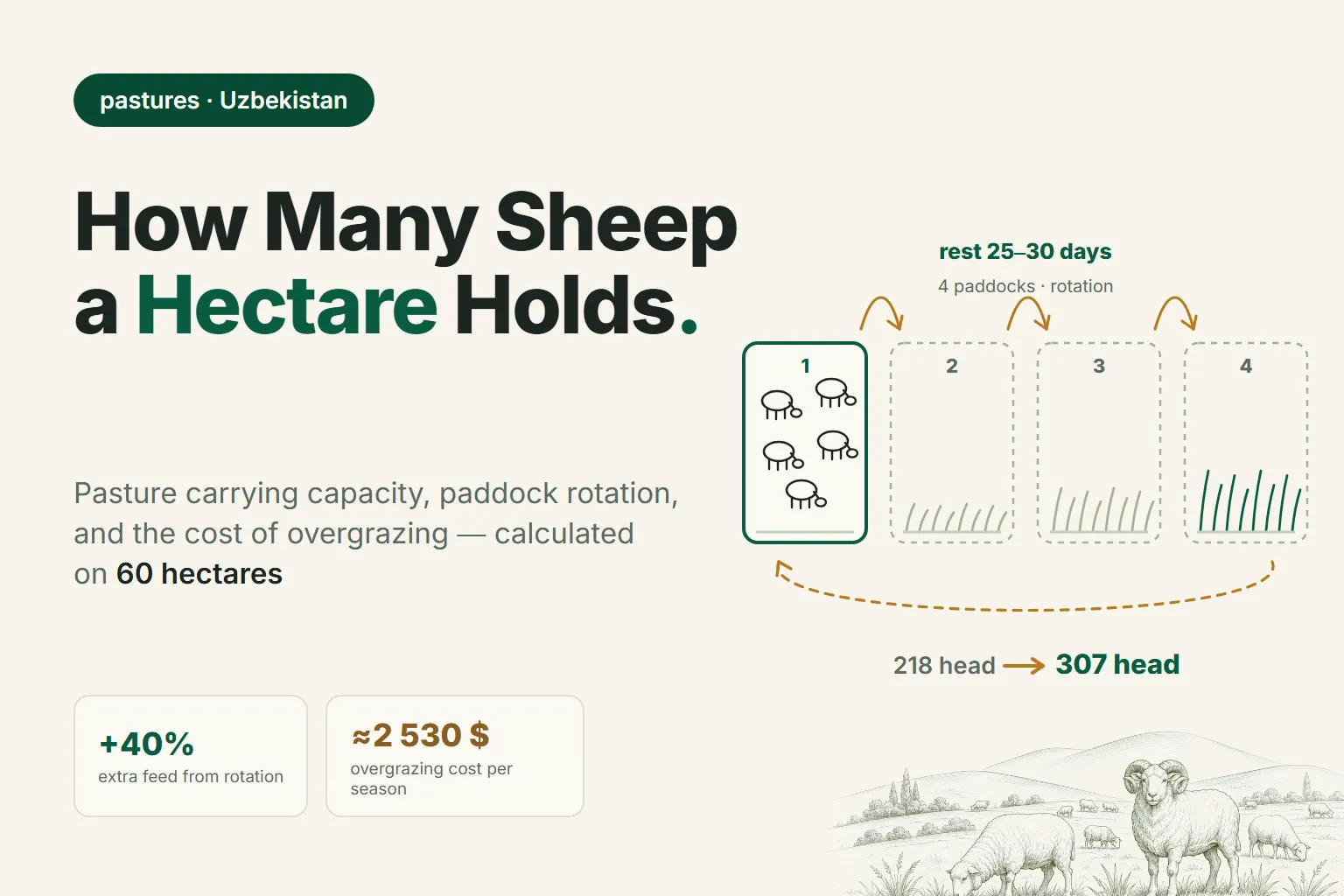
How to calculate how many head your plot can hold, what signs reveal an overgrazed pasture, and why paddock rotation gives up to 40% more feed for free. The formula, a table by pasture type in Uzbekistan, and the cost in som.
Pasture looks like free feed: you turn the flock out, and the grass grows itself. But a hectare has its limit, and once the flock crosses it, that free feed becomes the most expensive kind. The sheep come back half-empty, weight gain stalls, and the farmer goes off to buy hay — this time for cash.
Let's work through the numbers: how much feed a hectare actually gives in different zones of Uzbekistan, how to calculate your plot's carrying capacity in five minutes, what signs tell you a pasture is already overgrazed, and why splitting it into paddocks gives up to 40% more feed without spending a single som. The exchange rate used here is about 12 100 som per dollar.
Why This Is a Question of Money, Not Grass
Uzbekistan is rich in pasture area: more than 20 million ha, of which 16–17 million falls in the desert zone — almost half the country's territory. The problem isn't the hectares, it's how much livestock stands on them. The country has about 23 million head of sheep and goats — roughly twice what the pastures can feed without damage (the 2026 agricultural census, incidentally, came up 1.5 million head short in its reports). Under the industry development program, the herd is planned to reach 30 million — piling even more load onto the same land.
The result shows on the land itself. More than a quarter of the country's land is classified as degraded — the worst rate in Central Asia, with about 20 million ha at risk of desertification. Every year, overgrazing destroys more than 10 000 ha of valuable forage land, and 3 million ha have turned to moss instead of edible grasses.
What this looks like in the foothills was shown by a long-term study of pastures in the Akhangaran district. Biomass fell from 6.0 t/ha in 1969 to 4.8 t/ha in 1988 and 3.2 t/ha by 2018 — down 46% in half a century, with feed nutritional value dropping another 20% on top. Put simply, the same hectare now feeds half as many sheep as it fed your father's.
How Much Feed a Hectare Gives
What to calculate isn't “grass” but dry matter (DM) — what's left of the green mass after drying. A sheep eats about 3% of its live weight in dry matter per day: for an animal weighing 50–60 kg, that's 1.5–2.0 kg DM, or in green grass terms, the same 5–6 kg it gathers in a day of grazing. For our calculations we'll use 1.8 kg. A smaller karakul ewe in the desert needs only 1.3–1.5 kg.
Second rule: you can't eat the whole hectare's yield. Part of the sward gets trampled, part is inedible, and if you graze it right down to the root, the pasture won't recover by next year. The working utilization coefficient is 50% in the foothills and meadows, 45% in the desert. Leave half — that's not a loss, it's next year's harvest.
| Pasture type | Edible mass, kg DM/ha | Grazing season | ha per 1 sheep |
|---|---|---|---|
| Sandy and clay desert (Kyzylkum, Ustyurt) | 70–300 | year-round | 4–12 |
| Semi-desert, low adyrs | 300–600 | 6–8 months | 1.3–2.5 |
| Foothills, 300–450 mm rainfall | 1 000–2 100 | 5–6 months | 0.3–0.6 |
| Mountain meadows | 1 200–2 000 | 3–4 months | 0.2–0.35 |
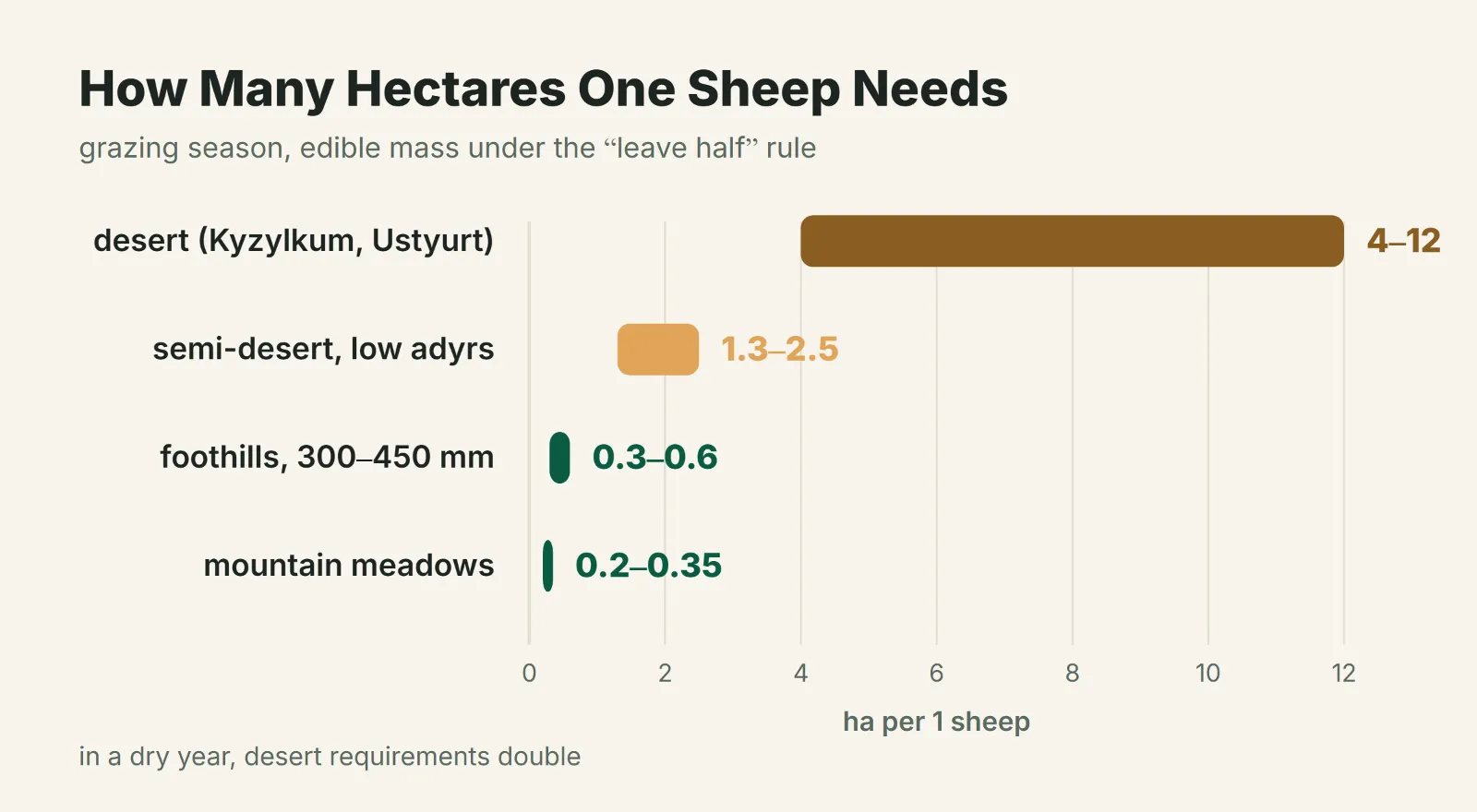
The spread within each row is weather. In the desert, with good spring rain, the sward gives up to 600 kg DM/ha, but in a dry year — only 70–150 kg/ha, four times less. That's why the desert zone is calculated on the lower bound of yield: budget 4–6 ha per head for a wet year, and a dry one will need 10–12, with the difference made up in feed.
Carrying Capacity Formula: Calculate Your Plot
Pasture carrying capacity — how many head it can feed for a season without supplemental feed:
Head = Area (ha) × Yield (kg DM/ha) × 0.5 ÷ (1.8 kg × Grazing days)
Let's take a typical farm: 60 ha of foothill pasture, a 160-day season, edible mass yield of 2 100 kg DM/ha — the average foothill figure under ordinary, unsystematic grazing.
- Feed available for grazing: 60 × 2 100 × 0.5 = 63 000 kg DM
- One sheep eats per season: 1.8 × 160 = 288 kg DM
- Capacity: 63 000 ÷ 288 ≈ 218 head
Now the honest question: how many head do you actually keep on those 60 ha? If it's 300 — the pasture is overloaded by a factor of 1.4, and 82 head are being fed at your expense.
Let's calculate the loss. Feed deficit: 82 × 288 = 23 616 kg DM. Converted to hay (which is about 85% dry matter) — nearly 28 tonnes. At the alfalfa hay price of 1 100 som/kg, that's 30.6 million som (≈ $2 530) per season, or 102 000 som (≈ $8.4) per head.
If you would rather not cut numbers, the deficit is covered with feed: to buy in extra hay and alfalfa for 28 tonnes is cheaper in summer than in January, once the overgrazed pasture has given up.
You'll pay one way or another: either in hay out of your pocket, or in weight — the flock simply won't gain and will go into winter thin. The second option is usually more expensive: an exhausted ewe comes into heat poorly, produces weak lambs, and loses them more often.
Five Signs Your Pasture Is Already Overgrazed
You don't need a tape measure to check yield — the plot signals it on its own:
- Grass shorter than your palm. On unsystematically grazed foothill pastures, sward height sits around 12.5 cm, versus 18 cm and up on well-managed ones.
- Ground shows through. Projective cover below 50% (bare soil between tufts) is a sure sign of overgrazing; the norm for a healthy plot is 60–65%.
- The grass mix changes. Valuable grasses and wormwood drop out, replaced by inedible and poisonous plants — adraspan (harmala), spurge, tough thorny weeds. On 3 million ha of the country, the sward has turned to moss entirely.
- A trampled circle around water. Around a well or watering point, land is trodden to dust for 2–5 km — livestock graze close to water and finish off exactly that zone.
- Sheep head straight for the feeder from pasture. The simplest test: if the flock comes back and rushes the hay — it came home hungry.
Paddocks and Rest: +40% Feed at No Cost
The main finding of a recent study on Uzbekistan's foothill pastures: it's not only about head count, but also about the grazing schedule. The same plot yields differently under unsystematic grazing versus paddock rotation.
| Indicator | Unsystematic grazing | Paddock rotation |
|---|---|---|
| Total biomass, t/ha | 3.20 | 3.85 (+20%) |
| Edible biomass, t/ha | 2.10 | 2.95 (+40%) |
| Ground cover | 45–50% | 60–65% |
| Sward height, cm | 12.5 | 18.2 |
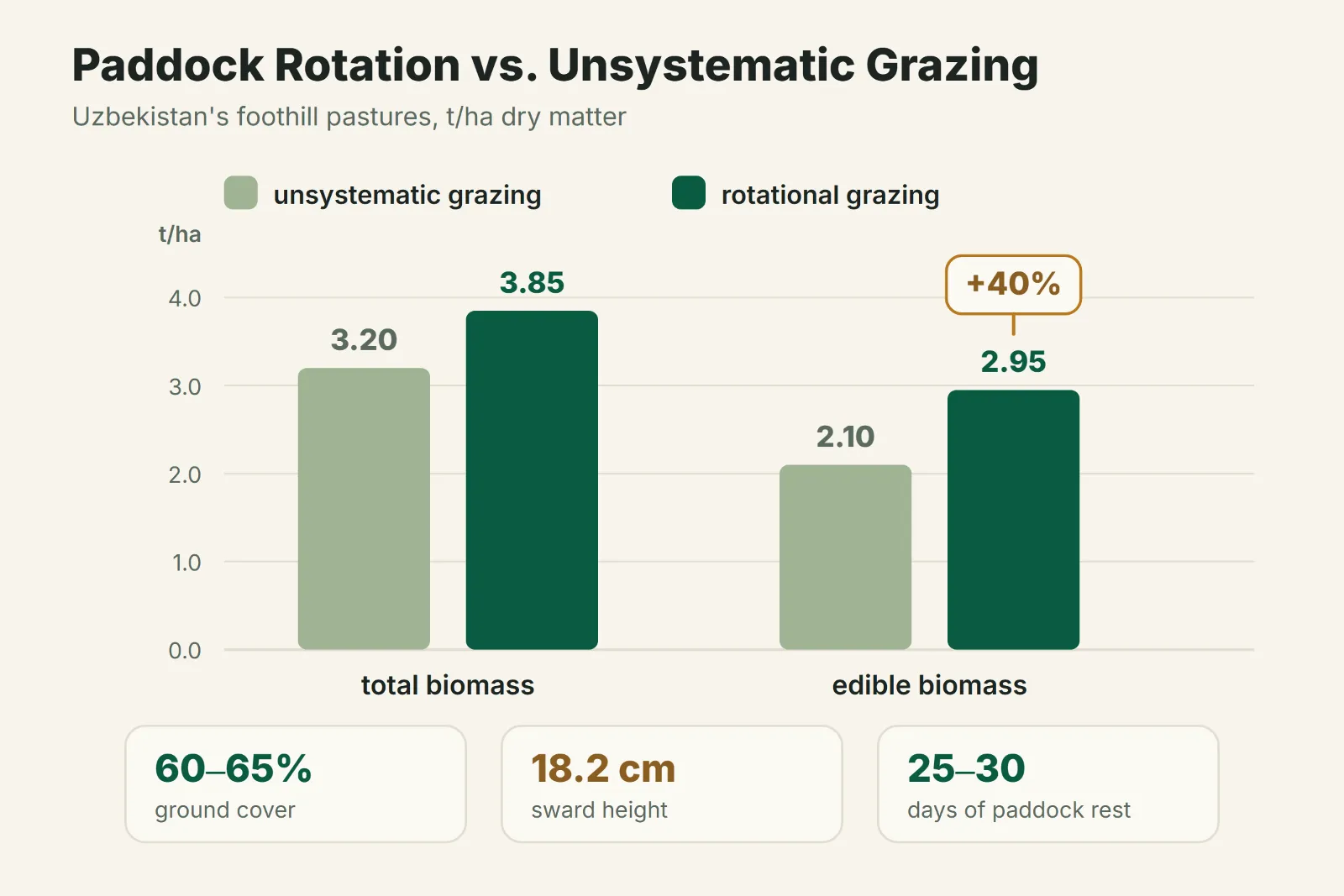
The key to these numbers is 25–30 days of rest between grazings. In that time, the plant manages to regrow its leaf and restore its root; if the flock returns earlier, it gets eaten “on credit” and gradually drops out of the sward.
How to set this up in practice:
- Split the plot into 4–5 paddocks. For our 60 ha, that's 12–15 ha per paddock.
- Graze each for 6–8 days, then move the flock to the next. A full cycle through 4–5 paddocks gives exactly the needed 25–30 days of rest.
- Don't graze to the root. Once half the sward height is eaten — move on; the rest feeds the root and holds the soil.
- Move the water point. A mobile trough or several watering points spread out the trampled zone instead of creating one dead circle.
- Skip a weak paddock. One season of rest restores a plot better than any reseeding.
Let's return to our example. Under rotation, the same 60 ha gives 60 × 2 950 × 0.5 = 88 500 kg DM, meaning capacity rises to 307 head. A flock of 300 head now fits without supplemental feed — and that same 30.6 million som (≈ $2 530) stays in your pocket. The investment is a mesh fence, time, and discipline.
What Changed in the Rules
Pastures have stopped being “no one's grass.” A decree dated January 30, 2025 introduced pasture rotation calendars and maximum permitted livestock loading norms, and plot use is now monitored via GPS and satellite imagery with digital cadastral maps — more than 8.18 million ha already digitized. Long-term leases go to farms that graze by plan, not by habit.
A resolution dated May 12, 2026 put more money into the feed base: acreage under forage crops is being increased 1.5-fold, and starting with the 2027 harvest, farms will be allowed to allocate up to 50% of their contracted cotton and grain acreage to forage crops. Banks are offering loans of up to 5 billion som at 10% annual interest for up to 10 years with a four-year grace period to build livestock complexes and buy breeding stock, and imports of breeding animals are exempt from VAT until 2029.
For a farmer, the point is simple: having your own forage plot has stopped being a luxury. Pasture covers the grazing season, while alfalfa from your own field covers wintering and the peak months. We calculated how much hay to stock up in the article “How Much Hay a Sheep Needs for Winter”.
Being next to cotton fields has a flip side too: in fall the fields get treated with defoliant, and grazing on them is banned for fifteen days. We covered what poisons sheep near treated fields and what to do in the first hour in "Sheep Poisoning on Pasture".
In Short
- A foothill hectare feeds 2–3 sheep per season; in the semi-desert, one head needs 1.3–2.5 ha; in the desert — 4–12 ha.
- Carrying capacity is calculated with the formula: area × yield × 0.5 ÷ (1.8 kg × grazing days).
- A 1.4x overload on 60 ha costs about 30 million som (≈ $2 530) per season — in hay or in lost weight gain.
- Rotating through 4–5 paddocks with 25–30 days of rest gives +40% edible feed for free.
- An overgrazed pasture shows in grass under 12 cm, bare soil, thorns instead of wormwood, and a trampled circle around water.
- Loading norms and rotation calendars are now backed by law, and plots are monitored by satellite.
The first step toward the calculation is knowing the exact head count by group: ewes, young stock, rams. If the flock is counted “by eye,” any carrying capacity formula turns into guesswork. In mobile flock headcount tracking, head count is tracked by group from your phone, so plugging the current figure into the calculation takes one minute.
Manage your flock in QoyHunterCRM for sheep farmers: livestock, health, weighing, finance and analytics — in the app and a Telegram bot.All features →