State Support for Sheep Farmers in 2026: Subsidies, 10% Loans, and VAT Breaks
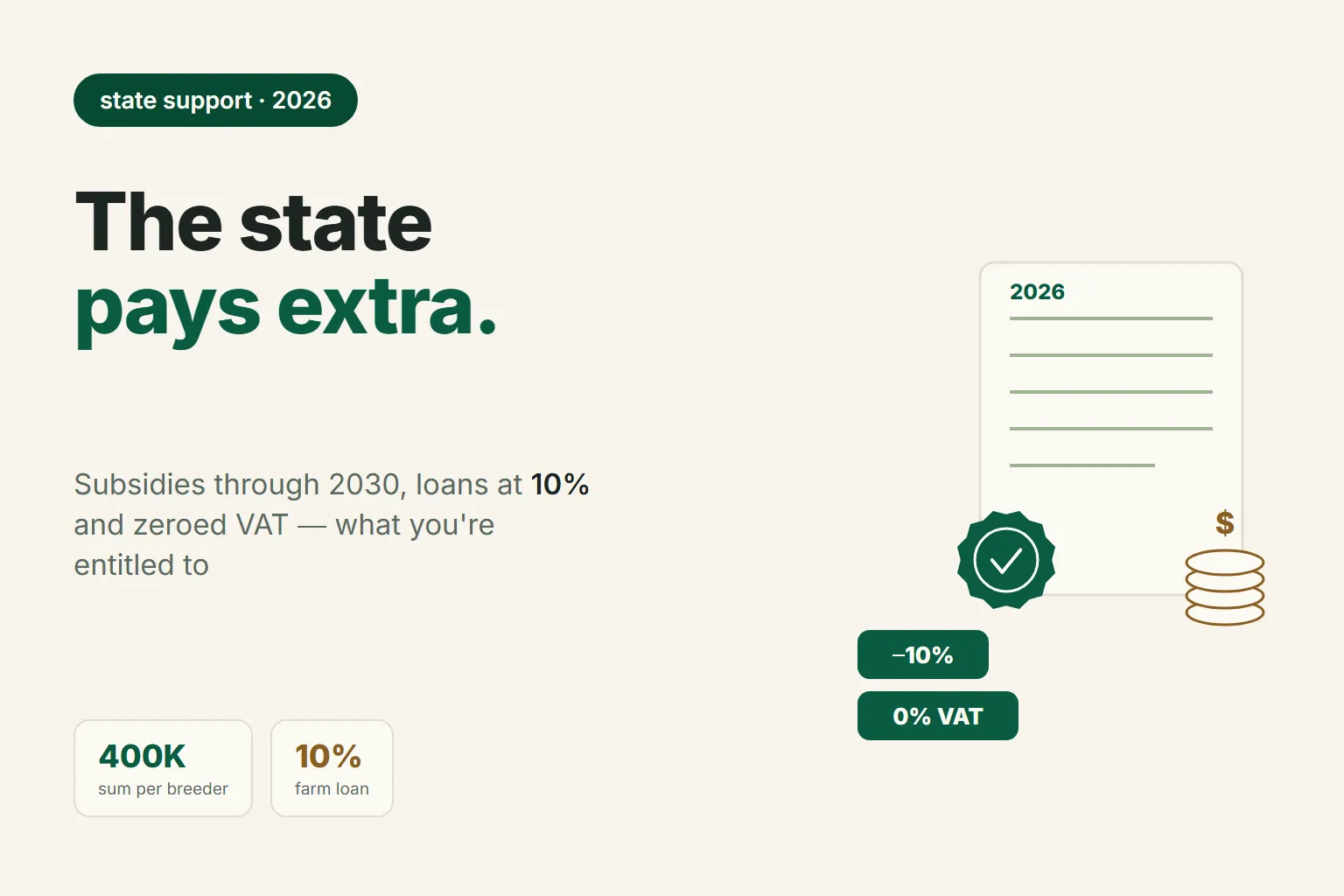
In 2026, the state significantly expanded support for livestock farming: subsidies for breeding sheep were extended through 2030, imports of breeding livestock were exempted from VAT, and farm loans are now issued at 10% a year with grace periods of up to 4 years. We've gathered all the measures, amounts, and deadlines in one place — and explain how sheep farmers can get them.
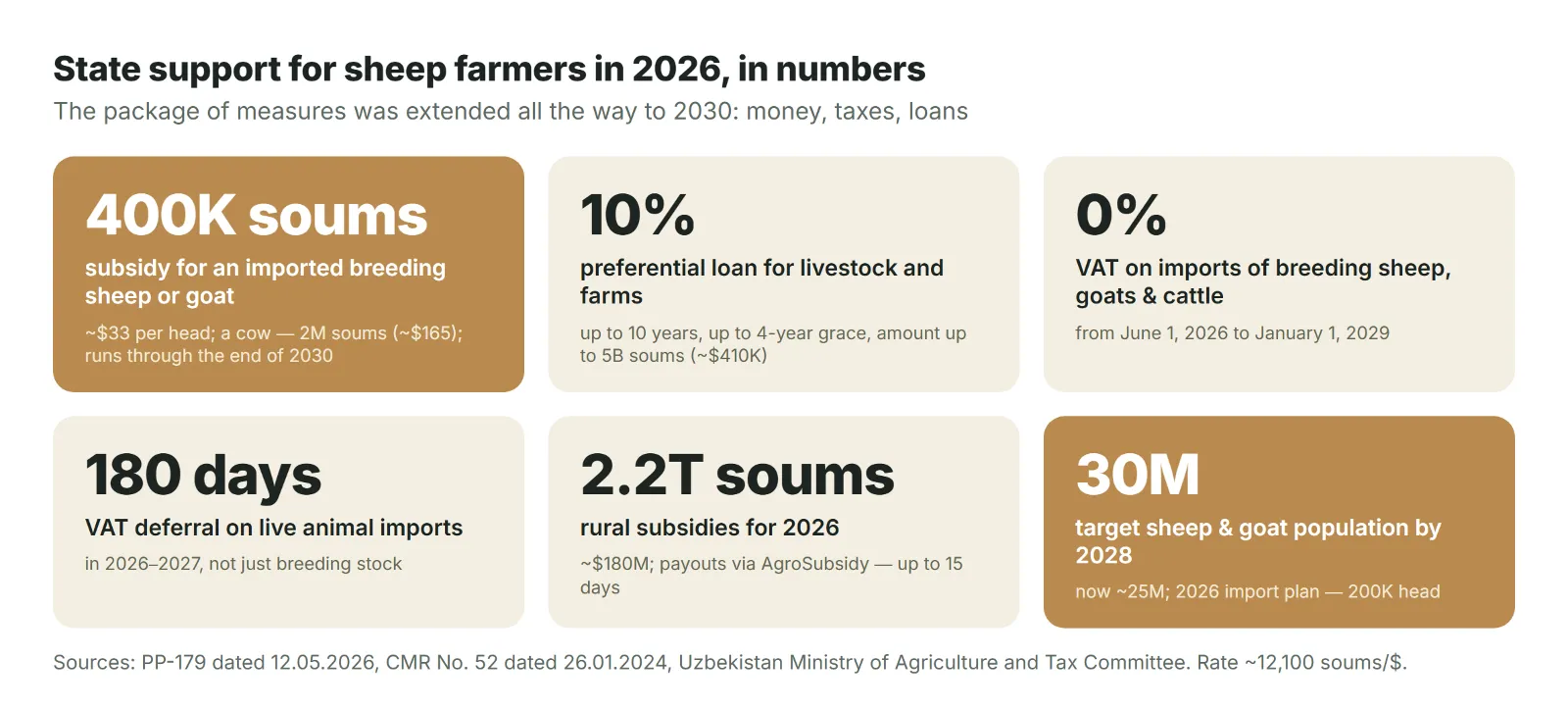
Meat prices are climbing — mutton rose 23.1% year-on-year in June 2026 — and the state is answering with money: 2.2 trillion soums (≈$180 million) in agricultural subsidies are planned for 2026, and the president's May decree (PP-179, dated 12.05.2026) added a whole new package of livestock benefits running through 2030. The stated goal is ambitious: raising the sheep and goat population from today's ≈25 million to 30 million by 2028.
The trouble is that most small farms simply don't know about most of these measures — or assume they're "for big farms only." That's not true: subsidies for breeding sheep, preferential loans, and VAT refunds are all open to dehkan (smallholder) farms too. We've gathered every active measure into one rundown: how much it pays, how long it runs, and where to apply.
Subsidies: What the State Pays in Cash
400,000 soums (≈$33) per head for an imported breeding sheep or goat, 2 million soums (≈$165) per head for a cow. This subsidy comes from Cabinet of Ministers Resolution No. 52 dated 26.01.2024: import breeding livestock from abroad, file an application, get paid. The May 2026 decree extended these subsidies through December 31, 2030, so you can plan a purchase with confidence.
Everything is processed electronically through the AgroSubsidy information system (agrosubsidiya.uz). The application requires four documents: a livestock origin certificate, a purchase contract, a payment order, and a customs declaration. Review used to take up to a month — under the new 2026 rules, payment is promised within 15 days.
For farms that keep more than sheep: starting July 1, 2026, subsidies also apply to breeding calves — 500,000 soums (≈$41) for a calf from artificial insemination and 700,000 soums (≈$58) for a calf from a transplanted embryo. The condition is that the cow must be identified (tagged and recorded in the tracking system). The measure runs through early 2030.
A separate track exists for those importing sheep from Mongolia: the state covers 50% of air transport costs through the end of 2027, and those importing 1,000+ head are allocated seasonal pastures. We covered this program in detail in our article on Mongolian sheep; the plan calls for 200,000 sheep and goats to arrive in the country in 2026.
VAT: Pay Nothing, Defer It, or Get Half Back
There are several tax measures at once, and they're all different — it's important not to mix them up.
Zero rate on your own products. In spring 2026, the Ministry of Agriculture and the Tax Committee approved a list of 518 items of agricultural products — live animals, meat, milk, and more — sold by producers themselves that are taxed at a 0% VAT rate. A ram sold from your own farm no longer adds a 12% tax to the price, and producers are entitled to reclaim the VAT they paid on inputs.
Import exemption. From June 1, 2026 through January 1, 2029, imports of breeding sheep, goats, and cattle are fully exempt from VAT. For a buyer, that's a 12% discount on the price of an imported breeding ram — significant if you're buying a batch.
The discount is calculated off the real price: check what a sire is going for right now — listings where you can buy pedigree sheep give a better benchmark than an average figure in a report.
Deferral. In 2026-2027, VAT on any imported live animals — not just breeding stock — can be deferred for up to 180 days. That eases cash flow: you pay the tax after the livestock has started generating income.
50% refund. Even before the zero rate, starting April 1, 2025, livestock farms where at least 90% of revenue comes from core products (meat, milk) gained the right to reclaim 50% of VAT paid — this mechanism runs through January 1, 2028, and stays relevant for products not covered by the "zero" list.
Loans: 10% a Year When the Market Rate Tops 20%
The Central Bank's key rate holds at 14%, while an ordinary commercial loan in soums costs a business more than 20% a year — at that price of money, paying off a sheep farm is nearly impossible. The preferential lending line launched on June 1, 2026 looks fundamentally different:
- rate — 10% a year;
- term — up to 10 years, including up to 4 years of a grace period (you only start paying once the farm is on its feet);
- amount — up to 5 billion soums (≈$410,000) for buying livestock and building farms; for breeding enterprises and laboratories, up to 20 billion soums.
Funding for the program is already in place: the Reconstruction and Development Fund is providing $50 million, and the State Support Fund for Agriculture is adding another 1 trillion soums (≈$83 million) annually. Loans are issued by commercial banks — you apply at a branch with a business plan and collateral.
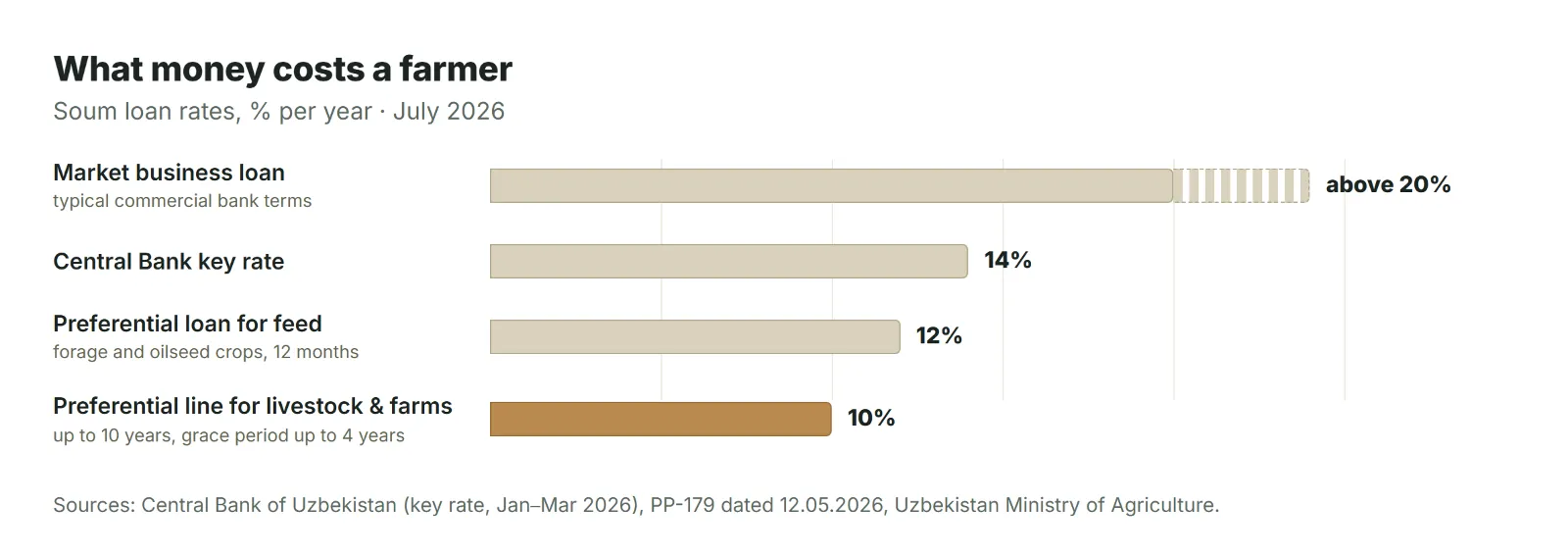
There are "smaller" lines too: loans for growing forage and oilseed crops go at 12% a year for 12 months — an option for those planting alfalfa and barley for their own feed. And for importing Mongolian sheep, there's a separate line at 10% for 5 years with two grace years.
If you're still working out whether your farm can carry a loan, start with our breakdown of sheep farming economics from scratch — it covers all the math on investment and payback.
Land and Feed: What Changes in 2026-2027
Two decisions directly affect the feed base.
Up to 20 sotka for a farm. Farmers growing grain and cotton gained the right to set aside up to 20 sotka (0.01-hectare plots) of their land for lightweight livestock structures — sheds, pens, feedlots. The condition: keep at least 3 conventional livestock units (head) per sotka, meaning a 20-sotka plot has to actually work, not sit empty.
Up to half of fields — for feed. Starting with the 2027 harvest, in districts specializing in livestock farming — one will be chosen in Karakalpakstan and in each region — farmers will be allowed to plant feed crops on up to 50% of the land allocated to cotton and grain. If your district makes the list, cheap alfalfa and corn will show up right next to the sheep pen — feed will be closer and cheaper to haul.
The picture is more complicated with pastures: of the 17 million hectares, nearly half are degraded, a reform is underway under Presidential Decree UP-15, and the state is negotiating with the Asian Development Bank for $63 million to restore pastures. Don't expect quick miracles here, but the direction has been set.
How to Apply: Three Steps
Step 1 — identify your livestock. Almost all subsidies are tied to identified herds: animals must be tagged and entered into the state tracking system. Without tags, there's no conversation about money to be had — this is the first thing worth sorting out.
Start with this step rather than the application: electronic ear tags and headcount records satisfy the identification requirement and at the same time give the bank a confirmed headcount.
Step 2 — apply for the subsidy. Register on agrosubsidiya.uz (you'll need an electronic signature), pick the service, and attach the documents. For the import subsidy, that's an origin certificate, purchase contract, payment order, and declaration. Under the new rules, review and payout take up to 15 days.
Step 3 — get a loan through a bank. With a business plan and collateral, go to a commercial bank that works with agricultural programs; the district agriculture department can tell you the list of tracks and terms. It's also worth stopping by there just to scout: some regional programs (electricity subsidies for pumps, local grants) exist only at the regional level.
And a practical tip: banks and AgroSubsidy love numbers. A farm that keeps records — how many ewes, what lambing rates, what weight gains — has a much easier time putting together a business plan and confirming its herd size. Farm business-plan record software makes that kind of record-keeping easy: it's free, works on your phone, and your lambing and flock records are always on hand — including when the bank asks for them.
Cheat Sheet: All the Measures in One Table
| Measure | Amount | Runs Through | Where to Apply |
|---|---|---|---|
| Subsidy for imported breeding sheep/goat | 400,000 soums (≈$33) per head | through 12/31/2030 | agrosubsidiya.uz |
| Subsidy for imported breeding cow | 2 million soums (≈$165) per head | through 12/31/2030 | agrosubsidiya.uz |
| Subsidy for breeding calf (AI/embryo) | 500,000/700,000 soums (≈$41/$58) | 07/01/2026–01/01/2030 | agrosubsidiya.uz |
| VAT on sale of own products (518 items) | 0% rate | since spring 2026 | tax office |
| VAT on import of breeding sheep, goats, cattle | 0% | 06/01/2026–01/01/2029 | automatic at customs |
| VAT deferral on live animal imports | up to 180 days | 2026–2027 | customs/tax office |
| VAT refund for farms (revenue ≥90% core products) | 50% of VAT paid | 04/01/2025–01/01/2028 | tax office |
| Loan for livestock and farms | up to 5 billion soums, 10%, up to 10 years, up to 4-year grace period | from 06/01/2026 | commercial banks |
| Loan for feed and oilseed crops | 12%, 12 months | since late 2025 | commercial banks |
| Compensation for air freight of sheep from Mongolia | 50% of transport cost | through 12/31/2027 | via the import program |
| Land for a farm for grain/cotton growers | up to 20 sotka (from 3 conventional livestock units (head) per sotka) | since 2026 | hokimiyat, district agriculture department |
The key thing to understand about 2026: the state is paying specifically for growing and improving the quality of the herd — for breeding stock, for farms, for feed. Against a backdrop of rising mutton prices, this is a rare window when farm growth is subsidized from three directions at once: cash, tax breaks, and cheap credit. Programs get updated, so check current terms at your bank and on agrosubsidiya.uz before you apply.
Manage your flock in QoyHunterCRM for sheep farmers: livestock, health, weighing, finance and analytics — in the app and a Telegram bot.All features →