
What to feed a ewe after lambing
A ewe with twins needs 1.8 kg hay, 0.8 kg barley and 0.2 kg cake a day, about 7,000 sum. Requirements, signs of low milk and payback.
What to feed a ewe after lambing: for the first 8 weeks, a nursing ewe needs 2–3 times more energy than a dry one, and almost all of it goes into milk. A 60 kg ewe with one lamb gets by on 2 kg of alfalfa hay and 0.4 kg of barley a day; a ewe with twins needs 1.8 kg of hay, 0.8 kg of barley and 0.2 kg of cottonseed cake. On hay alone, twins fall short on milk, and the lambs do not make up those kilograms by weaning.
Below are the requirements by group, a ration at November 2026 prices, a payback calculation and the signs that a ewe is short of milk.
Why a ewe needs more feed after lambing than during pregnancy
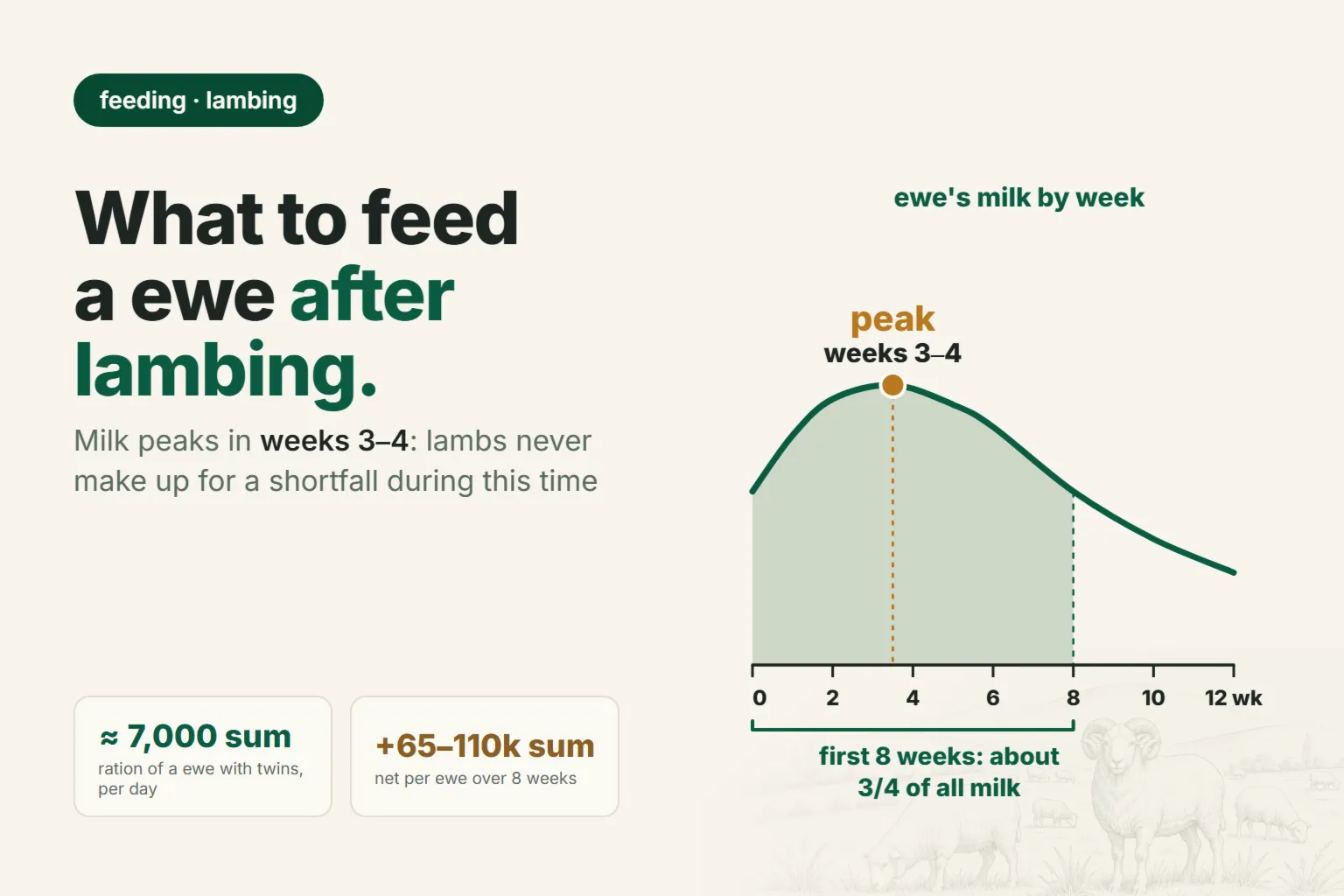
A nursing ewe is a ewe suckling her lambs, usually for the first 3–4 months after lambing. Milk yield rises right after lambing and peaks in weeks 3–4, then by week 12 drops to a third to a half of the peak. In the first 8 weeks the ewe produces about three quarters of her total milk for the lactation. These are the weeks that decide how much a lamb will weigh at weaning.
A lamb needs 5–6 kg of ewe's milk for each kilogram of gain. If the ewe is short of milk in the first month, the lamb grows more slowly, and it never catches up: by the time there is enough milk again, its needs have already grown.
A ewe's appetite after lambing grows more slowly than her milk. For the first weeks she makes up the shortfall from her own body fat and loses weight. That is normal within reason: over the first 8 weeks a ewe can lose up to half a condition score point; losing a whole point is already a sign of underfeeding.
How much energy and protein a nursing ewe needs per day
The guidelines for a 60 kg ewe in the first 6–8 weeks after lambing are based on NRC requirements (US National Research Council, 1985) and rounded:
| Group | Metabolizable energy, MJ per day | Crude protein, g per day | Dry matter, kg per day |
|---|---|---|---|
| Dry ewe, maintenance | ≈ 9 | ≈ 105 | 1.1 |
| Nursing, one lamb | ≈ 23 | ≈ 320 | 2.1–2.3 |
| Nursing, twins | ≈ 26 | ≈ 400 | 2.4–2.6 |
Metabolizable energy is the part of the feed's energy that the sheep actually uses for living, growing and making milk. A kilogram of barley has about 10.8 MJ, a kilogram of good alfalfa hay about 8 MJ.
The main thing in the table is the gap between a single and twins. A ewe with twins needs about 15% more energy and a quarter more protein. Feeding all nursing ewes the same ration means either underfeeding ewes with twins or overspending on ewes with singles.
A ration for a ewe with a single falls a little short of the energy requirement, and in the first weeks she makes up the rest from her fat. If a ewe loses more than half a point, raise the barley to 0.5–0.6 kg.
A nursing ewe's ration: how much hay, barley and cake per day
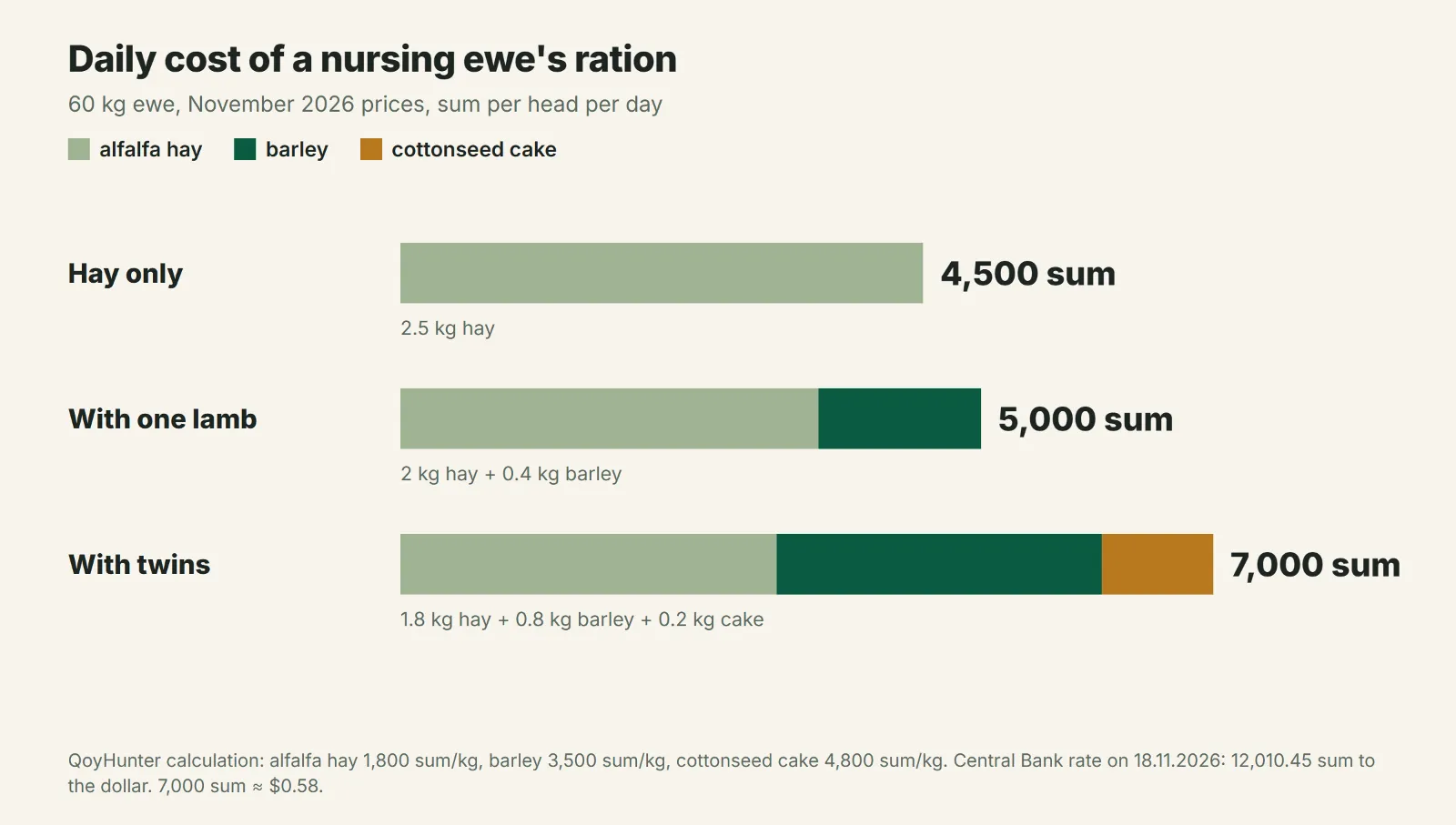
A ration from local Uzbek feeds at November 2026 prices: alfalfa hay 1,800 sum/kg (winter price), barley 3,500 sum/kg, cottonseed cake 4,800 sum/kg (from olx.uz listings). The Central Bank of Uzbekistan rate on 18 November 2026 is 12,010.45 sum per dollar.
| Ration for a 60 kg ewe, per day | Alfalfa hay | Barley | Cottonseed cake | Cost per day |
|---|---|---|---|---|
| Hay only (common practice) | 2.5 kg | — | — | 4,500 sum (≈ $0.37) |
| With one lamb | 2 kg | 0.4 kg | — | 5,000 sum (≈ $0.42) |
| With twins | 1.8 kg | 0.8 kg | 0.2 kg | 7,000 sum (≈ $0.58) |
How to read the ration:
- Hay is the base. Alfalfa hay gives both protein and the calcium needed for milk. If it is grass hay or coarse hay, it has less protein, and up to 0.2 kg of cottonseed cake is needed even for a ewe with one lamb.
- Barley is energy. Split the grain into two feedings, morning and evening, no more than 0.5 kg at a time. A nursing ewe usually needs no more than 1 kg of barley a day; if she needs more (triplets), split it into three feedings and check with a livestock specialist.
- Cottonseed cake is protein. An adult ewe gets up to 0.3 kg a day; lambs under 4 months get no cottonseed feed because of gossypol. So put the cake where the lambs cannot reach it. Whole cottonseed is not fed to nursing ewes: in trials on such feed the lambs drank less milk and grew more slowly.
- Bran can replace part of the barley, up to 0.4 kg a day: it has more protein and less energy.
How to move a ewe onto grain after lambing without causing acidosis
If the ewe was getting 0.3–0.4 kg of barley before lambing, do not change the amount in the first days after lambing. Then add 100 g every 2–3 days until you reach the group's requirement. A ewe with twins gets to 0.8 kg in about two weeks, just in time for the milk peak.
A sudden switch from hay to a kilogram of grain is dangerous: starch ferments fast in the rumen, acidity rises, and acidosis begins. The signs are that the ewe stops eating, stands with her head down, and has sour-smelling diarrhea. Always feed in two meals, give hay before grain, and make sure the feeder has room for everyone so the strong ewes do not eat the others' share.
How to tell a ewe is short of milk
A ewe has enough milk if her lambs sleep after feeding, their sides are full, and they stretch when they get up. Signs she is short:
- the lambs bleat often and loudly, follow the ewe and try to suckle every few minutes;
- they stand hunched, with hollow sides and a dull coat;
- twins grow unevenly: one lamb is clearly smaller than the other;
- one half of the udder is smaller, or hard and hot: that is no longer a feed problem but mastitis, and a vet should see the ewe.
The most reliable tool is a scale. A single lamb should gain 250–300 g a day in the first 4–6 weeks, a twin a little less. Weigh the lambs at birth and after 30 days: a lamb born at 4.5 kg should weigh about 12 kg at one month. If the lambs of a twin-bearing ewe gain 150 g a day, she is short of feed, even if she looks in fair shape.
It is convenient to keep such measurements in an app. For example, in QoyHunter, a CRM for sheep records and the bazar.qoyhunter.com marketplace, the lamb weighing and weight gain tracking feature works out the average daily gain from the weighing dates on its own and shows who is falling behind. With a notebook you can do the same by hand, and for a flock of 20–30 ewes a notebook is quite enough.
Does feeding nursing ewes pay off: a calculation per ewe and per flock
Take a ewe with twins. A ration with grain and cake costs 2,500 sum a day more than a hay-only one. Over 8 weeks that is 140,000 sum (≈ $11.7).
In trials, twin-bearing ewes on a poor ration gave 15–25% less milk over the lactation; at a peak of 2.5–3 L, that is about 0.4 L a day. Over 56 days that is 22 L of milk, or 3.7–4.5 kg of lamb live weight at 5–6 kg of milk per kilogram of gain. At a lamb price of 55,000 sum per kg of live weight, the shortfall costs 205,000–250,000 sum (≈ $17–21). The extra feed pays for itself and leaves a profit of 65,000–110,000 sum per ewe (≈ $5–9), and on top of that the ewe is not run down before the next breeding.
With a single, the picture is different. A ewe with one lamb does not need the twin ration: it costs 2,000 sum a day more, and the extra grain and cake go into fat, not milk. In the Hissar breed, every 100 ewes lambing produce 105–112 lambs, so twins are usually born to 5–12 ewes out of 100. If you feed everyone to the twin standard, 90 ewes with singles will eat ≈ 10 million sum (≈ $840) extra over 8 weeks.
From this comes a rule that pays off better than any supplement: after lambing, split the ewes into two groups, one lamb and twins, and feed each to its own standard. It is handy to mark a ewe with twins with paint right after lambing.
It is best to buy barley, cake and compound feed before lambing, while prices are still at winter levels, not spring ones. You can browse the listings of barley, cottonseed cake and compound feed for ewes, with prices without going to the market.
When to cut back the grain for a nursing ewe
From 2–3 weeks the lambs start nibbling feed on their own, and they are creep-fed separately in a pen the ewe cannot get into. From 6–8 weeks the ewe has less milk, and the lambs eat more of their own feed. From then on, the grain for a ewe with one lamb is cut gradually.
1–2 weeks before weaning, barley and cake are taken away from the ewes completely, and they are left on poorer hay. That way the milk dries up faster, and the udder does not overfill after weaning: less risk of mastitis. Weaning timing and creep feeding of lambs are covered in the article when to wean lambs from the ewe.
What else a nursing ewe needs besides feed
- Water. Ewe's milk is more than 80% water. A nursing ewe needs 8–12 liters of water a day in cool weather and up to 18–20 liters in the heat, a ewe with twins at the upper end. In winter the water trough must not freeze: a ewe that drinks little gives little milk.
- Salt and minerals free-choice, with a lick block in every pen.
- Magnesium in spring. 2–8 weeks after lambing, heavy-milking ewes can get grass tetany, a magnesium deficiency, most often on young green grass. The signs are trembling, convulsions, the ewe going down. Magnesium supplements reduce the risk: a lick block with magnesium or magnesium oxide in the concentrate, starting 1–2 weeks before turning out onto the first green grass. Choose the dose with a vet. Feeding hay in the morning before turnout also helps. If a ewe trembles or goes down in convulsions, she needs a vet urgently: magnesium is given by injection.
FAQ
How much barley should a ewe get after lambing?
A ewe of about 60 kg with one lamb gets by on 0.4 kg of barley a day with 2 kg of alfalfa hay. A ewe with twins gets 0.8 kg of barley and 0.2 kg of cottonseed cake with 1.8 kg of hay. Raise the grain gradually, by 100 g every 2–3 days, and split it between morning and evening. A nursing ewe usually does not need more than 1 kg of barley a day.
What should I do if a ewe has little milk after lambing?
First check the udder: if one half is hard, hot, or the milk has flakes, it is mastitis and you need a vet. If the udder is healthy, add barley and protein (cottonseed cake up to 0.2–0.3 kg a day), make sure she has plenty of water and good alfalfa hay. A lamb that still does not get enough milk is bottle-fed or fostered onto another ewe.
How much does it cost to feed a nursing ewe in 2026?
At November 2026 prices in Uzbekistan, the ration of a ewe with one lamb (2 kg of alfalfa hay and 0.4 kg of barley) costs about 5,000 sum a day (≈ $0.42). The ration of a ewe with twins (1.8 kg of hay, 0.8 kg of barley, 0.2 kg of cottonseed cake) costs about 7,000 sum a day (≈ $0.58). Over the 8 weeks after lambing, the difference from feeding hay alone for a ewe with twins is about 140,000 sum (≈ $11.7).
Can you feed cottonseed cake to a nursing ewe?
An adult nursing ewe can have cottonseed cake, up to 0.3 kg a day: it is cheap protein for milk. Lambs under 4 months get no cottonseed feed because of gossypol, so put the cake in the ewe's feeder where the lambs cannot reach it.
How long should a ewe get extra feed after lambing?
The higher ration is needed for the first 6–8 weeks, through the milk peak. Then, once the lambs eat their own feed, cut the ewe's grain, and 1–2 weeks before weaning at 3–4 months take barley and cake away completely so the milk dries up and the udder does not overfill.
Manage your flock in QoyHunterCRM for sheep farmers: livestock, health, weighing, finance and analytics — in the app and a Telegram bot.All features →