Mating, Lambing, and Newborn Lamb Care: A Shepherd's Step-by-Step Guide
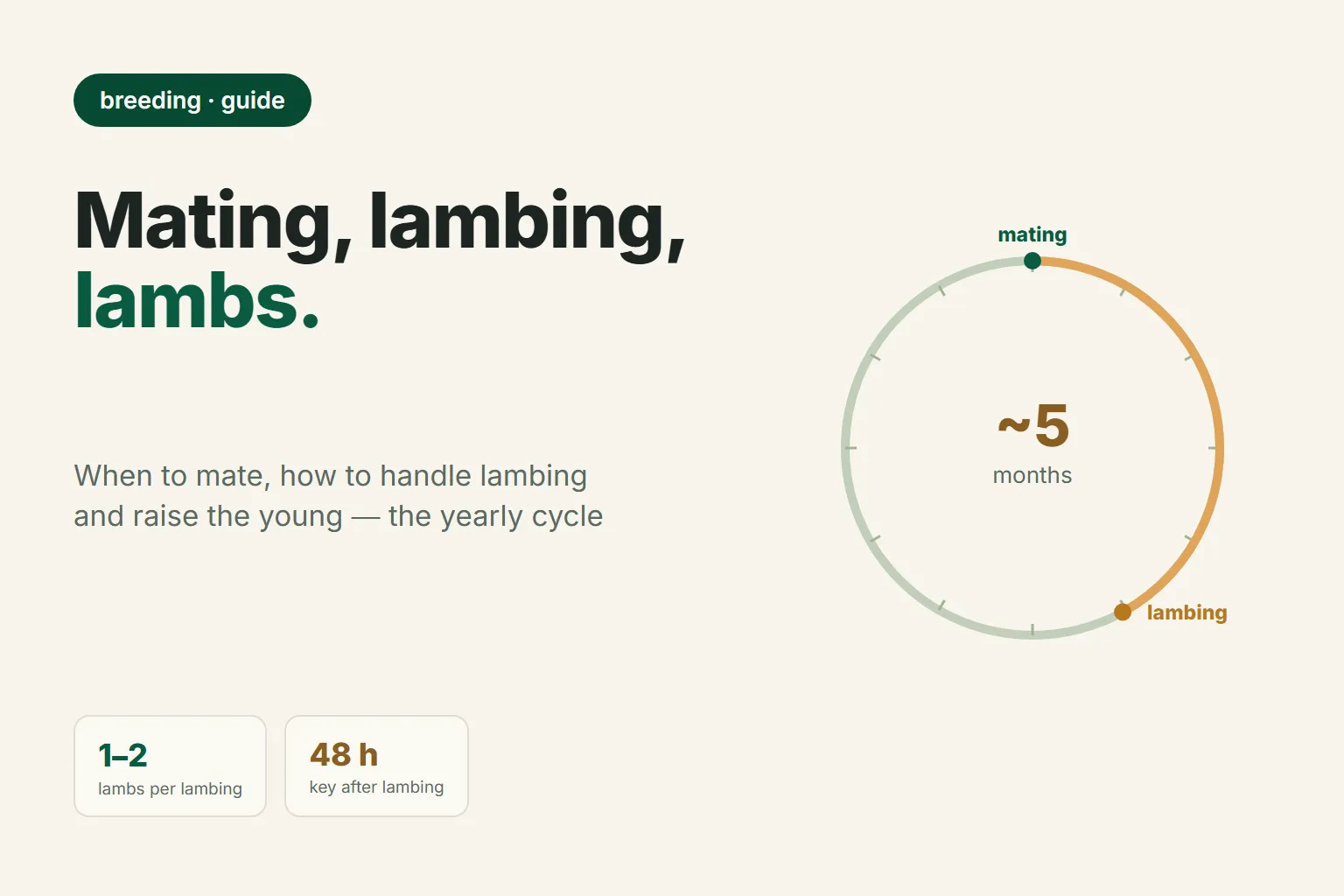
When to mate, how gestation and lambing go, and how to keep newborn lambs alive. The yearly cycle, timing, and care — a shepherd's step-by-step guide.
A flock's entire income for the year is born during the lambing campaign: how many lambs you get, and how many of them survive, is your profit for the year ahead. And it all gets set in motion in autumn, during mating. Let's walk through the whole cycle step by step — when to mate, how gestation unfolds, what to do during lambing, and how not to lose newborn lambs. Preparation for autumn mating really needs to start back in summer.
When to Mate: The Yearly Calendar
For fat-tailed and coarse-wool breeds of Central Asia, mating is carried out in autumn — in October–November. The logic is simple: gestation lasts about five months, so lambing falls in March–April, when the weather warms up and grass starts to appear. The lambs meet spring and grow strong by the start of the grazing season.
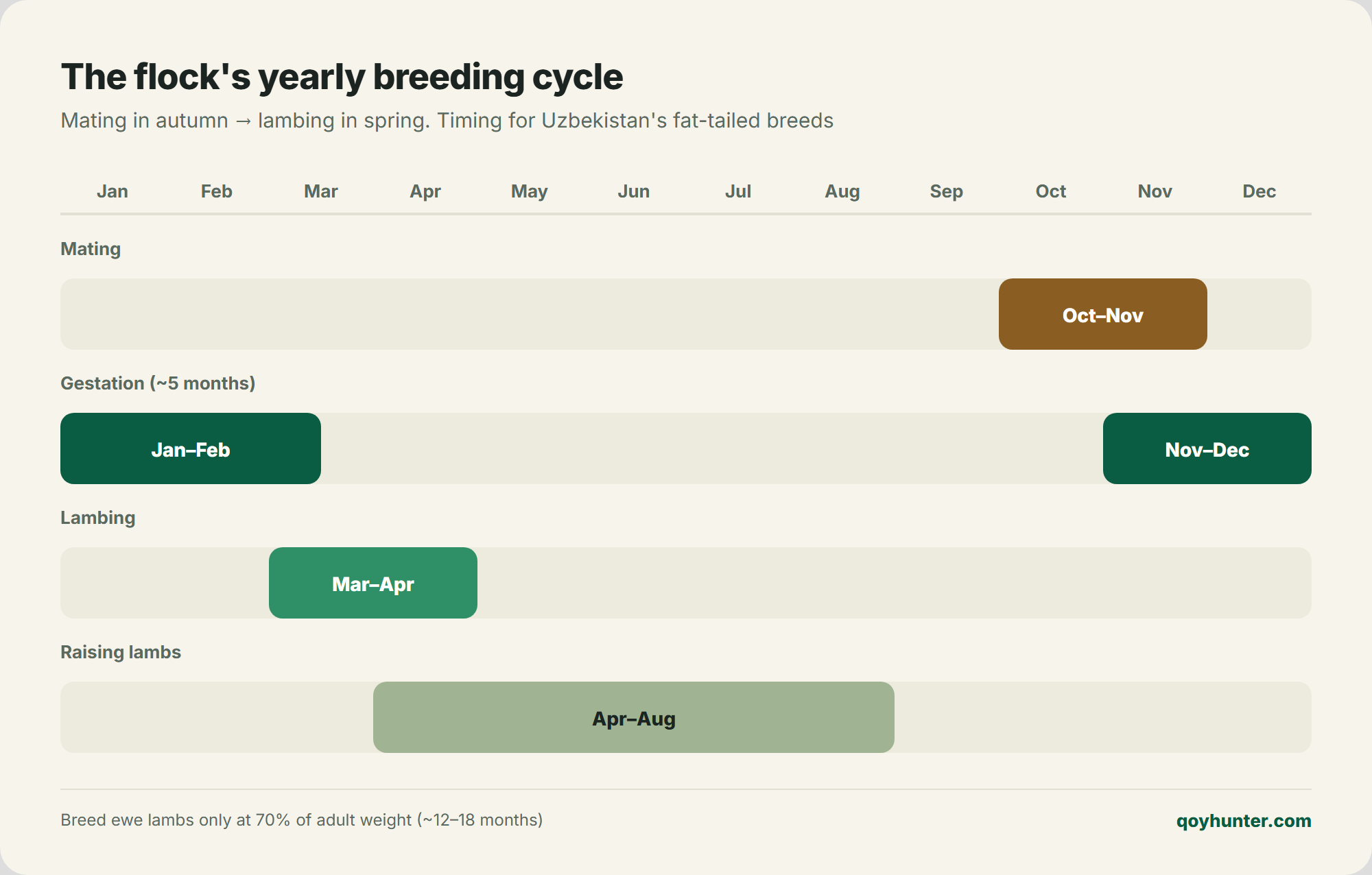
Autumn mating is also more advantageous because it coincides with a period of good feeding: well-conditioned ewes come into heat more uniformly and conceive better.
Age at First Mating
Don't rush young ewe lambs into the ram pen. A ewe lamb should not be mated until she has reached at least 70% of her breed's mature ewe weight — usually around 12–18 months of age. Early mating is harmful: the ewe lamb's body is still growing, lambing is harder on her, lambs are born weaker and die more often, and the young ewe herself falls behind in development. It's better to lose one season than to ruin a future breeding ewe.
Preparing for Mating
1–1.5 months before mating, ewes are switched to enhanced feeding (zootechnicians call this "flushing"). A well-conditioned ewe comes into heat more uniformly, and prolificacy increases. The breeding ram is also prepared in advance: he needs to be in good shape, healthy, and not run down.
Supplement for these six weeks is budgeted as its own line: to buy grain and cake for flushing before September costs less than topping up sack by sack at the height of mating.
How many ewes per ram? With pasture mating (the ram runs loose with the flock), it's roughly one ram per 25–50 ewes. The load is reduced for young rams. A ewe's reproductive cycle is about 16–17 days, and heat lasts roughly one to two days, so the ram covers the ewes that come into heat within one cycle, while unbred ewes come into heat again in two to three weeks.
Gestation: Five Months
Pregnancy (gestation) in sheep lasts on average 145–152 days — about five months. The first sign is that the ewe doesn't come back into heat; after that she becomes calmer and starts gaining weight. A veterinarian can carry out precise diagnosis (ultrasound) if needed.
The most important thing during gestation is feeding in the last third (the last 6–8 weeks), when the fetus grows fastest. Nutritional needs rise noticeably during this period — and that's exactly where the danger lies:
Pregnancy toxemia in ewes is a metabolic disease of the last weeks of pregnancy, especially in ewes carrying twins, or those that are too thin or too fat. Signs: lethargy, refusal to eat, the ewe separating from the flock, followed by blindness and convulsions. Without intervention, the animal dies. At the first signs, get a veterinarian immediately; a balanced diet — neither starving nor overfeeding the ewe — prevents the disease.
Preparing for Lambing
About two weeks before lambing, move ewes into a clean, dry, warm, draft-free space with clean bedding. Prepare in advance: clean rags, an antiseptic for the umbilical cord (iodine solution), and a bottle with a nipple in case a lamb can't nurse on its own.
Signs that lambing is approaching (one to two days ahead): the udder swells, the external genitalia swell, the belly sags, the ewe becomes restless, lies down, refuses feed, and "paws" at the bedding.
Normal delivery, once the water breaks, takes 30–60 minutes and usually doesn't require any intervention. The correct position for the lamb is head and both front legs coming forward together.
When you need a veterinarian urgently: labor drags on for more than two hours; your attempts to help produce no result after more than half an hour; the lamb is positioned incorrectly (not head-first with front legs); the placenta doesn't pass for many hours; there's bleeding with no lamb appearing. Trying to pull out a malpositioned lamb yourself is dangerous both for the lamb and for the ewe.
The Lamb's First Hours of Life Are the Most Important
It's in the first hours that whether the lamb survives gets decided. Three things are critical.
1. Breathing and warmth. Immediately wipe the mucus off the lamb and clear its nose and mouth so it can breathe. Hypothermia is the leading cause of death in newborn lambs. Make sure it stays warm and dry, especially in cold weather.
2. Treat the umbilical cord with an antiseptic (iodine solution) — this protects against infection.
3. Colostrum — within the first hour. The mother's first milk (colostrum) gives the lamb immunity, and it's absorbed best in the first hour of life. The sooner the lamb nurses, the better; the absolute deadline is the first 24 hours, but every hour of delay raises the risk. Check that the lamb has stood up and is actually nursing from the ewe. If the ewe won't let it nurse, or has too little milk, milk out the colostrum and bottle-feed it (warm, around 38–40°C), or foster the lamb onto another ewe.
How to Reduce Lamb Mortality
Most losses occur in the first two weeks of life, and the main causes are hypothermia and hunger (not getting colostrum). Simple measures work against both:
- full feeding of ewes at the end of gestation — for strong lambs at birth;
- warmth and dryness in the lambing area;
- mandatory colostrum in the first hours;
- checking that every lamb is nursing.
If twins are born and the ewe has too little milk, one lamb gets supplement-fed by bottle or fostered onto a nurse ewe. In case of mass mortality (diarrhea, coughing in several lambs), don't guess — call a veterinarian to determine the cause.
Separately, on the first three days after lambing — why lambs die of hypothermia and missed colostrum, and what to do hour by hour — see the breakdown why newborn lambs die.
On Prolificacy
The Hissar breed has relatively low prolificacy — about 105–115 lambs per 100 ewes, meaning twins are rare and a single large lamb is more common. Jaydari sheep, according to available data, have higher lambing rates. This is a normal trait of local meat-and-fat-tailed breeds: they compete not on the number of lambs but on their size and hardiness.
Hence the common question: can a ewe give more than one lambing per year? The answer, with the numbers, is in how often sheep lamb: moving to three lambings in two years only pays off from 106 lambs per hundred ewes upwards.
In Brief
- Mating — October–November, lambing — March–April (gestation ~5 months).
- A ewe lamb is mated no earlier than 70% of adult weight (~12–18 months).
- A month before mating — enhanced feeding of ewes; one ram per 25–50 ewes.
- The end of gestation is the most critical period for feeding; watch for toxemia.
- The lamb's first hour of life decides everything: warmth, dryness, umbilical cord, colostrum.
- Any deviation from normal delivery, or mass mortality — call a veterinarian right away.
Running a lambing campaign is much easier with proper records: on a mating and lambing log, matings, lambings, and offspring are logged for free for every ewe right from your phone — you can see who's due to lamb and when, and how many lambs survived. You can buy ewes or a breeding ram on the ewes and breeding rams for sale.
This article is for informational purposes only. Help with difficult births and lamb illnesses should only come from a veterinarian; this article does not replace an in-person consultation.
Manage your flock in QoyHunterCRM for sheep farmers: livestock, health, weighing, finance and analytics — in the app and a Telegram bot.All features →