Karakul Sheep: Pelts, Milk, Meat — What Actually Pays Off Today
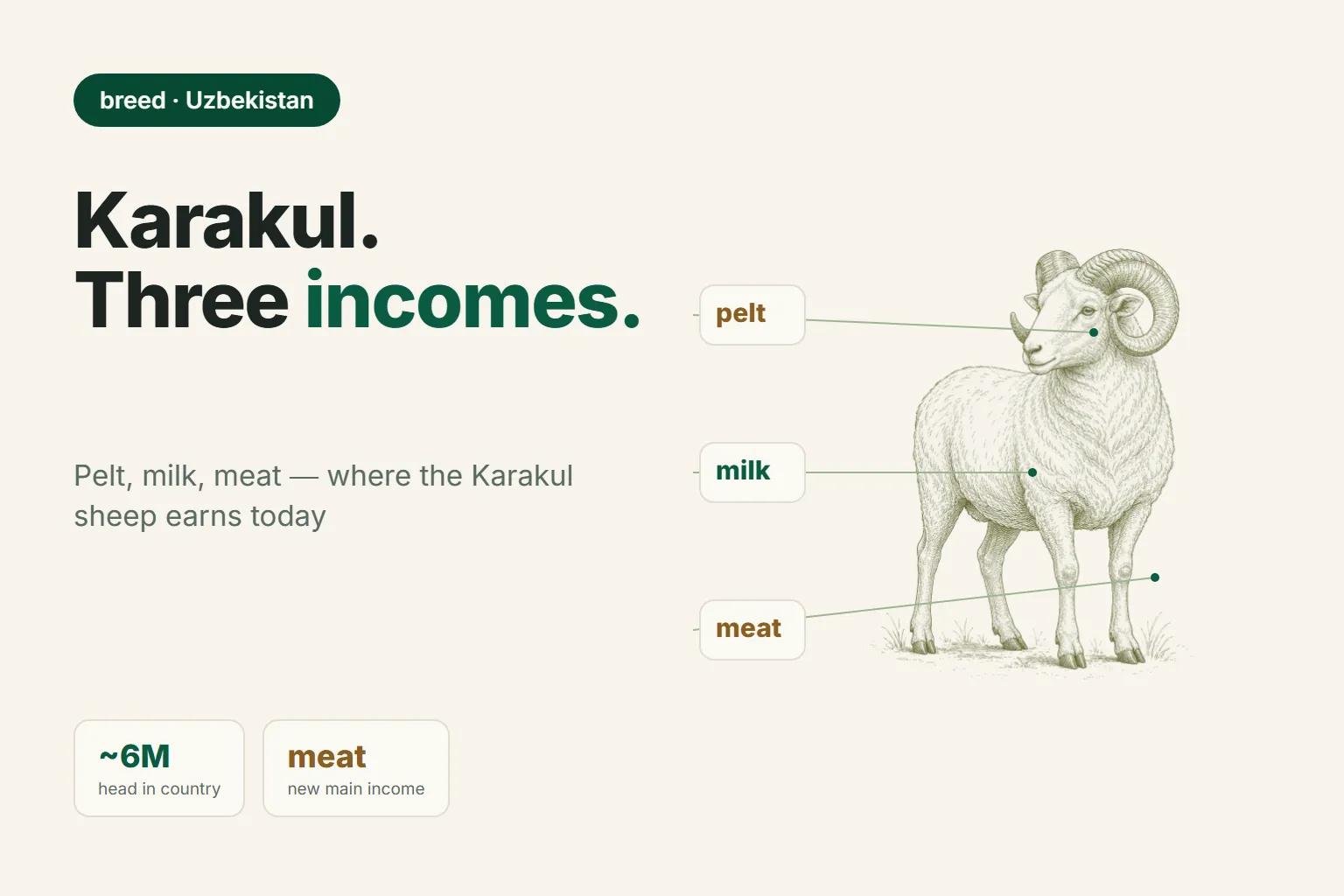
The Karakul sheep is Uzbekistan's pride — a breed forged by the desert. We break down its productivity and honestly work out what actually pays a farm's bills today, now that the pelt market has slumped: milk and brynza, meat, fat tail, breeding stock.
A Breed Forged by the Desert
The Karakul sheep takes its name from the village of Qorakoʻl (Karakul) in the Bukhara region — it was here, in the lower reaches of the Amu Darya, that the breed took shape centuries ago. For Uzbekistan it isn't just "one of many" breeds — it's home-grown: the country is the birthplace of Karakul and remains one of the world's main breeding centers for it.
Its defining trait is the pelt line: the breed was developed for the valuable curl on a newborn lamb's skin (the Karakul pelt). But another quality matters just as much: the Karakul is a desert-pasture animal. It withstands heat and drought, forages well on sparse semi-desert pastures, uses water sparingly, and keeps a sturdy build in conditions where meat breeds lose weight. For arid regions — Bukhara, Navoiy, Kashkadarya — this is a breed that fits the address.
Productivity by the Numbers
Karakul is a small-bodied, coarse-wool breed. Don't expect Hissar-style weight gains from it: its strength lies not in bulk, but in its low demands and the range of products it yields from the same modest diet.
| Indicator | Value |
|---|---|
| Ewe live weight | 40–50 kg |
| Breeding ram live weight | 65–80 kg |
| Lamb birth weight | 4–4.5 kg |
| Wool clip (2 shearings) | ewe 2–2.2 kg, ram 3.5–3.8 kg |
| Milk per lactation (marketable) | 25–30 kg, 7–8% fat |
| Lambing rate | ~110 lambs per 100 ewes |
Lambing is modest: a Karakul ewe almost always produces a single lamb, twins are rare. The wool is coarse, carpet-grade, not fine fleece. Keep this in mind when counting income: the Karakul doesn't win on one record-breaking figure — it wins on the sum of small amounts from each direction.
Pelts: Why You Can No Longer Bet on Them Alone
Historically, the entire point of the breed was the pelt. Today that line of business is in deep crisis: global fashion has turned away from natural fur, major fashion houses are dropping it, and demand and prices for Karakul pelts have collapsed. We covered this in detail, with figures and causes, in a separate article — "Karakul: the world has stopped buying pelts." The short takeaway: building a farm's economics on pelts alone in 2026 means depending on a market that may never come back.
The good news is that the Karakul sheep is not just a pelt. It has at least four other income streams, and together they keep a farm afloat.
Milk and Brynza — an Underrated Line
Karakul ewes are traditionally milked, and this is a strong, often-overlooked side of the breed. After the lamb is weaned, an ewe yields roughly 25–30 kg of marketable milk per lactation at 7–8% fat — a very rich milk, about twice as fatty as cow's milk. That translates into a high yield of brynza (a salty sheep's-milk cheese) and hard cheeses: fat and protein are exactly what a cheesemaker pays for.
Selling sheep's-milk brynza is more profitable than selling raw milk to a middleman. Homemade sheep brynza is a familiar local product with steady demand at bazaars and teahouses. This line requires no new investment — you simply milk the same ewes that are already in the flock. There's a seasonal bonus, too: milking and cheese bring in cash in summer and autumn, before the main livestock sales begin — smoothing out the farm's cash flow across the year.
To see which line actually pays, income is broken out by category: revenue tracking by line of business over a season shows at once what the cheese brought in and what the young stock did.
Meat and Fat Tail — a Secondary but Real Income
Karakul won't be a meat champion — the carcass is small (an adult animal weighs 40–50 kg live, with a dressing yield of roughly half). But its meat is dense and lean, raised on "desert" forage — valued on the local market for its flavor.
Karakul is a fat-tailed breed, though its tail is modest (around 2–2.5 kg, against the tens of kilograms of a Hissar sheep). The tail fat is sold separately and adds to the carcass price. The main source of meat income is culled ewes, surplus rams, and lambs not destined for pelts: in the past these were slaughtered for their skins, but today it makes more sense to raise and sell them for meat — especially ahead of Qurbon Hayit, when demand and prices for rams peak. Keeping such animals to 1–1.5 years and selling them once they've filled out beats offloading skinny youngsters for a pittance in autumn.
And there is no point holding raised animals "for a better price": sell young sheep fetches the most around Qurbon Hayit, while winter keep eats up the difference.
Breeding and Genetics — a Quiet but Steady Income
Uzbekistan is the breed's homeland, and purebred Karakul animals are valuable in their own right. A breeding ram, elite ewes, and young stock for reproduction sell for more than ordinary commercial animals. Demand comes both from within the country and from exports to other arid regions searching for drought-hardy flocks. This line doesn't bring fast money, but for a solid breeding operation it's the most stable one: demand for genetics isn't as fickle a fashion as fur.
Summary: What Pays Off Today
| Direction | What you sell | Demand today | Comment |
|---|---|---|---|
| Pelts (Karakul) | Lamb pelts | Down | Market in crisis, not a foundation |
| Milk and brynza | Milk 25–30 kg/lactation, cheese | Stable | Underrated, no new investment needed |
| Meat | Carcass, culls, lambs | Stable, peaks around Qurbon Hayit | Carcass is small, but meat is valued |
| Fat tail | Tail fat ~2–2.5 kg | Stable | A small add-on to meat |
| Wool | Coarse, carpet-grade, 2–3.8 kg | Low | More about covering costs than profit |
| Breeding stock | Rams, ewes, young stock for breeding | Stable | The most stable line, a long game |
The takeaway is simple: pelts alone no longer pay the bills. But the Karakul sheep as a whole — milk, meat, fat tail, breeding stock, plus whatever remains of the pelt trade — still does, if you count across every line at once.
Keeping Karakul in an Arid Zone
The breed's strong point is low-cost keeping. Karakul sheep graze on pasture and seasonal drives year-round, digest the coarse forage of semi-desert land well, and tolerate heat and water shortages. Feed costs run lower than for meat breeds that need alfalfa and concentrates. In winter and lean periods, supplementary feeding is essential — straw, hay, a little barley — but overall this is a breed that thrives where others struggle. The key condition is water and a well-planned grazing route: where there are wells and watering points, the flock finds its own feed and needs almost no bought-in concentrates.
That's precisely why, in Uzbekistan's arid districts, there is still no equal substitute for the Karakul sheep. It's not the breed that's changing — it's the reason for keeping it: the center of gravity is shifting from pelts to milk, meat, and breeding stock. And income now needs to be counted across the whole animal, not just one curl of fur.
Manage your flock in QoyHunterCRM for sheep farmers: livestock, health, weighing, finance and analytics — in the app and a Telegram bot.All features →