
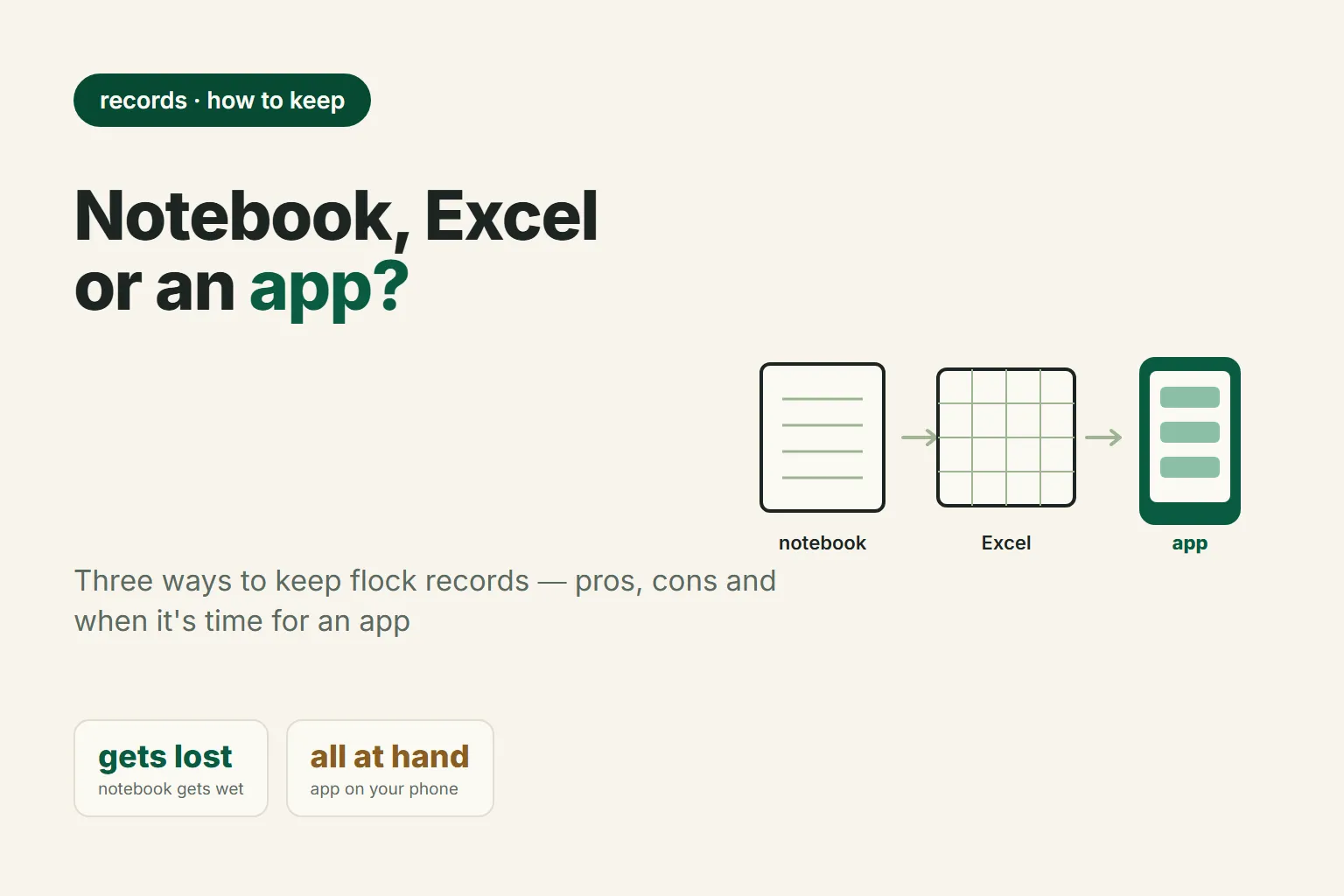
How to Keep Sheep Records: Notebook, Excel, or Software
We compare three ways to keep sheep records — a notebook, Excel, and dedicated software. Pros, cons, and a comparison table to help you choose as your herd grows.
Every sheep farmer eventually catches themselves thinking: "How many head do I actually have? Which sheep have been vaccinated, and which haven't? Which ram sired this ewe?" When the flock is a handful of animals, you can keep it all in your head. But the herd grows, and memory starts to fail. What's "written in your head" turns into real losses: a missed vaccination, a death that goes unnoticed for too long, a ram sold for next to nothing when its weight gain made it worth far more.
Record-keeping isn't paperwork for its own sake. It's a way to see your farm in numbers and make decisions based on facts instead of gut feeling. In this article we'll take an honest look at three ways to do sheep record-keeping: a notebook, Excel, and dedicated software. Each has its pros and cons — by the end you'll know what actually fits your farm.
Why a farm without records loses money
Let's look at exactly what "leaks away" when there's no record-keeping.
Weight gain. Fattening rams put on weight differently: one shows solid daily weight gain, another just "stands still" and eats feed for nothing. Without weighing and records, you can't tell which animals are earning you money and which are costing you. And selling "by eye" almost always means selling for less than the animal is actually worth.
Checking yourself is simple: before a deal, look at what comparable rams are selling for in the listings and compare that with what the reseller is offering.
Vaccinations and treatments. Vaccination, deworming, and parasite treatment all run on a schedule. Miss a date and you risk a disease outbreak that wipes out the whole flock. Keeping dozens of dates in your head is impossible, and on paper they're easy to lose track of.
Losses. If you don't log every case, you'll miss the pattern — for example, that lambs keep dying in the same period, or that it's always the same ewe. Miss that, and you can't fix the cause — you'll just keep losing lambs.
Pedigree. Without records of which ram bred which ewe, it's easy to end up with inbreeding. That leads to weak offspring, defects, and lower productivity — including lower lamb survival. This matters especially for breeding operations, where a clean bloodline is valuable.
Barren ewes. A ewe that produces no offspring for two seasons running is a pure loss — she still eats feed but gives nothing back. You can only spot her by checking your lambing records.
In short, record-keeping turns "things seem fine" into "I know exactly where I'm losing money and where I'm making it."
Option 1. A notebook
The most familiar option is a farm ledger or a plain notebook. Jot down the tag number, breed, breeding date, weight — done.
Pros:
- Nothing to learn — anyone can use it.
- Works without electricity, internet, or a phone.
- Costs next to nothing.
Cons:
- It doesn't calculate anything. You'll have to add up average weight, weight gain, and profit per head by hand — and in practice, most people just never bother.
- It doesn't search. Pulling up one sheep's history means flipping through pages.
- It doesn't remind you. A notebook won't tell you a vaccination is due — that's on you to remember.
- It's easy to lose. Get it wet, torn, or misplaced, and years of data are gone.
- It doesn't scale. At 200 head, a notebook turns into chaos.
Bottom line: for 10–20 head, or as a rough field notepad, a notebook still works. For a growing operation, it runs out of room fast.
Option 2. Excel (a spreadsheet on your computer)
The next step up is a spreadsheet in Excel or Google Sheets. Columns for tag number, sex, breed, weight, dates. This is real progress — you can filter, sort, and calculate totals and averages.
Pros:
- It calculates. Formulas give you average weight, total costs, and simple analytics.
- It searches and filters. Find every ewe born in 2025 in a second.
- It's free (Google Sheets) and familiar to a lot of people.
Cons:
- You need a computer and some skill. Formulas and pivot tables aren't every farmer's idea of fun.
- It's awkward in the field. You weigh a sheep in the pen, but the spreadsheet is at home on a laptop.
- It doesn't remind you on its own. Excel won't send a notification when a vaccination is due.
- It's easy to break. One accidental edit to a formula and the numbers quietly go wrong — and you might not even notice.
- The file lives with one person. Working with a shepherd and a vet turns into emailing files back and forth.
Bottom line: Excel is a sensible choice if you're comfortable with computers and manage your records at a desk. But it wasn't built for working in the field, from a phone.
Option 3. Dedicated software (a farm app)
The third option is sheep record-keeping software built specifically for livestock. Everything you'd have to build by hand in Excel is already there, tailored to a flock.
What it does:
- Animal profile. Every sheep gets its own page: tag number, breed, sex, age, weight, and a full history of vaccinations, lambings, and breedings. The animal's entire life is in one place, pedigree included.
- Vaccination and treatment reminders. Enter a date once, and the app reminds you when it's due. In QoyHunter, reminders land straight in Telegram — no need to log in.
- Weighing and weight gain. Log a weight, and the app calculates the animal's daily weight gain automatically. You immediately see which animals are earning their keep and which are just eating feed.
- Finances and profit per head. Income and expenses by category for any month, plus profit calculated per head. It's clear at a glance whether the farm is making money or eating into it.
- QR tags. Every animal has a QR code on its tag — point your phone at it and the profile opens. No more hunting for a sheep's number in a thick notebook.
- Access from your phone. Data lives in the cloud, not in one notebook or on one laptop. The shepherd logs a weighing in the pen, you see the numbers at home, and the vet sees their part too.
To be fair, it has downsides too:
- You need a smartphone and internet to enter data (though it uses very little traffic).
- It takes a little time to get used to and to add your animals to the system.
- Advanced features are on a paid plan, though basic record-keeping is free.
Bottom line: for a growing flock, a farm app with reminders saves both time and money — because it doesn't just store records, it calculates and reminds you automatically.
Table: notebook, Excel, or software
| Criterion | Notebook | Excel | Software |
|---|---|---|---|
| Calculates weight gain and profit | No | Partially, by hand | Yes, automatically |
| Reminds you about vaccinations | No | No | Yes |
| Search by animal | Flip through pages | Filter | Instant / by QR |
| Works in the field from a phone | Yes (for writing) | Awkward | Yes |
| Collaboration | No | Difficult | Yes, with roles |
| Risk of losing data | High | Medium | Low (cloud) |
| Skill required | None | Yes | Minimal |
| Cost | Next to nothing | Free | Free plan available |
So what should you choose
The honest answer depends on the size of your operation:
- Under 15–20 head with no plans to grow — a notebook will do for now.
- You're comfortable with computers and manage things at a desk — Excel covers the basics.
- Your herd is growing, you're into the dozens or hundreds, and weight gain, breeding lines, profit, and vaccination schedules all matter — you need dedicated livestock accounting software. It pays for itself just by making sure you never miss a deadline or sell an animal for less than it's really worth.
The good news: you can start for free, straight from your phone, without installing anything. See what QoyHunter can do — flock records, health tracking, weighing, finances, analytics, QR tags, and a Telegram bot, all in one app, in Russian and Uzbek.
Manage your flock in QoyHunterCRM for sheep farmers: livestock, health, weighing, finance and analytics — in the app and a Telegram bot.All features →