Edilbay Sheep Breed: Weight, Fat Tail, Productivity and Price
How much an Edilbay ram weighs, its fat tail and dressing percentage, how fast the lambs grow, and why the breed suits Uzbekistan's heat and long-distance grazing — with real 2026 figures and prices.
The Edilbay is one of the most recognizable fat-tailed sheep breeds in Central Asia. It is kept for meat and fat, handles long drives to distant pastures and a hot, dry summer with ease — exactly what many farms in Uzbekistan need. In this article we look at it without exaggeration: how much an Edilbay really weighs, what its fat tail is like, how fast the lambs grow, and what an animal costs in 2026.
We have a separate detailed piece on the Hissar breed — here we talk only about the Edilbay and how it differs.
Where the breed came from
The Edilbay sheep was developed by folk breeders in Western Kazakhstan almost two centuries ago, in the steppes between the Ural and Volga rivers. Local Kazakh fat-tailed ewes were crossed with large Astrakhan coarse-wool rams, and for decades the toughest, "fattest" animals were selected. That is how this fat-tailed meat-and-fat breed emerged.
Even the name is disputed and steppe-born: by one account it comes from the Kazakh name for the Volga — Edil; by another, from a clan elder named Edilbay. For a farmer, what matters more is this: the breed was bred for nomadic grazing and poor pastures, not for warm barns and abundant feed. It has kept that hardiness.
Live weight: ram and ewe
Let's start with the main question, the one surrounded by the most tall tales. The real — not "bazaar" — figures are:
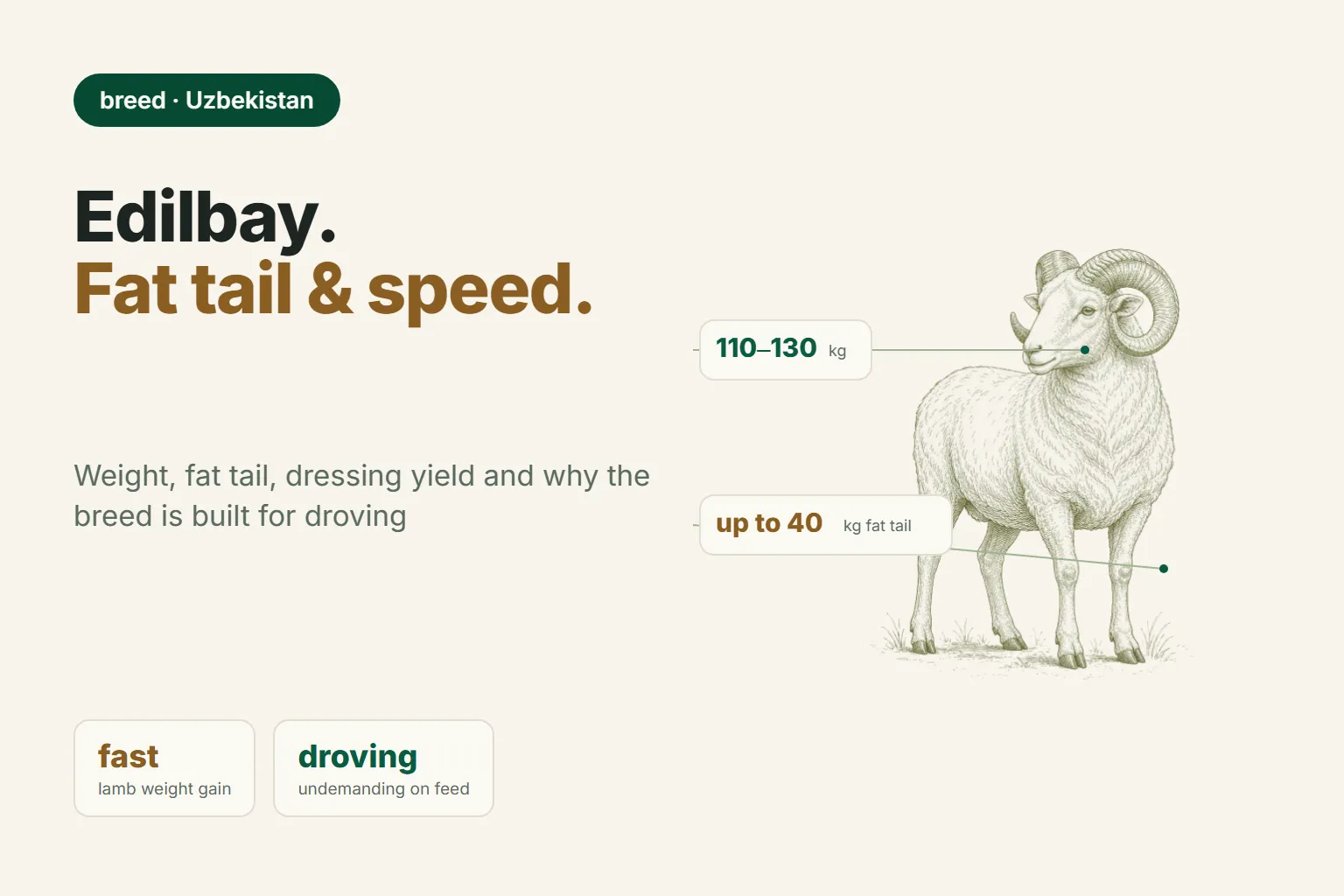
- Breeding ram — 110–120 kg. This is a typical adult male in normal condition.
- The best rams — up to 150–160 kg. These are record, pedigree, well-fattened animals, not the average flock.
- Ewe — 65–70 kg, the best ones — 90–100 kg.
If someone offers you a "200 kg Edilbay," treat it with heavy skepticism: only a few Hissar record-holders reach that, and on a scale, not in words. For the Edilbay an honest benchmark is a little over 100 kg for an adult ram.
Fat tail and dressing percentage
The fat tail is the breed's calling card and the main source of prized mutton fat. A well-fattened adult carries 10–14 kg of fat in it, and some individuals more. That is noticeably less than a Hissar (18–20 kg and up), but the Edilbay "sags" less on meat.
- Dressing percentage — 50–55%. For a coarse-wool meat-and-fat breed that is an excellent figure.
- Adult carcass — 40–45 kg.
- A lamb slaughtered at 4 months yields a 20–24 kg carcass and a 3–4 kg fat tail — meaning you can get marketable meat in the very first season, without waiting for a second winter.
How fast the lambs grow
Early maturity is the Edilbay's main economic trump card. Lambs are born large (5–6 kg) and grow very fast:
- in the first 40 days live weight roughly quadruples;
- by weaning at 4 months a lamb weighs 40–45 kg — almost seven times its birth weight;
- while suckling under a good milking ewe, daily gains hold at 200–300 g.
The fast growth rests on the ewes' milk yield: over a lactation a ewe gives about 120–180 liters of milk, and the lamb gets everything it needs "from mother's tank," without costly supplements. For fattening for sale this means a short cycle and less spent on feed before the animal reaches market weight.
Hardiness and grazing ability
This is where the Edilbay is especially interesting for an Uzbek farm. The breed was created in a harsh steppe, so it:
- withstands long-distance grazing. The sheep can cover great distances and fatten on natural, meager pastures — the very thing that mountain-foothill and steppe herding cannot do without.
- tolerates heat and swings. A dry Uzbek summer and cold winters are routine for a steppe breed; the fat tail works as an energy reserve for lean times.
- has a sturdy build. Well-developed bone, a deep chest, and resilience to the strain of drives.
Put simply, the Edilbay does not demand hothouse conditions: if you have pastures and water, the breed "feeds itself" for most of the season. That lowers the cost per kilogram of live weight — the key figure when meat prices are rising at the market.
Wool and fertility: where the breed is weaker
Honestly about the downsides, so there are no inflated expectations.
The wool is coarse and low-value. The clip is small: 3–3.5 kg from a ram, 2.3–2.6 kg from a ewe; the fleece is mixed, with kemp and dead hair, staple length up to 15 cm. You cannot earn on wool today — this applies to almost all fat-tailed breeds, and the Edilbay is no exception. It is kept for meat and fat, not for fleece.
Fertility is moderate — 110–120 lambs per 100 ewes. Most often a single lamb; twins are rare. If your goal is to grow the flock as fast as possible, the Jaydara with its 130–150% gives more offspring. The Edilbay wins not on the number of lambs but on their weight and growth rate.
Characteristics table
| Indicator | Value |
|---|---|
| Type | Fat-tailed meat-and-fat, coarse-wool |
| Ram live weight | 110–120 kg (best — up to 150–160) |
| Ewe live weight | 65–70 kg (best — up to 90–100) |
| Fat-tail fat | 10–14 kg and more |
| Dressing percentage | 50–55% |
| Adult carcass | 40–45 kg |
| Lamb weight at 4 months | 40–45 kg |
| Daily gain while suckling | 200–300 g |
| Wool clip (ram/ewe) | 3–3.5 / 2.3–2.6 kg |
| Fertility | 110–120% |
| Milk yield per lactation | 120–180 l |
What an Edilbay costs in Uzbekistan (2026)
Price depends on age, condition, sex and season — before Kurban Hayit the ram market noticeably picks up and rises. Approximately for 2026 (at a rate of about 12,100 sum to the dollar):
- Young stock, 6–9 months — about 2–3.4 million sum ($165–280).
- An adult grazing ram for slaughter — about 4.5–7 million sum ($370–580).
- A pedigree breeding ram — from 7–9 million sum and up ($580–745+), often a negotiated price.
These are benchmarks, not a price list: the spread across regions and sellers is wide, and elite animals are sold "by agreement." Before a deal, look at live weight, condition and origin, not just the seller's word.
It is better to check the benchmark against the live market: Edilbay sheep for sale listings with stated weight and age give a more honest picture than a national average.
Who the Edilbay suits
The Edilbay is the workhorse of Uzbek meat sheep farming: not the largest (the Hissar is heavier), not the most prolific (the Jaydara leads on offspring), but hardy, early-maturing and undemanding. It is worth taking if you have pastures and grazing routes and your goal is fast marketable meat with a good yield and minimal feed costs.
For the breed to pay off, you need to count: lamb gains, fattening periods, feed consumption and cost per kilogram. When the numbers on each animal are at hand, you can see which ewes give the best offspring and which ram is more profitable to sell before winter — and the farm stops working "by eye."
Doing all this in a notebook across a hundred head is not realistic: per-animal gain and cost tracking collects the same figures automatically, and by autumn you can see which lamb paid for its feed.
Manage your flock in QoyHunterCRM for sheep farmers: livestock, health, weighing, finance and analytics — in the app and a Telegram bot.All features →